Gênesis 11
Yi Antiw Bible / Yi Ac'aj Testament · Toque num versículo para ver as referências cruzadas.
Yi muyc kale cwe't suk'ij chiyol wunak
1Itzun bantz le xe'tzbil tzaj, junit chiyol cyakil wunak. 2Ej nin yi cyele'n tzaj lilen tzi'n, jal jun chin ẍk'ajlaj cya'n le ama'l cwent Sinar. Ya'stzun e' a'te'tz.
3Itzun bantz nintzun cyal cobox squibil quib: “Kabne' lagris nin ba'n kapat.” Ej nin yi bnixe'n cya'n ja xcon tetz xel c'ub tan banle'n chica'l. Ncha'tz ja xcon jun jilwutz ẍpupu' cya'n tetz ẍchib lagris. 4Yi xone'n tiemp at e' cyal: “Or itetz kabne' jun chin tnum nin jun chin wutzile'n muyc tzone'j, yil jepon jalen tzi'n tcya'j. Sjalok wi'nin kak'ej ta'n. Ej nin qui tajwe'n tan kele'n xit bene'n tzi'n wi munt.”
5Inti Ryos nin cu'ul tan xmaye'n yi jun tnuma'tz tu yi jun chin muyc yi na chitzan wunak tan banle'n. 6Toque'n tzun i'-tz tan xtxumle'n, nintzun taltz: “Tampaj yi junit e', nin junit chiyol, ja cho'c tan banle'n yi ak'une'j. Nin cya'l jun yi nink xcye' tan xite'n chitxumu'n. 7Ba'n tcu'n kacuk ẍchixo'l tan suk'le'n cu'n chiyol, bantz qui't tz'el chitxum squibil quib.”
8I nintzun tulejtz. Ej nin cyaj cyen quilol yi ak'un tan banle'n yi jun muyca'tz, na qui't na el chitxum tetz chiyol squibil quib. Ej nin e' el xit bene'n tzi'n wi' munt tan Kataj Ryos. 9Ya'stzun cwe'n suk'ul Kataj chiyol cyakil wunak. Ej nin ya'stzun yi cyele'n xit bene'n tzi'n wi munt. Cha'stzun te ja oc bi' yi jun tnuma'tz tetz Babel.
Yi e' xonl Sem
10Je tzun yi e' xonl Sem banake'. Te yi nsken el cobix yob yi ticy'le'nix yi jun chin wutzile'n a'bala'tz, at tzun Sem tul jun cient yob. Ej nin ya'stzun yi titz'e'n yi cy'ajl yi na bi'aj Arfaxad. 11A'tij Sem o'-t cient yob yi nsken itz'ij Arfaxad. Ej nin tul yi jun tiempa'tz e' jal mas nitxajil i'.
12At Arfaxad tul junak o'laj yob yi titz'e'n Sala yi cy'ajl i'. 13Nin a'tij cyaj cient tu oxt yob, nin tul yi tiempa'tz e' jal mas nitxajil i'.
14At Sala tul junaklaj yob yi titz'e'n Heber yi cy'ajl. 15Nin a'tij cyaj cient tu oxt yob, nin tul yi tiempa'tz e' jal mas nitxajil i'.
16At Heber tul junak cyajlaj yob yi titz'e'n Peleg yi cy'ajl i'. 17Nin a'tij cyaj cient tu junaklajt yob, nin tul yi tiempa'tz e' jal mas nitxajil i'.
18At Peleg tul junaklaj yob yi titz'e'n Reu yi cy'ajl i'. 19Nin a'tij cob cient tu belujt yob, nin te yi tiempa'tz e' jal mas nitxajil i'.
20At Reu tul junak coblaj yob yi titz'e'n Serug yi cy'ajl i'. 21Nin a'tij cob cient tu jukt yob, nin tul yi tiempa'tz e' jal mas nitxajil i'.
22At Serug tul junaklaj yob yi titz'e'n Nacor yi cy'ajl i'. 23Nin a'tij cobt cient yob, nin tul yi tiempa'tz e' jal mas nitxajil i'.
24At Nacor tul junak beluj yob yi titz'e'n Taré yi cy'ajl i'. 25Nin a'tij jun cient tu belujt yob, nin tul yi tiempa'tz e' jal mas nitxajil i'.
26At Taré tul oxc'al tu lajuj yob yi quitz'e'n yi e' nitxajil yi na chibi'aj: Abram, Nacor, tu Harán.
Yi e' xonl Taré
27I bin jalu' je chibi' e' xonl Taré yi chitaj Abram, Nacor tu Harán, yi taj Lot. 28Yi Harána'tz bajx quime'n i' swutz yi taj, na cho'n quime'n i' le ama'l Ur, cwent e' caldeo, kale itz'e't i'.
29Ma Abram umewe'n nin e' bantz tu Sarai. Nin ncha'tz Nacor umewe'n nin e' bantz tu Milca, yi me'l Harán, yi stzicy Isca. 30Ma yi Sarai, yi txkel Abram, qui nin jal tal, na qui'c talbil i'.
31Inti yi Taré nin cyaj tilol yi tnum Ur, cwent e' caldeo, tan bene'n le ama'l yi na bi'aj Canaán. Ej nin el tcy'al yi cy'ajl yi Abram, tu Lot yi mam i', nin ncha'tz Sarai yi tlib. Poro yi cyopone'n le tnum Harán, tanewe'n nintzun e' bantz te chipyaj. Ej nin ya'stzun e' najewe'tz. 32Cho'n tzun quime'n Taré-tz le ama'la'tz. At i' tul cob cient tu o' yob yi quime'n.
Você sabia?
Babel e o caminho desde Ur
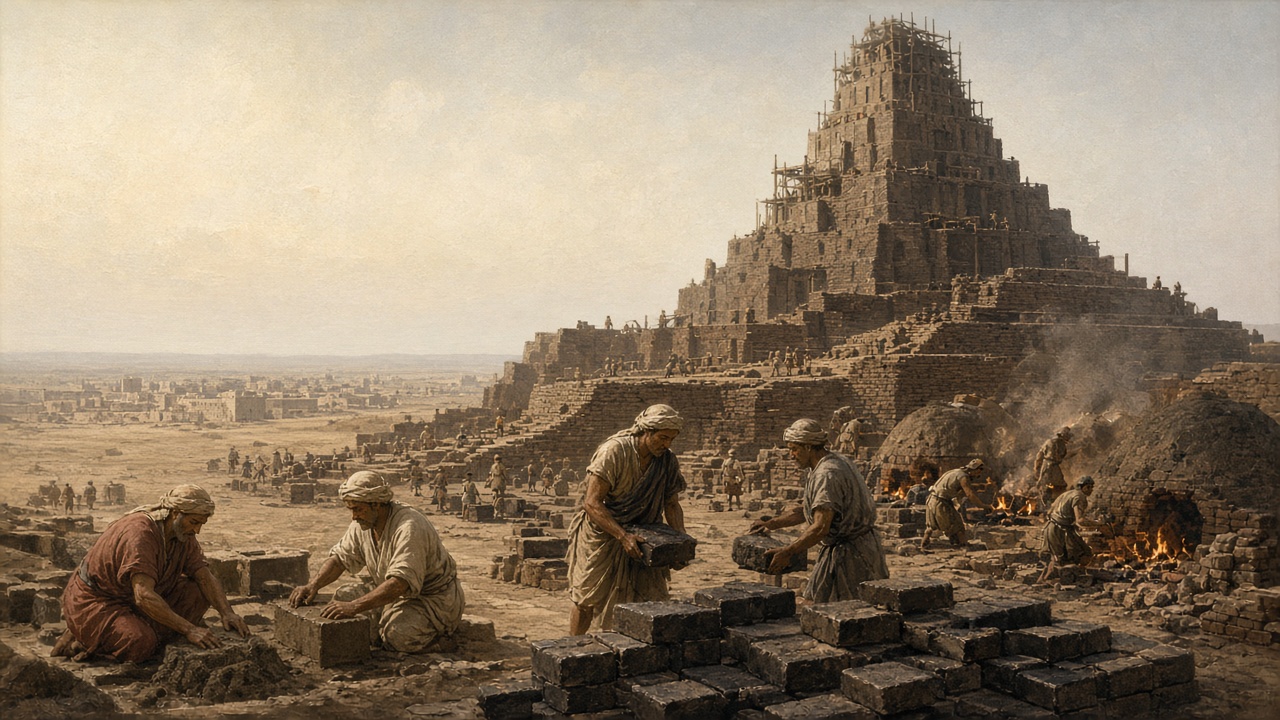
- Viajantes, neste capítulo, se estabelecem numa planície em Sinar e constroem com tijolo cozido e betume, em vez de pedra e argamassa. Um dicionário trata Sinar como, provavelmente, a Babilônia ou o sul da Mesopotâmia, estendendo-se quase até o golfo Pérsico, diz que a torre de Babel foi construída ali e descreve os primeiros habitantes da terra como gente que fabricava tijolos e edificava cidades.Fontes: o próprio texto bíblico · Shinar
- A cidade inacabada recebe o nome de Babel porque, segundo a narrativa, ali o Senhor confundiu a língua do mundo inteiro e dispersou o povo. Um dicionário explica o nome como 'confusão' e sugere que a torre foi, provavelmente, pensada como um ponto de reunião na vasta planície de Sinar, depois de uma migração desde as terras altas da Armênia, para que os construtores não se dispersassem.Fontes: o próprio texto bíblico · Babel
- O capítulo termina com Terá saindo de Ur dos caldeus rumo a Canaã, com Abrão, Sarai e seu neto Ló, e estabelecendo-se depois em Harã, onde morre aos 205 anos; seu filho Harã já havia morrido em Ur. Um dicionário chama Ur de terra natal desse filho, a maior cidade de Sinar ou da Caldeia do norte, e um centro de comércio e poder político, e situa Harã, hoje Harran e chamada Charrã no Antigo Testamento grego e em Atos, junto ao Belik, afluente do Eufrates na Alta Mesopotâmia, onde Abrão permaneceu até a morte de Terá.Fontes: o próprio texto bíblico · Terah · Ur of the Chaldees · Haran
Notas escritas com auxílio de IA a partir de fontes abertas (Theographic Bible Metadata, CC BY-SA 4.0; Easton’s Bible Dictionary, domínio público) e revisadas antes de publicar.
Lugares deste capítulo
- Shinar · Hoje: Babylonia · 32.543, 44.422 · versículo 2
- Chaldea · 30.962, 46.104 · versículos 28, 31
- Canaan · 32.767, 35.333 · versículo 31
- Haran · Hoje: Harran · 36.864, 39.033 · versículos 31, 32
Só aparecem lugares com identificação de alta confiança (90% ou mais segundo as fontes acadêmicas reunidas pelo OpenBible). Mapa da época: DARE (Digital Atlas of the Roman Empire), CC BY 4.0; mapa atual: © colaboradores do OpenStreetMap; lugares: OpenBible.info (CC BY 4.0).
Créditos e licença desta tradução
Yi Antiw Bible / Yi Ac'aj Testament
Bible in Aguacateco (GT:agu:Aguacateco)
copyright © 2011 Wycliffe Bible Translators, Inc.
Language: Aguacateco
Translation by: Wycliffe Bible Translators, Inc.
Copyright Information
© 2011-02-18, Wycliffe Bible Translators, Inc. All rights reserved.
This translation text is made available to you under the
terms of the Creative Commons License: Attribution-Noncommercial-No Derivative Works.
( http://creativecommons.org/licenses/by-nc-nd/3.0/ )
In addition, you have permission to port the text to different file formats, as long as you
do not change any of the text or punctuation of the Bible.
You may share, copy, distribute, transmit, and extract portions
or quotations from this work, provided that you include the above copyright
information:
You must give Attribution to the work.
You do not sell this work for a profit.
You do not make any derivative works that change any of the actual words or punctuation of the Scriptures.
Permissions beyond the scope of this license may be
available if you contact
us with your request.
The Bible
in Aguacateco
© 2011-02-18, Wycliffe Bible Translators, Inc. All rights reserved.
This translation is made available to you under the terms of the
Creative Commons Attribution-Noncommercial-No Derivatives license 4.0.
You may share and redistribute this Bible translation or extracts from it in any format, provided that:
You include the above copyright and source information.
You do not sell this work for a profit.
You do not change any of the words or punctuation of the Scriptures.
Pictures included with Scriptures and other documents on this site are licensed just for use with those Scriptures and documents.
For other uses, please contact the respective copyright owners.
2014-04-21
Fonte: http://ebible.org/aguBl/ · eBible.org