Lucas 6
Tupã Je'ẽha · Toca un versículo para ver sus referencias cruzadas.
Jundéu awa tama'e putu'uha 'ar rehe har
1Jundéu awa tama'e putu'uha 'ar rahã, ahúi aja me'ẽ ty rupi Jesu wata oho ixo, jumu'eha ta namõ. Pe, ame'ẽ ke jumu'eha ta amõ amõ po'ok ixo. (Ame'ẽ ke ipo pe kamyrik. Aja pirer ke ombor. Upa ombor rahã, ame'ẽ ke u'u.) 2Pe, amõ parise ta a'ep ixo. Ame'ẽ ta pandu:
—Anĩ. Katu ym u'uha. Jundéu awa tama'e putu'uha 'ar rahã, aja nema'e jumu'eha ta kamyrik rahã, katu ym. (Paraky te'e, aja saka. A'erehe katu ym.) Aja Moise je'ẽha rehe panduha ihĩ — aja parise ta pandu.
3(Amõ rehe pyrara usak ta me'ẽ te'e, aja Jesu mujekwa tar katu,) a'erehe a'e pandu:
—Yman Ndawi myahy te riki. Inamõ ixo ame'ẽ ta aja tĩ. Myahy te tĩ. Ame'ẽ ta ma'eha ke Tupã je'ẽha rehe pesak riki. 4Ma'e u'u ame'ẽ ke nixói te rahã, Tupã rehe ngã jumu'eha renda keruhũ pe a'e ixe oho. Pe, mbeju a'ep ihĩ. Ame'ẽ ke u'u. Inamõ ixo ame'ẽ ta pe me'ẽ tĩ. A'eta u'u tĩ. Ame'ẽ mbeju ke Tupã ruwa koty pa'ihu moĩ, ame'ẽja saka. Pa'i ta jõ ame'ẽ ke u'u katu. Amõ ta u'u rahã, anĩ. (Ndawi ta pa'i ta ym.) A'erehe Ndawi ta u'u rahã, katu ym ta tipe. (Aja Moise je'ẽha rehe hendu ym) — aja Jesu pandu.
5A'e pandu tĩ:
—Jundéu awa tama'e putu'uha 'ar rahã, ma'e ke amõ ma'e, ame'ẽ ke ihẽ riki apandu katu. Tupã je'ẽha rupi ajur ame'ẽ ke ko ihẽ. Awa ihẽ tĩ — aja parise ta pe Jesu pandu.
Ipo ke upa te'e jupu'a ame'ẽ ke Jesu mukatu
6Amõ jundéu awa tama'e putu'uha 'ar rahã, jundéu awa tama'e jy'ariha renda pe ixe oho. A'ep ngã ke a'e mu'e uĩ. A'ep amõ sawa'e ihĩ. Ipo ke upa te'e jupu'a ame'ẽ ke a'e. Ijywa katu kotyhar ipo ke upa te'e jupu'a. 7A'ep Moise je'ẽha mu'e ame'ẽ ta amõ ihĩ tĩ. Parise ta amõ ihĩ tĩ. Jesu rehe a'eta usak katu uĩ. Putu'uha 'ar rahã, ma'e ahy ixo ame'ẽ ke Jesu mukatu ta my? Mukatu rahã, pandu ta ipe: “Mã! Katu ym nde erema'e. Putu'uha 'ar rahã, nde eremukatu. (Nde ereparaky te'e, ame'ẽja saka.) Jundéu awa ta je'ẽha rehe nde erehendu ym. Katu ym aja” aja Jesu pe a'eta pandu ta. A'erehe a'eta usak katu ehe uĩ, Jesu rehe. 8Ame'ẽ ta ipy'a pe ukwa ukwa uĩ, ame'ẽ ke Jesu ukwa katu. A'erehe ipo ke upa te'e jupu'a ame'ẽ pe pandu:
—Epu'am! Se heta ame'ẽ ta pyter pe ejur! — aja riki.
Sawa'e pu'am. Heta ame'ẽ ta pyter pe pu'am oho. 9Pe, ngã pe Jesu pandu:
—Ihẽ pe pepandurahã! Putu'uha 'ar rahã, myja jundéu awa je'ẽha mujekwa my? Myja riki katu my? Ko amõ ta rehe amõ pyrara usak rahã, katu my? Ko mai rahã, katu my? Ko amõ ta ke jukwa rahã, katu my? Ko jukwaha ke muputu'u rahã, katu my? Myja katu my? Pepandurahã! — aja ngã pe pandu.
10Pe, ngã rehe juramã usak. Pandu ym awa. A'erehe ipo ke upa te'e jupu'a ame'ẽ pe pandu:
—Nde po epirar 'y! — aja.
Ipo ke sawa'e pirar rahã, upa puku oho ipe. Imembek katu oho ipe tĩ. Upa katu. 11Ame'ẽ ke rehe usak rahã, parise ta parahy te ehe, Jesu rehe. Jundéu awa je'ẽha rehe hendu ym, aja ukwaha naĩ, a'erehe parahy. Pandu pandu a'eta jupe:
—Myja Jesu ke japyhyk ta my? Pe, jajukwa — aja parise ta pandu pandu a'eta jupe.
Jumu'eha ta ke Jesu mujy'ar
12Amõ pytun ramõ rahã, ywy'ã rehe jeje te Jesu jupir oho. A'ep Tupã namõ pandu pandu u'am. Aja te'e xu'em oho. 13Wera rahã, jumu'eha ta ke mujy'ar. Ame'ẽ ta ngi har awa py mokõi sawa'e ta ke jo'ok. Ame'ẽ ta pe pandu:
—Pehẽ riki ihẽ amondo ta ame'ẽ ta ke apo 'y — aja.
14Ame'ẽ ta rer kuja. Ko Simã. Amõ her moĩ ehe. “Petu” aja her moĩ ehe. Ko Andere amõ tĩ. Simã mu a'e. Tian amõ tĩ. Ko Juã amõ tĩ. Tian mu a'e. Amõ Siri tĩ. Amõ Matoroméu tĩ. 15Amõ Matéu tĩ. Amõ Tome tĩ. Amõ Tian tĩ. Apéu ra'yr a'e. Amõ Simã tĩ. Sero aja amõ ta ipe tĩ. (“Sero” aja pandu rahã, jundéu awa tama'e ywy ngi huwajan ta ke a'e mujan tar katu muhem, aja mujekwa.) 16Amõ Jun tĩ. Tian ra'yr a'e. Ko Jun Ikario amõ tĩ. A'e riki Jesu rehe huwajan ta ke muhyk ta werur.
Ngã ke Jesu mu'e. Ahy ixo ame'ẽ ta ke mukatu tĩ.
17Pe, ame'ẽ ta namõ ywy'ã ngi wyjy oho. Ywy ipe katu ame'ẽ pe a'eta uhyk. Amõ jumu'eha ta heta a'ep ixo tĩ. A'ep Jundéi ywy ngi uhyk uwyr ame'ẽ ta heta ixo tĩ. Jerusarẽ ok ta ngi uhyk uwyr ame'ẽ ta amõ tĩ. Heta ixo tĩ. Tir ok ta ngi uhyk uwyr ame'ẽ ta amõ tĩ. Sinõ ok ta ngi uhyk uwyr ame'ẽ ta amõ tĩ. Heta ixo tĩ. Sinõ ok ta y ramũi rake ihĩ. Tir ok ta aja tĩ. Y ramũi rake ihĩ tĩ. 18Jesu pandu ame'ẽ ke rehe johu ngã hendu uwyr. Ma'e ahy ixo ame'ẽ ta ke mukatu, ame'ẽ ke rehe johu ngã uhyk uwyr tĩ. Ãjã ipy'a rehe ihĩ ame'ẽ ta uhyk uwyr ehe tĩ. Ame'ẽ ta ke a'e mukatu tĩ. 19Ima'e pyrãtãha namõ ngã ke mukatu hũ. A'erehe upa ngã ipo ke mujar tar katu ehe. Mujar ehe rahã, upa katu oho ipe.
Huryha rehe har. Pyaiha rehe har tĩ.
20Jumu'eha ta rehe Jesu usak. Pandu:
—“Tupã rehe har jakwa ym jande” aja pekwa ame'ẽ ta mã peja pehẽ rury katu pe'am.
Ixotyhar ta aja pemuruwak ta. Pe, inamõ pexo ta, a'erehe mã peja pehẽ rury katu pe'am.
21Amõ myahy rahã, ma'e ke u'u ta. Aja Tupã putar ame'ẽ ke pema'ema'e tar katu te rahã, mã peja pehẽ rury katu pe'am. Upa peputar ame'ẽ ke Tupã muwyr katu ta.
Ma'e peka'u te'eha ke pema'e, a'erehe pejixi'u apo. Ame'ẽ ke Tupã pe pepandu. Aja rahã, mã peja pehẽ rury katu ta pe'am. Pepuka ta tĩ. Tupã ipy'a jywyr ta pehẽ rehe, a'erehe pehẽ rury katu pe'am.
22—Mã! Pehẽ rury katu pehẽ. Ihẽ rehe pejurujar katu, a'erehe pehẽ rehe amõ ta parahy. Pehẽ ke putar ym tĩ. Pehẽ rehe juru ai ngã tĩ. “Peme'ẽ ta jaxer ai” aja pehẽ rehe har pandu naĩ tĩ. Ihẽ rehe pejurujar katu, a'erehe upa aja ta. Aja rahã, pehẽ rury katu pexo. Pehẽ ruryha namõ pepor pepor pexo. Pehẽ aja ymanihar Tupã je'ẽha pandu ame'ẽ ta tĩ. Ame'ẽ ta ke pehẽ ramũi ta mupyrara tĩ. Aja pehẽ ke amõ ta mupyrara ta tĩ. Anĩ. Tapijar te'e we ihẽ rehe pejurujar katu. Awa ihẽ tĩ. Tupã je'ẽha rupi ajur. Ywa pe pehẽma'e hũ ta, a'erehe pehẽ rury katu pe'am.
24—Apo pehẽma'e hũ namõ pexo, a'erehe pehẽ rury katu pe'am.
Mã! I'i atu we rahã, pepyai ta. (Amõ ta rehe pekyty'ym.) A'erehe pehẽ ke Tupã mupyrara hũ ta.
25“Ma'e ke japutar ym te apo. Upa katu te jandema'e kohĩ apo, a'erehe Tupã ke japutar ym” aja pepandu ame'ẽ ta. Mã! Tupã koty pehẽma'e nixói te ta. Myahy te hũ, aja saka nixói te ta. Mã! Tupã mupyrara hũ ta pehẽ ke.
“Upa katu te jandema'e kohĩ, a'erehe Tupã ke japutar ym” aja apo pepuka puka ame'ẽ ta. Mã! Pepyai ta. I'i atu we rahã, pejixi'u hũ ta. Tupã mupyrara ta, a'erehe pejixi'u hũ ta.
26—Yman Tupã je'ẽha pandu ame'ẽ ta ran rehe har amõ ta pandu: “Katu peme'ẽ ta” aja naĩ. Te'e riki. A'engi Tupã mupyrara hũ riki. A'erehe: “Mã! Katu peme'ẽ ta” aja pehẽ rehe har pandu naĩ rahã, mã pepyai pe'am. Ymanihar ta aja Tupã mupyrara ta my tĩ — aja Jesu pandu.
Huwajan ta rehe ipy'a katu
27A'e pandu tĩ:
—Ihẽ rehe hendu ame'ẽ ta pe ihẽ apandu katu. Pehẽ ruwajan ta rehe pepy'a katu. Pehẽ rehe parahy ame'ẽ ta rehe pepy'a katu tĩ. 28“Mã peja pehẽ ke Tupã mahy” aja pandu ame'ẽ ta pe kuja pepandu: “Mã peja pehẽ rehe Tupã usak katu” aja ipe. Pehẽ ke mahy ame'ẽ ta rehe har Tupã namõ pepandu katu. (“Mã peja esak katu ehe” aja Tupã namõ pepandu.) 29Nde ruwa amõ nupã rahã, aja emujywyr ym ipe tĩ. Mã peja nde ruwa wajar a'e nupã tĩ. Nema'e kamixa ke amõ raho rahã, mã peja nema'e xirur raho tĩ. 30“Nema'e aputar” aja nde pe amõ pandu rahã, ame'ẽ ke eme'ẽ ipe. Nema'e ke amõ pyhyk rahã, ame'ẽ mujywyriha ke epandu ym ipe. 31Pehẽ pe ma'e ke amõ ta ma'ema'e katu, ame'ẽ ke peputar. Aja pemujywyr ipe tĩ. Katu ame'ẽ ke pema'ema'e ngã pe tĩ.
32—Pehẽ rehe ipy'a katu ame'ẽ ta rehe jõ pepy'a katu rahã: “Mã! Peme'ẽ katu ame'ẽ ke” aja pehẽ rehe har Tupã pandu ym. Pesarahã! Jaxer ame'ẽ ta aja tĩ. Ipy'a katu ehe ame'ẽ ta rehe jõ ipy'a katu tĩ. (Mã! Pehẽ ruwajan ta rehe pepy'a katu ta me'ẽ te'e tĩ.)
—Pe, pehẽ pe ma'e katu ame'ẽ ke ma'e. Ame'ẽ ta rehe jõ pepy'a katu rahã! “Mã! Peme'ẽ katu ame'ẽ ke” aja pehẽ rehe har Tupã pandu ym tĩ. Pesarahã! Jaxer ame'ẽ ta aja tĩ. Ma'e katu ame'ẽ ke ma'e katu. Ame'ẽ ta rehe jõ ipy'a katu tĩ. (Mã! Pehẽ ruwajan ta rehe pepy'a katu ta me'ẽ te'e tĩ.)
—Amõ ta pe tamatarer pemupyta rahã, ame'ẽ ke pehẽ pe mujywyr ta, aja pekwa. A'erehe ame'ẽ ta pe pemupyta katu. Aja rahã: “Mã! Peme'ẽ katu ame'ẽ ke” aja pehẽ rehe har Tupã pandu ym. Pesarahã! Jaxer ame'ẽ ta aja tĩ. Aja mupyta tĩ. Juja katu te mujywyr tĩ, aja ukwa. Aja ym pehẽ! (Pehẽ ruwajan rehe pepy'a katu.) Ame'ẽ ta rehe pesak katu tĩ. Tamatarer ke pemupyta katu. Mujywyriha ke peputar ym pexo. Aja rahã Tupã koty nema'e heta te hũ ta. “Tupã ra'yr ta” aja ta pexo. Tupã riki ywatehar te ke a'e. Upa ngã rehe katu ame'ẽ ke a'e ma'ema'e. “Ne jõ riki katu te me'ẽ ke” aja pandu ym ame'ẽ ta rehe a'e usak katu tĩ. Jaxer ame'ẽ ta rehe aja tĩ. Usak katu tĩ. Upa ngã rehe aja tĩ. Usak katu tĩ. Aja Tupã. 36Pehẽ rehe pehẽ pái keruhũ pyrara usak. Aja amõ ta rehe pepyrara pesak tĩ — aja Jesu pandu.
“Katu ym nde” aja amõ rehe har epandu ym
37A'e pandu tĩ:
—Amõ ta rehe har kuja ym pepandu: “Peme'ẽ ta katu ym” aja. Aja pepandu rahã, aja juja katu te pehẽ rehe har Tupã pandu ta tĩ. A'erehe aja ym pepandu. Kuja amõ ta rehe har kapitã pe pepandu ym: “Peme'ẽ riki katu ym. A'erehe emahy” aja pepandu ym. Pepandu ym rahã, aja pehẽ rehe har Tupã pandu ym ta tĩ. “Katu ym pehẽ” aja a'e pandu ym ta tĩ.
—Amõ rehe peparahy rahã, pehẽ py'a pemujywyr katu ehe. Aja rahã, pehẽ katu ym rahã, pehẽ rehe Tupã ipy'a jywyr katu ta tĩ.
38—Amõ ta pe ma'e ke peme'ẽ katu. Aja rahã, pehẽ pe ma'e ke Tupã me'ẽ katu ta tĩ. Tyryhem aja pehẽ pe muwyr ta. Jetehar te ke! I'ar koty te we muwyr ta, pehẽ pe. Myja me'ẽ amõ ta pe ma'e ke pema'e, aja juja katu te pehẽ pe Tupã ma'e ta tĩ — aja Jesu pandu.
39Myja me'ẽ eha ym te ame'ẽ my, ame'ẽ ke jumu'eha ta pe Jesu pandu:
—Mokõi eha ym te ame'ẽ ta ixo rahã, marã ka ym jumokõi wataha. Ipo rehe a'eta jupyhyk wata oho rahã, janam ha pe te'e mokõi oho ta. (Aja eha ym te aja ym pehẽ tĩ. Jetehar te ke pejumu'e katu rahã, ame'ẽ ke amõ ta pe pemu'e katu ta. Janam ha aja pejawy ym ta.) 40Jumu'eha riki mu'eha aja ym. Mu'eha 'ar koty te we ukwa ym. Pe, upa katu te jumu'e rahã, mu'eha aja a'e tĩ. Ukwa katu ta tĩ.
41—Ne mu reha ke myra kurer mupuk, ame'ẽ rehe nde eresak. (Aja rahã, ta'yr mi ma'e ka'u te'eha ke a'e ma'e.) Mã peja ame'ẽ rehe har ekwa ekwa ym exo. Nde reha rehe myra keruhũ mupuk riki. (Aja rahã, mãte hũ nde ereka'u te'eha ke nde erema'e. Katu ym aja.) Mã peja ame'ẽ rehe har ekwa ekwa py exo.
42—Kuja ne mu pe epandu my: “Éi! Sa'e! Nde reha ngi myra kurer ke ihẽ ajo'ok ta” aja. (Aja rahã, kuja riki: “Ta'yr mi ma'e nde ereka'u te'eha ke nde erema'e. Ame'ẽ ke mã peja ehijar” aja nde erepandu.) Mã! Nde eresak ym my? Nde reha rehe myra keruhũ ihĩ. (Aja rahã, mãte hũ nde ereka'u te'eha ke nde erema'e.)
—Mã! Mokõi nde erekwaha namõ nde erexo. Nde reha ngi myra keruhũ ke ejujo'ok py. (Aja rahã, mãte hũ nde ereka'u te'eha nde erema'ema'eha ke nde erehijar katu py.) Aja rahã, upa ma'e ke nde eresak katu ta. Pe, nde mu reha ngi myra kurer ta'yr mi nde erejo'ok katu ta. (Aja rahã, nde mu pe nde erepandu: “Ma'e nde ereka'u te'eha nde erema'eha ke ehijar” aja nde erepandu katu) — aja Jesu pandu.
I'a rehe har
43A'e pandu tĩ:
—Ma'eywa'y hury katu rahã, i'a katu riki. Pe, ma'eywa'y hury ym rahã, i'a ym. 44I'a katu rahã, ma'eywa'y rehe har amõ ukwa katu ta. (Ma'eywa'y hury katu, aja ukwa katu ta.) Pesarahã! Juruwe'y ngi akaju ke amõ po'ok ym te. Japekã'y ngi waja ke amõ po'ok ym te tĩ. 45Aja amõ tĩ. I'a aja amõ rehe har amõ ta ukwa katu tĩ. Katu ame'ẽ ke amõ ma'ema'e rahã, sawa'e katu ame'ẽ ke a'e, aja amõ ta ukwa. (I'a katu, ame'ẽja saka.) Jaxer ame'ẽ ke amõ ma'e rahã, sawa'e katu ym ame'ẽ ke a'e, aja amõ ta ukwa. (I'a ym, ame'ẽja saka.) Ipy'a pe ukwa ukwa ixo, ame'ẽ ke amõ pandu. A'erehe i'a ym aja: “Katu ym a'e” aja ehe har ukwa katu awa — aja Jesu pandu.
Ok mujãha rehe har
46A'e pandu tĩ:
—Ihẽ pe nde erepandu: “Éi! Sawa'e! Nde katu!” aja. Mã! Aja panduha jõ. Anĩ. Ihẽ apandu ame'ẽ ke rehe nde erehendu ym rahã, katu ym aja. 47Ihẽ rehe amõ uhyk. Pe, ihẽ je'ẽha rehe amõ hendu katu. Pe, aja ma'ema'e. Esarahã! Ehe har ihẽ amujekwa ta pehẽ pe. 48Ok ke mujã a'e. Kuja y rake mujã. Ywykwar ypyp pykũi katu. Itahu rehe uhyk oho. Ame'ẽ 'ar pe ok pyter ke jytyka. Ok pyter ke hãtã jytyka. Pe, y tiha rahã, ok ke u'ar ym. Ok pyter hãtã jytyka, a'erehe y ombor ym.
49—Amõ anĩ. Ihẽ je'ẽha rehe amõ hendu tipe. Pe, aja a'e ma'e ym. Ame'ẽ riki amõ koty ok ke mujã. Kuja, y rake mujã tĩ. Ok pyter ke hãtã ym jytyka. Pe, y tiha rahã, upa munde raho. Pahar ok ke y ombor oho. Tũ! Mã! Tyapu hũ! — aja Jesu pandu.
¿Sabías que…?
El sábado, los Doce y la llanura
- En un sábado, mientras Jesús pasaba por los sembrados, sus discípulos arrancaban espigas, las restregaban entre las manos y se las comían, y algunos fariseos dijeron que eso era ilícito. Jesús recordó que David y sus compañeros, con hambre, comieron el pan consagrado de la casa de Dios, lícito solo para los sacerdotes, y dijo que el Hijo del Hombre es Señor del sábado. En otro sábado, restauró en la sinagoga la mano derecha atrofiada de un hombre, mientras los escribas y fariseos lo observaban buscando un motivo para acusarlo; una cronología fecha ambos episodios en el año 28 d. C.Fuentes: el propio texto bíblico · Corn on the Sabbath · Healing a Withered Hand
- Después de pasar la noche en oración en el monte, Jesús llamó a sus discípulos y eligió a doce, a quienes designó apóstoles. Entre ellos estaban Simón, a quien llamó Pedro, y Andrés, hermano de Pedro, pescadores de Betsaida, en la costa occidental del mar de Galilea, y Mateo, recaudador de impuestos en Capernaúm, antes conocido como Leví.Fuentes: el propio texto bíblico · Simon Peter · Andrew · Matthew
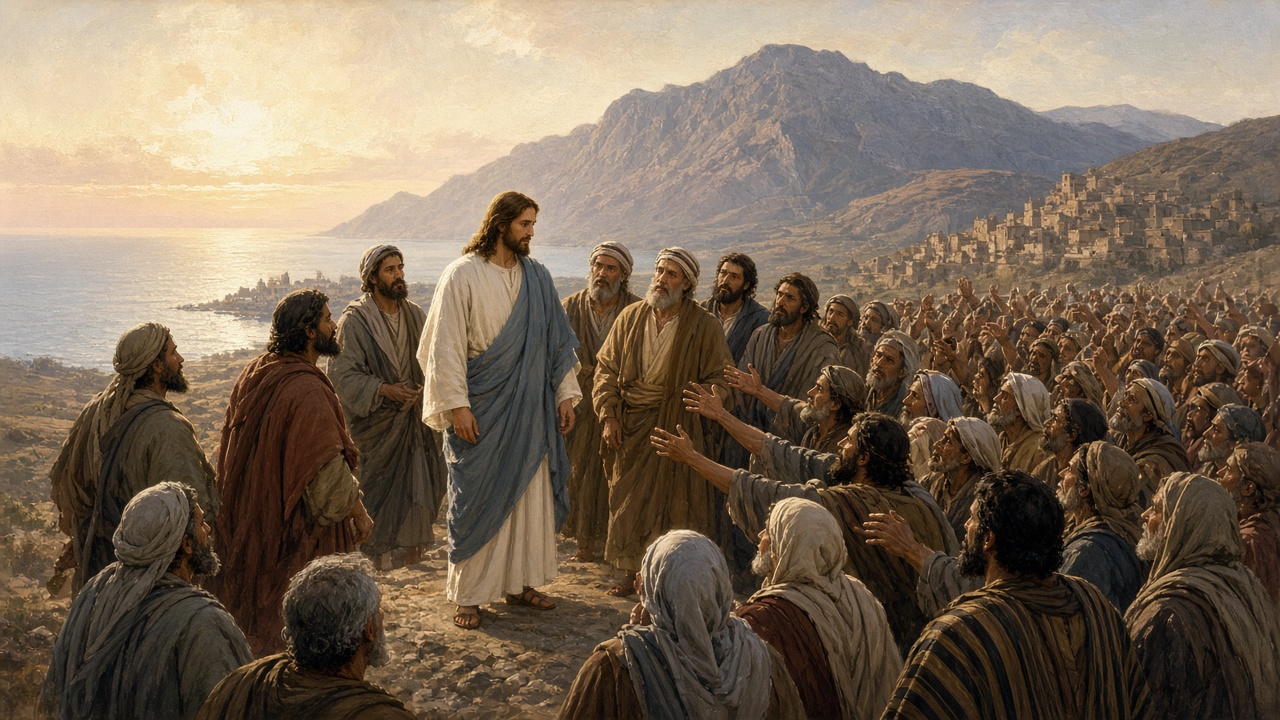
- Jesús bajó con ellos y se detuvo en un lugar llano, donde se había reunido gente de Judea, de Jerusalén y de la costa de Tiro y Sidón para oírlo y ser sanada. Tiro y Sidón eran antiguas ciudades fenicias del Mediterráneo; Sidón, la más antigua, quedaba a unas veinticinco millas al norte de Tiro. Una cronología fecha esta enseñanza en el año 28 d. C. y la titula Sermón del Monte, aunque el relato sitúa a Jesús en terreno llano después de bajar del monte.Fuentes: el propio texto bíblico · Tyre · Sidon · Sermon on the Mount
Notas escritas con ayuda de IA a partir de fuentes abiertas (Theographic Bible Metadata, CC BY-SA 4.0; Easton’s Bible Dictionary, dominio público) y revisadas antes de publicarse.
Lugares de este capítulo
- Jerusalem · 31.777, 35.234 · versículo 17
- Judea · Hoy: Judea 1 · 31.777, 35.234 · versículo 17
- Sidon · Hoy: Sandikli archaeological site in Sidon · 33.561, 35.372 · versículo 17
- Tyre · 33.271, 35.196 · versículo 17
Solo aparecen lugares identificados con alta confianza (90 % o más según las fuentes académicas reunidas por OpenBible). Mapa de la época: DARE (Digital Atlas of the Roman Empire), CC BY 4.0; mapa actual: © colaboradores de OpenStreetMap; lugares: OpenBible.info (CC BY 4.0).
Créditos y licencia de esta traducción
Tupã Je'ẽha
New Testament in Kaapor (BR:urb:Kaapor)
copyright © 2012 Wycliffe Bible Translators, Inc.
Language: Kaapor
Translation by: Wycliffe Bible Translators, Inc.
Copyright Information
© 2012, Wycliffe Bible Translators, Inc. All rights reserved.
This translation text is made available to you under the
terms of the Creative Commons License: Attribution-Noncommercial-No Derivative Works.
( http://creativecommons.org/licenses/by-nc-nd/3.0/ )
In addition, you have permission to port the text to different file formats, as long as you
do not change any of the text or punctuation of the Bible.
You may share, copy, distribute, transmit, and extract portions
or quotations from this work, provided that you include the above copyright
information:
You must give Attribution to the work.
You do not sell this work for a profit.
You do not make any derivative works that change any of the actual words or punctuation of the Scriptures.
Permissions beyond the scope of this license may be
available if you contact
us with your request.
The New Testament
in Kaapor
© 2012, Wycliffe Bible Translators, Inc. All rights reserved.
This translation is made available to you under the terms of the
Creative Commons Attribution-Noncommercial-No Derivatives license 4.0.
You may share and redistribute this Bible translation or extracts from it in any format, provided that:
You include the above copyright and source information.
You do not sell this work for a profit.
You do not change any of the words or punctuation of the Scriptures.
Pictures included with Scriptures and other documents on this site are licensed just for use with those Scriptures and documents.
For other uses, please contact the respective copyright owners.
2014-04-27
Fuente: http://ebible.org/urbNT/ · eBible.org