Hechos 24
Parmeswar ke naawa poestak · Toca un versículo para ver sus referencias cruzadas.
Paulas laat Feleks ke aage
1Tab paatj rodj baad sab se barka agwa Aanaaniaas aur ekaatgo doesar barkwan ekgo Tertalas naam ke okiel ke leike aaike laat ke paas pahoetjal Paulas ke naalies kare khaatien. 2Aur djab Paulas laat ke aage aail, tab Tertalas soeroe karies okar kasoer bataawe ke.
3Oe bolies: „Laat Feleks djie, tor sahaaita se hamlogke djaatie soekh se rahe hai. Tor raadj tjalaawe ke dwaara to ie des me dher tjiedj auro barhia hoi gail hai. Ohie khaatien hamlog hardam aur sagaro toke dhanbaad deila. 4Aur ab ham tose bienaai kariela thora der khaatien hamaar baat par dhiaan lagaawe ke. Djaise toe hardam hamlog par aapan dhiaan lagaile hai, oisane ab bhie kariehe. 5Hamlog to djaan gailie hai kie ie aadmie ek khatarnaak aadmie hai. Oe doenia bhar ke Israel ke djaatie log ke tjienta me daarke haltjal matjaawe hai. Aur oe Naasaaret sahar ke Jiesoe ke dal me ke ekgo barkwa hai.
6Tab djab oe maangies Parmeswar ke mahal barbaad karwaawe, tab hamlog oke pakar leilie oke aapan kaanoen dwaara sadja dewe ke. 7Bakie Jeroesaalem ke thaana ke barkwa Liesias aapan soerdjaatie leike aail aur oke djabar-djastie se pakarke legail. 8Aur oe hamlogse bolies aapke paas djaai ke ie aadmie ke kasoer dewe khaatien. Djab toe ose ie sab baat ke baare me poetjhiehe, tab toe apane djaan djaihe hamlog oke kaahe ke kasoer deila.”
9Tab Israel ke sab se barka agwa aur doesar barkwan Tertalas ke alang bhail aur bolies: „Ha, aisane hai.”
10Tab laat Paulas ke sankiaais batiaai khaatien aur Paulas bole lagal kie: „Laat djie, ham djaaniela kie toe dher baries se ie djaatie ke oeppar faisala kare hai. Ohie se ham hiemmat baanhke tore aage ailie. 11Sab koi tose bataai sake hai kie hamme Jeroesaalem me aile aur Parmeswar ke poedje ke abbe baara rodj bhail hai. 12Oesab hamme koi se moeh tjalaawat na dekhies hai. Ham Parmeswar ke mahal me aur partjaar ke ghar me aur bhie na kahie sahar me haltjal matjailie hai. 13Oelog hamme kasoer dewe hai, bakie na darsaai sake hai.
14Ham toke djanaaila kie ham aapan baap-daada log ke Parmeswar ke aadar kariela. Ham Mosas ke kaanoen me aur Parmeswar ke pahiele ke sanesian ke sab liekhal baat me bhie bieswaas kariela. 15Hamaar aasa Parmeswar par hai aur ham agoriela kie sab manai, tjaahe barhia ja kharaab, oesab djie oethiega. Aur hamaar kasoer dewe waalan ohie agore hai. 16Ohie se ham kausies kariela Parmeswar aur manai ke aage hardam safa sotj-bietjaar se rakhe ke.
17Dher baries bhail kie ham Jeroesaalem sahar me na rahielie, tab ham lautke gailie aapan djaatie log me ke koetjh garieb waalan ke paisa dewe aur bhie Parmeswar ke koetjh baliedaan kare. 18Tab djab ham ie kaam karat rahielie, tab oelog hamme Parmeswar ke mahal ke angana me dekhies. Ham safa karwaawal gailie rahielie aur ekko haltjal kie to hoerdoem na bhail raha.
19Bakie ekaatgo Aasia des ke Israel logan hamme hoewa par dekhke pakaries raha. Djab oelog hamare me koetjh kasoer paawat, tab ohielogke tjaahat raha aadj tore aage aawe ke hamaar oeppar naalies kare ke. 20Aur toe hia ke manai log se poetjh sake hai kie oelog hamare me kaun kasoer paais hai djab ham oesabke barkwan ke aage ledjaawal gailie rahielie. 21Ham oelogse bollie: ‘Ham bieswaas kariela kie maral logan djie oethiega, ohie khaatien ham aadj toelogke aage thara baatie.’ Hoi sake hai kie oelog hamme ie baat ke biese me kasoer dewe hai.”
22Laat Jiesoe ke rasta ke biese me thiek se djaanat raha. Tab oe sabha rok deis aur Paulas se bolies: „Djab barkwa Liesias aaiga, tab ham tor oeppar faisala karabe.” 23Aur oe soerdjaatie ke barkwa ke hoekoem deis Paulas ke band kare ke aur attjha se dekh-bhaal kare ke aur okar saathie log ke mauka dewe ke oke sewa kare khaatien.
Paulas laat Feleks aur okar aurat Droesela ke aage
24Koetjh dien baad laat aapan aurat Droesela leike hoewa gail. Okar aurat ekgo Israel ke aurat raha. Tab Feleks Paulas ke bolwaais aur soene lagal kie oe Kriest Jiesoe ke rasta ke biese me ka bolies. 25Bakie djab Paulas soeroe karies bole ke kie hamlogke tjaahie aapan djiewan safa se bietaawe ke aur apane ke samhaare ke, aur bhie kie Parmeswar hamlogke oeppar faisala kariega, tab oe deraai gail aur bolies: „Ab etana thiek hai. Toe djaai sake hai. Djab hamme tem rahie, tab ham toke phien se bolwaabe.” 26Oe aasa karat raha kie Paulas oke paisa bharat tjhoetkaara paawe khaatien. Ohie se oe oke ber ber bolaawat raha koetjh baat-tjiet kare khaatien. 27Bakie djab doei baries biet gail, tab Feleks ke darie par Porsias Festas laat bhail. Aur Israel ke djaat ke man waala kare khaatien, Feleks Paulas ke band karle rahan deis.
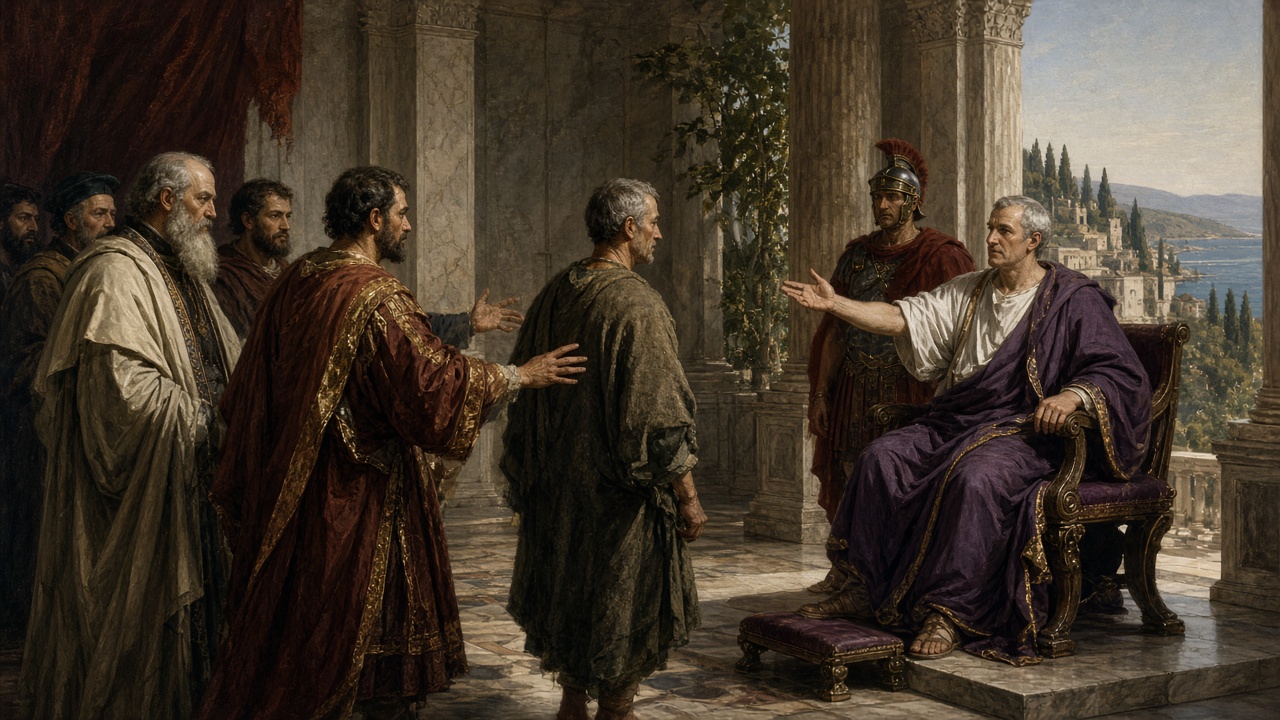
¿Sabías que…?
Pablo ante Félix
- El sumo sacerdote Ananías bajó con algunos ancianos y un abogado llamado Tértulo, a quien el Diccionario Bíblico de Easton describe como un abogado romano empleado por los judíos para exponer su causa contra Pablo ante Félix. Tértulo elogió al gobernador y luego dijo que Pablo era una peste que provocaba disensión entre los judíos por todo el mundo, cabecilla de la secta de los nazarenos y un hombre que había intentado profanar el templo. El diccionario relaciona ese elogio inicial con la limpieza que Félix hizo del país, al expulsar a bandidos e impostores.Fuentes: el propio texto bíblico · Tertullus · Felix
- Félix, que estaba bien informado acerca del Camino, aplazó la audiencia y mantuvo a Pablo bajo guarda, aunque le permitió cierta libertad y dejó que sus amigos atendieran sus necesidades. El relato dice que esperaba que Pablo le ofreciera un soborno y por eso lo mandaba llamar con frecuencia; el Diccionario Bíblico de Easton también afirma que al parecer esperaba un soborno y, por ello, tuvo varias entrevistas con él. Después de dos años lo sucedió Porcio Festo —el Diccionario Bíblico de Easton (1897) fecha ese nombramiento en el año 60 d. C.— y, queriendo hacer un favor a los judíos, Félix dejó a Pablo en prisión.Fuentes: el propio texto bíblico · Felix · Portius Festus
- Unos días después, Félix regresó con su esposa Drusila, que era judía, y escuchó a Pablo hablar de la fe en Cristo Jesús y de la justicia, el dominio propio y el juicio venidero; Félix se asustó y lo despidió. El Diccionario Bíblico de Easton (1897) identifica a Drusila como la tercera y la más joven hija de Herodes Agripa I y dice que Félix la indujo a dejar a su esposo, Azizus, rey de Emesa. La misma entrada dice que ella y su hijo perecieron en la erupción del monte Vesubio en el año 79 d. C.Fuentes: el propio texto bíblico · Drusilla
Notas escritas con ayuda de IA a partir de fuentes abiertas (Theographic Bible Metadata, CC BY-SA 4.0; Easton’s Bible Dictionary, dominio público) y revisadas antes de publicarse.
Lugares de este capítulo
- Caesarea · Hoy: Caesarea Maritima · 32.500, 34.892 · versículo 1
- Jerusalem · 31.777, 35.234 · versículos 11, 17
- Asia · 38.400, 28.300 · versículo 18
Solo aparecen lugares identificados con alta confianza (90 % o más según las fuentes académicas reunidas por OpenBible). Mapa de la época: DARE (Digital Atlas of the Roman Empire), CC BY 4.0; mapa actual: © colaboradores de OpenStreetMap; lugares: OpenBible.info (CC BY 4.0).
Créditos y licencia de esta traducción
Parmeswar ke naawa poestak
New Testament in Hindustani, Caribbean (NS:hns:Hindustani, Caribbean)
copyright © 2010 Wycliffe Bible Translators, Inc.
Language: Hindustani, Caribbean
Translation by: Wycliffe Bible Translators, Inc.
Hindustani, Caribbean [hns], Suriname
Copyright Information
© 2010, Wycliffe Bible Translators, Inc. All rights reserved.
This translation text is made available to you under the
terms of the Creative Commons License: Attribution-Noncommercial-No Derivative Works.
( http://creativecommons.org/licenses/by-nc-nd/3.0/ )
In addition, you have permission to port the text to different file formats, as long as you
do not change any of the text or punctuation of the Bible.
You may share, copy, distribute, transmit, and extract portions
or quotations from this work, provided that you include the above copyright
information:
You must give Attribution to the work.
You do not sell this work for a profit.
You do not make any derivative works that change any of the actual words or punctuation of the Scriptures.
Permissions beyond the scope of this license may be
available if you contact
us with your request.
The New Testament
in Hindustani, Caribbean
© 2010, Wycliffe Bible Translators, Inc. All rights reserved.
This translation is made available to you under the terms of the
Creative Commons Attribution-Noncommercial-No Derivatives license 4.0.
You may share and redistribute this Bible translation or extracts from it in any format, provided that:
You include the above copyright and source information.
You do not sell this work for a profit.
You do not change any of the words or punctuation of the Scriptures.
Pictures included with Scriptures and other documents on this site are licensed just for use with those Scriptures and documents.
For other uses, please contact the respective copyright owners.
2014-04-25
Fuente: http://ebible.org/hnsNT/ · eBible.org