Apocalipsis 11
U BULUNGANA U NIGA · Toca un versículo para ver sus referencias cruzadas.
A elasolana tsonun hahatei
1Ba lia i hale tei u toa u roein tutuna ba lia i hateie tou, “Na tune iema a Luman Lotu Pan tere Sunahan ba lö te tuna hasem a makumun hats. Ba lö te ase rem u katun te lotu ria tara Luman Lotu Pan. 2Kaba alö go ma tunei a makumun oho i ielesala, taraha nonei i hala hakapa nia turu tematan. Nori e tötö homier romana a Taun a Goagono antunana tara 42 a tsihau. 3Na lia e hale goi a pal tsonun hahatei i tar a nitagala te gi hahatei menien u ranga tere Sunahan tara poata teka, antunana turu 1260 u lan. Ba nori te hasoge riou u labalaban bek te haruto nena a nitatagi.”
4A elasolana katun teka nori u huol u roein olip te hatein e Sekaria a propet i manasa na nori has u huol u lam te gum ria i matana Tsunono te tsunono nena a han i puta. 5Te katsin kato homi renoa romana ta katun a elasolana katun teka, bu tula te lakasa nama romana i rungren ba te kato homi rena u pakö i taren. A katun te torohanan kato homi ranen e mar atung hamate mena roi teka. 6Nori e ka mer romana a nitagala te gi keits menien a langits ba te ma polo nei tara poata te hatei narien u ranga tere Sunahan. Na nori e ka has mer romana a nitagala te gi hapalis menien u kioun ramun turu rahatsing. Na nori e ka has mer romana a nitagala te gi hala menien a mamana mar nomi turu han i puta tara saha poata te gi ngile ien.
7Poata te hatei hakapa naro ien romana u ranga, ba ka a omi te butu nama i iahana kiou te tsiruku nitoa uana i iogana e hiatatung mera nen romana. Ba nonei te tagala saluhe ranen romana ba te atung hamate ranen. 8Bu tuanrei i taren te opuna romana tara kalana tara taun pan ti tapala nia a Tsunono i taren tara koruse. U solon haharoei tara taun teka i Sodom na i Itsip. 9Turu topisa u lan na hapala, u katun tara mamana hun katun na tara mamana han na turu mamanu mar ranga e rutser romana a tuanreiren, ba nori te hapiu ner te gi kaho merien. 10U katunur i puta e sasala mer romana ti mate u a elasolana katun teka. Nori e katoer romana a man kannou na man pati, ba te hiahalhala ner a man presen tara hapala i taren, taraha nori a elasolana tsonun hahatei i mate hakapa, nori u katun ti kato hakamits korur u katunur i puta. 11I murina u topisa u lan na hapala, e Sunahan e pihu hatoatoa ranen romana ba nori te takeir. Ba barebana hoboto te tara raren romana te matout korur. 12Ba elasolana katun te hengoer romana u ranga pan i Kolö ba te poiena i taren, “La sei uamuma teka!” Ba nori te la sei uar romana i Kolö turu koasi, bu pakö i taren te tara raren. 13Nonei has tara poata teka e ka mena romana a nun pan a tagala, ba nonei te kato homiena a toa tara maloto a pala tara taun teka ba te kato hamate rena u 7000 tara katun. Ba palair u katun te ka noar te matout korur romana, ba nori te soloseie riou e Sunahan i Kolö.
14A nomi hahuol e kapa. Kaba ruto! A hatopisana nomi e la nama.
A hatohitina tuhil
15Ba hatohitina angelo e piheto a tuhil i tanen. Ba man ranga pan i Kolö i poieto, “A Tsunono i tarara ne Mesaia i tanen e tsunono ner u han hoboto i puta i romana, ba nonei te king nitoa nou tara mamana poata!” 16Bu 24 u katun u tsunono ti gumia tara gumgum a goagono i taren i matane Sunahan e hopue ria a peisaren i puta me hatsunoner e Sunahan. 17Ba nori e poier,
“O Tsunono, alö a Sunahan a tagala koru. Alö u ka mam koru ba te ka noa hasim i romana. Alam e haniga mem tu haruto meni lö a nitagala a kapan i tamulö me tanian tsunono mia tara han i puta.
18U katunur i puta i raharaha korue iolö, kaba poata te go hala meni lö a nihahuna e butu hakapa.
A poata e butu hakapama te go tsimou meri lö u katun ti mate. Na poata e la hakapama te go hala meni lö a hihol a niga turu barebanan kui i tamulö — u propet nu katun hoboto i tamulö te matoutse rio lö, u katun u kapan nu katun papala has.
A poata e butu hakapama te go kato homi meri lö u katun ti kato homi a han i puta!”
19Ba Luman Lotu Pan tere Sunahan i Kolö e kalatser, ba lia e taregu nonei a bokis te ka mei u rangan kits i iahanen ba te kana tara Luman Lotu Pan tere Sunahan. Bu kanaha e butuna nu gururu nu gutsil na nun, ba aisin langits a tiama e rus uana i puta.
¿Sabías que…?
Los dos testigos y la gran ciudad
- Apocalipsis 11 dice que los cuerpos de los dos testigos yacerán en la calle de la gran ciudad, llamada en sentido figurado Sodoma y Egipto, donde también fue crucificado su Señor. Una entrada de diccionario explica Sodoma como ardiente, o la amurallada, una ciudad destruida por fuego del cielo a causa de la maldad de sus habitantes, una destrucción que las Escrituras recuerdan con frecuencia. Egipto, la tierra del Nilo y de las pirámides, se describe igualmente como un lugar de gran importancia en las Escrituras.Fuentes: el propio texto bíblico
- A los dos testigos se les da poder para profetizar durante mil doscientos sesenta días, vestidos de cilicio. Son los dos olivos y los dos candeleros que están delante del Señor de la tierra, y tienen poder para cerrar el cielo de modo que no llueva, para convertir las aguas en sangre y para herir la tierra con toda clase de plagas.Fuentes: el propio texto bíblico
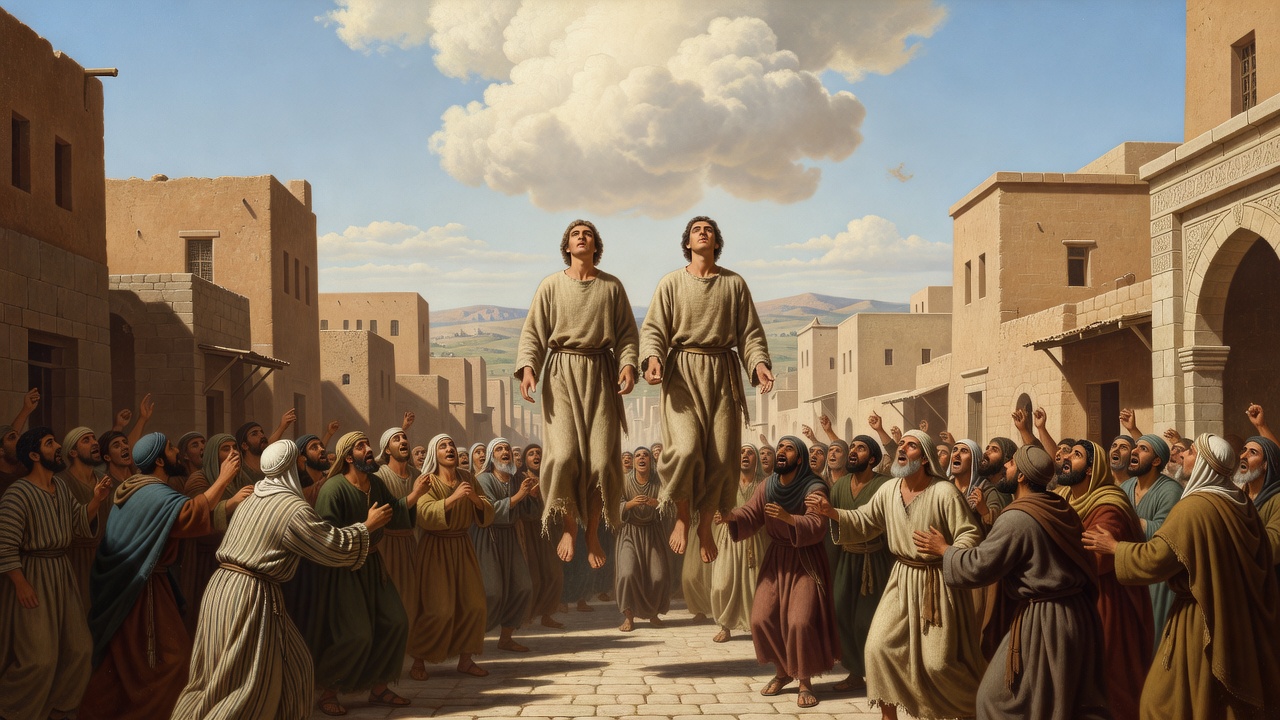
- Cuando los dos testigos terminan su testimonio, la bestia que sube del Abismo los vence y los mata. Durante tres días y medio, pueblos, tribus, lenguas y naciones ven sus cuerpos y no permiten que sean puestos en un sepulcro, mientras los habitantes de la tierra se burlan de ellos, celebran y se envían regalos, porque los dos profetas los habían atormentado. Después de eso, el aliento de vida que viene de Dios entra en ellos; se ponen de pie y suben al cielo en una nube, mientras sus enemigos los observan.Fuentes: el propio texto bíblico
Notas escritas con ayuda de IA a partir de fuentes abiertas (Theographic Bible Metadata, CC BY-SA 4.0; Easton’s Bible Dictionary, dominio público) y revisadas antes de publicarse.
Lugares de este capítulo
Solo aparecen lugares identificados con alta confianza (90 % o más según las fuentes académicas reunidas por OpenBible). Mapa de la época: DARE (Digital Atlas of the Roman Empire), CC BY 4.0; mapa actual: © colaboradores de OpenStreetMap; lugares: OpenBible.info (CC BY 4.0).
Créditos y licencia de esta traducción
U BULUNGANA U NIGA
The New Testament in the Halia Language of Papua New Guinea
Nupela Testamen long tokples Halia long Niugini
copyright © 2020 Wycliffe Bible Translators, Inc.
Language: Halia
Translation by: Wycliffe Bible Translators
This translation is made available to you under the terms of the
Creative Commons Attribution-Noncommercial-No Derivatives license 4.0.
You may share and redistribute this Bible translation or extracts from it in any format, provided that:
You include the above copyright and source information.
You do not sell this work for a profit.
You do not change any of the words or punctuation of the Scriptures.
Pictures included with Scriptures and other documents on this site are licensed just for use with those Scriptures and documents.
For other uses, please contact the respective copyright owners.
2022-06-08
Fuente: http://png.bible/hla/ · eBible.org