Jueces 18
Bib Sen An · Toca un versículo para ver sus referencias cruzadas.
1Nan jou sa yo, pa t gen wa an Israël. Epi nan jou sa yo tribi a Danit yo t ap chache yon eritaj kote pou yo menm ta viv ladann; paske jis rive nan jou sa a, tiraj osò eritaj la potko tonbe pou yo kòm posesyon pami tribi Israël yo. 2Pou sa, fis a Dan yo te ranvoye sòti nan fanmi pa yo, senk mesye ki sòti nan yo tout, mesye vanyan ki sòti Tsorea avèk Eschthaol, pou fè ankèt nan tèren an e egzamine li. Konsa yo te di yo: “Ale fè rechèch tèren an.”
Epi yo te vin rive nan peyi ti mòn Ephraïm yo, kote lakay Mica, pou te loje la. 3Lè yo te vin toupre lakay Mica, yo te rekonèt vwa a jennonm nan, Levit la; epi yo te vire akote la e te di li: “Se kilès ki te mennen ou isit la? Epi kisa w ap fè nan kote sa a? Epi kisa ou gen isit la?”
4Li te di yo: “Men tèl bagay ak tèl bagay Mica te fè m, e li te anplwaye m, epi mwen te vin prèt li.”
5Yo te di li: “Souple, mande Bondye pou nou kab konnen si vwayaj ke nou ap pran an va byen reyisi.”
6Prèt la te di yo: “Ale anpè. Bondye dakò avèk vwayaj ke nou ap fè a.”
7Alò, senk mesye yo te pati pou te rive Laïs e te wè pèp la t ap viv an sekirite, nan fason a Sidonyen yo, anpè avèk sekirite. Paske pa t gen okenn chèf ki t ap imilye yo pou anyen nan peyi a, yo te lwen Sidonyen yo e yo pa t gen okenn relasyon avèk lòt moun. 8Lè yo te retounen vè frè yo Tsorea ak Eschthaol, frè yo te di yo: “Kisa ou di?”
9Yo te di: “Leve e annou monte kont yo; paske nou te wè peyi a e vwala, li trè bon. Epi ankò, èske w ap chita anplas toujou? Pa pèdi tan pou antre posede peyi a. 10Lè ou antre, ou va rive sou yon pèp ki an sekirite avèk yon peyi ase vast. Paske Bondye te mete li nan men ou, yon plas ki pa manke anyen ki sou latè.”
11Alò, soti nan fanmi Danit yo, soti Tsorea avèk Eschthaol, sis-san lòm avèk tout zam lagè yo te pati. 12Yo te monte pou te fè kan nan Kirjath-Jearim nan Juda. Pou sa, yo te rele plas sa a Machané-Dan jis rive jodi a. Tande byen, li vè lwès a Kirjath-Jearim. 13Yo te pase soti la nan peyi ti kolin Ephraïm yo pou te rive lakay Mica.
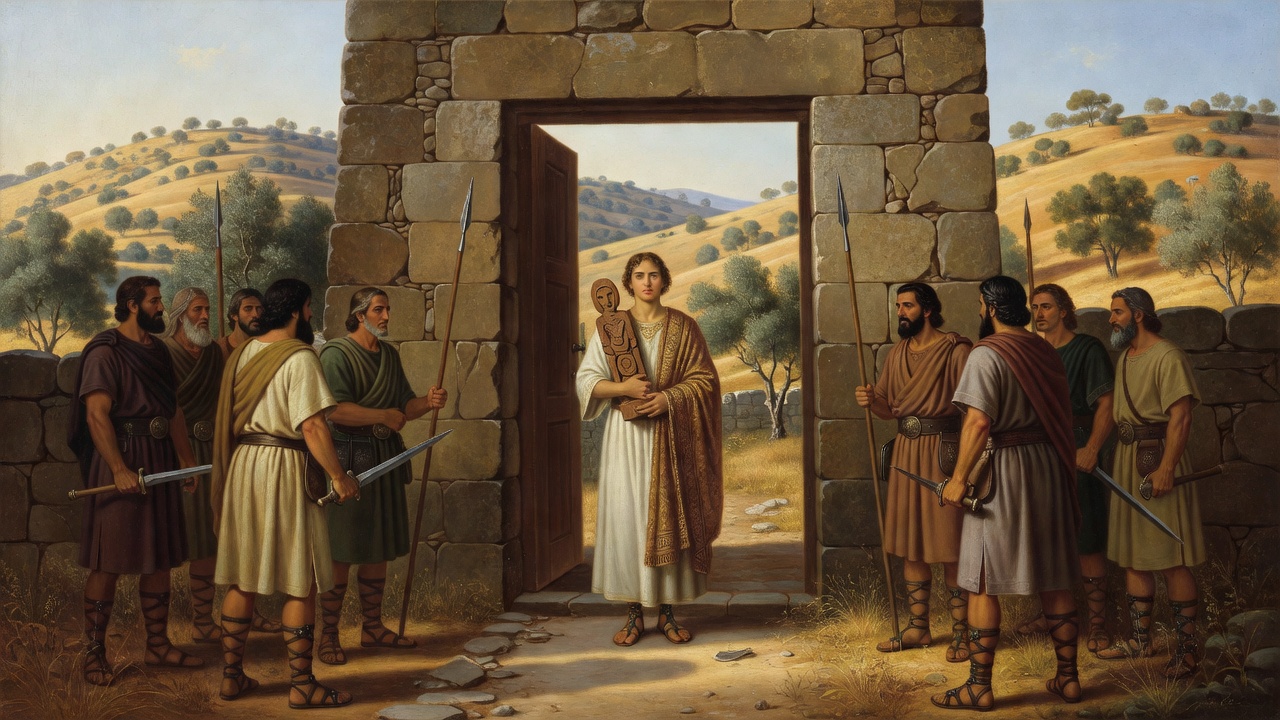
14Epi senk mesye ki te pase fè espyonaj nan peyi Laïs la te di a moun fanmi pa yo: “Èske nou konnen ke genyen nan kay sa yo yon efòd avèk zidòl lakay yo, avèk yon imaj taye ak yon imaj fonn? Pou sa, konsidere kisa ou ta dwe fè.” 15Yo te vire akote la e te rive nan kay a jennonm nan, Levit la, lakay Mica e te mande li si tout bagay ale byen pou li. 16Sis-san lòm ame avèk zam lagè, ki te pou fis a Dan yo, te kanpe akote antre pòtay la. 17Alò, senk mesye ki te ale fè espyonaj peyi a te pwoche, yo te antre la pou te pran imaj taye avèk efòd la ak imaj lakay yo ak imaj fonn nan, pandan prèt la te kanpe nan antre pòtay la avèk sis-san lòm ki te ame avèk zam lagè yo.
18Lè moun sila yo te antre lakay Mica pou te pran imaj taye a, efòd la avèk zidòl lakay yo a, avèk imaj fonn nan, prèt la te di yo: “Kisa nou ap fè la a?”
19Yo te di li: “Pe la, mete men sou bouch ou e vini avèk nou pou devni pou nou yon papa, ak yon prèt. Èske li pi bon pou ou pou fè prèt lakay a yon sèl moun, oswa devni prèt a yon tribi e yon fanmi an Israël?”
20Kè a prèt la te kontan. Li te pran efòd la avèk zidòl lakay yo a, imaj taye a e li te ale pami pèp la. 21Yo te vire sòti pou te mete pitit yo avèk tout bèt yo avèk byen yo ranmase devan yo. 22Lè yo te fè yon sèten distans soti lakay Mica, mesye ki te nan kay toupre lakay Mica yo te rasanble yo pou te vin jwenn fis a Dan yo. 23Yo te kriye sou fis a Dan yo e yo te vire di Mica: “Kisa nou genyen nou vin rasanble konsa?”
24Li te di: “Nou fin pran dye ke m te fè yo, avèk prèt la e sòti; epi kisa mwen genyen plis ke sa? Kijan nou kab di mwen: ‘Kisa ou genyen?’”
25Fis a Dan yo te di li: “Pa kite vwa ou tande pami nou, oswa mesye fewòs yo va vin tonbe sou ou e ou va pèdi lavi ou avèk lavi tout lakay ou.”
26Konsa, fis a Dan yo te fè wout yo. Epi lè Mica te wè ke yo te twò fò pou li, li te vire retounen lakay li. 27Epi yo te pran sa ke Mica te fè yo, avèk prèt ki te pou li a, e yo te vini bò kote Laïs, a yon pèp ki te pezib e an sekirite. Yo te frape yo avèk lam nepe; e yo te brile vil la avèk dife. 28Pa t gen pèsòn pou sove yo akoz li te lwen Sidon e yo pa t gen relasyon avèk okenn lòt pèp. Li te nan vale ki te toupre Beth-Rehob la. Konsa, yo te rebati vil la pou te viv ladann. 29Yo te rele vil la Dan, menm non a Dan, papa ki te fèt an Israël yo. Men avan sa, non a vil sa a se te Laïs. 30Fis a Dan yo te fè monte pou kont yo, menm imaj taye a; epi Jonathan, fis a Guerschom lan, fis a Manassé a, li menm avèk fis li yo te prèt pou tribi Danit lan jis rive jou ke peyi a te vin pran an kaptivite a. 31Alò, konsa, yo te monte pou kont yo imaj taye ki te pou Mica a, ke li menm te fè, pandan tout tan ke kay Bondye a te nan Silo a.
¿Sabías que…?
La migración de Dan y el santuario robado
- En busca de un territorio propio, espías danitas encontraron Lais, un asentamiento tranquilo y aislado en el extremo norte, cerca de las fuentes del Jordán. Debido a que la ciudad carecía de alianzas militares y estaba lejos de la ciudad fenicia de Sidón, seiscientos guerreros danitas la capturaron e incendiaron con facilidad, reconstruyéndola con el nombre de Dan.Fuentes: el propio texto bíblico · Laish · Dan · Sidon
- En su marcha hacia el norte, los danitas confiscaron la imagen tallada, el efod y los ídolos domésticos de Micaías, convenciendo a su joven sacerdote levita de unirse a ellos como sacerdote tribal. Al final del relato, el sacerdote es identificado como Jonatán, hijo de Gersón, descendiente de Moisés, cuya familia mantuvo este sacerdocio en el norte durante generaciones.Fuentes: el propio texto bíblico · Jonathan · Gershom · Micah
- Los seiscientos guerreros danitas se movilizaron desde las ciudades de Zora y Estaol. Su campamento temporal al oeste de Quiriat-jearim, en el territorio de Judá, pasó a llamarse Mahaneh-dan, que significa 'Campamento de Dan'.Fuentes: el propio texto bíblico · Mahaneh-dan · Zorah · Eshtaol
Notas escritas con ayuda de IA a partir de fuentes abiertas (Theographic Bible Metadata, CC BY-SA 4.0; Easton’s Bible Dictionary, dominio público) y revisadas antes de publicarse.
Lugares de este capítulo
- Aram · 33.511, 36.306 · versículos 7, 28
- Dan · Hoy: Tel Dan · 33.249, 35.652 · versículos 7, 14, 27, 29
- Sidon · Hoy: Sandikli archaeological site in Sidon · 33.561, 35.372 · versículos 7, 28
- Kiriath-jearim · Hoy: Deir el Azar · 31.809, 35.104 · versículo 12
- Shiloh · Hoy: Khirbet Seilun · 32.056, 35.290 · versículo 31
Solo aparecen lugares identificados con alta confianza (90 % o más según las fuentes académicas reunidas por OpenBible). Mapa de la época: DARE (Digital Atlas of the Roman Empire), CC BY 4.0; mapa actual: © colaboradores de OpenStreetMap; lugares: OpenBible.info (CC BY 4.0).
Créditos y licencia de esta traducción
Bib Sen An
The Holy Bible in Haitian Creole, 2023 update
copyright © 2017-2023 Ron Smith
Language: Kreyòl Ayisyen (Haitian)
Translation by: Ron Smith
Contributor: Felix Nixon
This translation is made available to you under the terms of the
Creative Commons Attribution Share-Alike license 4.0.
You have permission to share and redistribute this Bible translation in any format and to make reasonable revisions and adaptations of this translation, provided that:
You include the above copyright and source information.
If you make any changes to the text, you must indicate that you did so in a way that makes it clear that the original licensor is not necessarily endorsing your changes.
If you redistribute this text, you must distribute your contributions under the same license as the original.
Pictures included with Scriptures and other documents on this site are licensed just for use with those Scriptures and documents.
For other uses, please contact the respective copyright owners.
Note that in addition to the rules above, revising and adapting God's Word involves a great responsibility to be true to God's Word. See Revelation 22:18-19.
2026-06-11
Fuente: http://ebible.org/hatbsa/ · eBible.org