Habacuc 3
Bib Sen An · Toca un versículo para ver sus referencias cruzadas.
1Yon priyè Habacuc, pwofèt la, selon fòm Sigonoth la.
2SENYÈ, mwen te tande yon rapò sou Ou menm
e mwen kanpe etone nèt.
O SENYÈ, fè zèv ou yo leve ankò nan mitan ane yo.
Fè yo vin koni nan mitan ane yo.
Nan chalè kòlè, Ou, sonje mizerikòd.
3Bondye soti nan Théman;
Sila ki Sen an soti nan Mòn Paran. Tan
Bèlte Li kouvri syèl la,
e tè a vin plen ak lwanj Li.
4Ekla Li tankou reyon solèy la.
Gen tras klate limyè ki soti nan men L,
e nanpwen anyen ki kache de pouvwa Li.
5Devan Li, tout kalite touman mache;
dèyè Li, epidemi a swiv sou pye L.
6Li te kanpe;
tè a te sekwe.
Li te gade;
nasyon yo te etone.
Wi, lansyen mòn yo te vin detwi,
ansyen kolin yo te vin efondre.
Chemen li yo dire jis pou tout tan.
7Mwen te wè tant a Cush yo anba detrès.
Rido tant a Madian yo t ap tranble.
8Èske SENYÈ a te malkontan ak rivyè yo?
Èske se ak rivyè yo Ou te fache?
Oswa, èske kòlè Ou te kont lanmè a,
ki fè Ou te monte sou cheval Ou yo,
sou cha delivrans Ou yo?
9Ou te rale banza a soti nan fouwo l;
Ou te rele flèch ou yo fè sèman an. Selah.
Ou te fann tè a ak rivyè yo.
10Mòn yo te wè, Ou e yo te tranble.
Flèv dlo yo te kouri desann.
Pwofondè a te gwonde.
Li te leve men l anlè.
11Solèy la ak lalin nan te kanpe nan plas yo.
Nan eklè flèch Ou yo,
ak briyans lans Ou yo,
solèy ak lalin nan te kanpe sou plas.
12Nan gwo kòlè Ou, Ou te mache travèse tè a.
Nan kòlè Ou, Ou te foule mache sou nasyon yo.
13Ou te soti pou delivrans a pèp Ou a,
pou sali pèp onksyon Ou an.
Ou te frape tèt peyi mechanste a.
Ou te ekspoze li nèt,
depi nan kwis li pou rive nan kou l. Selah.
14Ou te frennen tèt gèrye li yo ak pwòp nepe yo.
Yo te antre kon toubiyon pou gaye nou.
Ak gwo lajwa yo te tankou sila
ki devore malere an sekrè yo.
15Ou te foule mache sou lanmè a
ak cheval Ou yo,
sou lam lanmè a k ap boulvèse dlo a.
16Mwen te tande,
e zantray mwen te tranble.
Lèv mwen te tranble ak son vwa a.
Pouriti a antre nan zo m,
mwen te tranble sou plas,
paske mwen oblije tann jou detrès la, byen kalm,
tann pèp k ap leve a vin anvayi nou.
17Menmsi pye fig la pa ta fleri,
ni pa gen fwi sou branch rezen yo,
menmsi donn oliv la vin sispann,
e chan yo pa pwodwi manje,
menmsi bann mouton an ta koupe
separe de pak la,
e pa gen bèf nan pak la,
18mwen va toujou egzalte nan SENYÈ a.
Mwen va rejwi nan Bondye, sali mwen an.
Mwen va ranpli ak jwa akoz delivrans mwen an.
19Senyè BONDYE mwen an se fòs mwen.
Li te fè pye mwen vin tankou pye sèf;
Li te ban m fòs pou mache sou wo plas yo.
Pou direktè koral la, sou enstriman a kòd mwen yo.
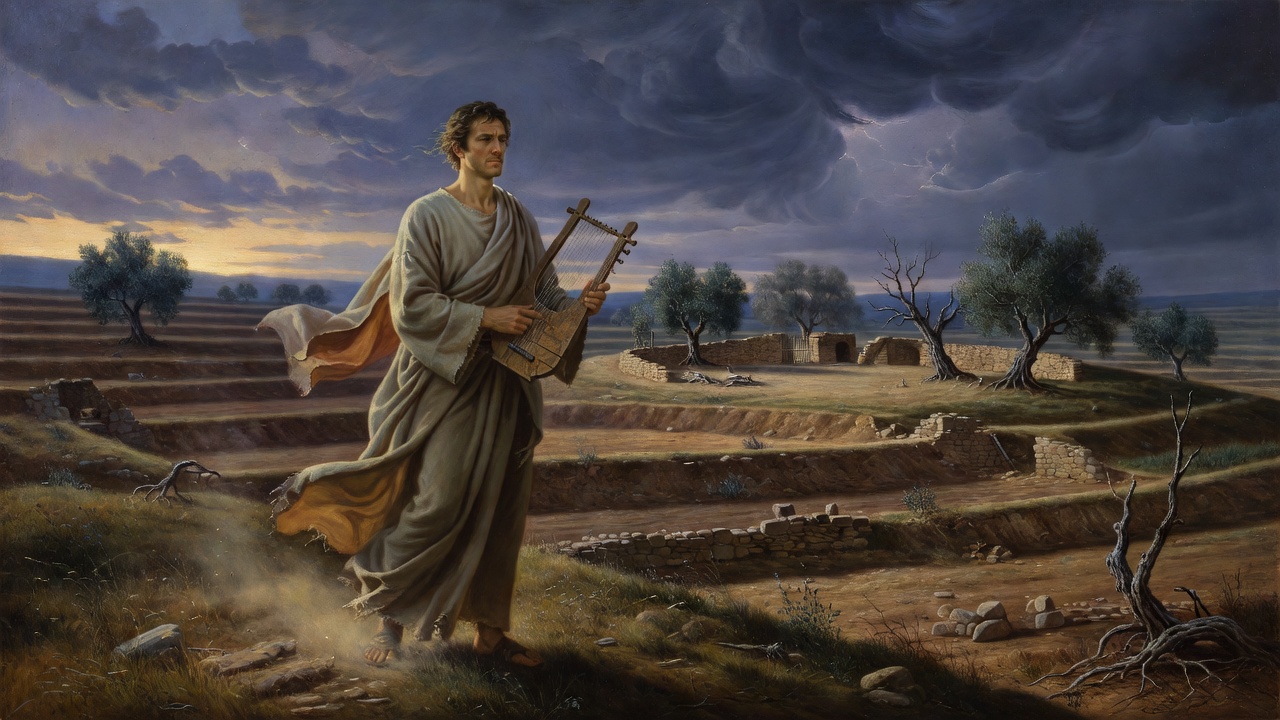
¿Sabías que…?
La oración de Habacuc y el cántico de fe
- El poema describe a Dios manifestándose desde el desierto meridional, mencionando a Temán en el sur de Idumea y al monte Parán en el límite desértico de la Tierra Prometida. Estas referencias geográficas evocan descripciones poéticas antiguas del Señor marchando en majestad desde el sur.Fuentes: Teman · Mount Paran · el propio texto bíblico
- Cusán y Madián son representadas temblando ante el avance divino. Los madianitas eran tribus árabes nómadas que habitaban en tiendas a través de los desiertos y pastizales del Sinaí y el norte de Arabia.Fuentes: Cushan · Midian · el propio texto bíblico
- El capítulo está estructurado como un salmo litúrgico, con términos musicales como 'Sigionot', 'Selah' y una dedicatoria final al director del coro para ser interpretado con instrumentos de cuerda.Fuentes: el propio texto bíblico
Notas escritas con ayuda de IA a partir de fuentes abiertas (Theographic Bible Metadata, CC BY-SA 4.0; Easton’s Bible Dictionary, dominio público) y revisadas antes de publicarse.
Lugares de este capítulo
- Midian · 28.495, 35.012 · versículo 7
Solo aparecen lugares identificados con alta confianza (90 % o más según las fuentes académicas reunidas por OpenBible). Mapa de la época: DARE (Digital Atlas of the Roman Empire), CC BY 4.0; mapa actual: © colaboradores de OpenStreetMap; lugares: OpenBible.info (CC BY 4.0).
Créditos y licencia de esta traducción
Bib Sen An
The Holy Bible in Haitian Creole, 2023 update
copyright © 2017-2023 Ron Smith
Language: Kreyòl Ayisyen (Haitian)
Translation by: Ron Smith
Contributor: Felix Nixon
This translation is made available to you under the terms of the
Creative Commons Attribution Share-Alike license 4.0.
You have permission to share and redistribute this Bible translation in any format and to make reasonable revisions and adaptations of this translation, provided that:
You include the above copyright and source information.
If you make any changes to the text, you must indicate that you did so in a way that makes it clear that the original licensor is not necessarily endorsing your changes.
If you redistribute this text, you must distribute your contributions under the same license as the original.
Pictures included with Scriptures and other documents on this site are licensed just for use with those Scriptures and documents.
For other uses, please contact the respective copyright owners.
Note that in addition to the rules above, revising and adapting God's Word involves a great responsibility to be true to God's Word. See Revelation 22:18-19.
2026-06-11
Fuente: http://ebible.org/hatbsa/ · eBible.org