Gálatas 2
Bib Sen An · Toca un versículo para ver sus referencias cruzadas.
1Answit, apre yon espas katòz ane mwen te monte ankò Jérusalem avèk Barnabas, e mwen te pran Tite osi. 2Se te akoz yon revelasyon ke mwen te monte a. Epi konsa, mwen te soumèt devan yo menm levanjil ke mwen preche pami pèp etranje yo. Men mwen te fè sa an prive a sila ki te gen repitasyon yo, pou lakrent ke mwen ta ka petèt kouri, oubyen te kouri anven. 3Men pa menm Tite ki te avèk mwen an, malgre li te yon Grèk, pa t oblije sikonsi. 4Men se te akoz de fo frè yo ki te antre an kachèt pou espyone libète ke nou gen nan Kris Jésus a, pou yo ta ka mennen nou nan esklavaj. 5Men nou pa t soumèt a yo menm pandan menm yon moman, pou verite levanjil la ta kapab rete avèk nou tout. 6Men de sila ki te gen gwo repitasyon yo—sa yo te ye pa gen enpòtans pou mwen; Bondye pa nan patipri—byen, sila ki te gen repitasyon yo pa t ogmante anyen anplis pou mwen. 7Men okontrè, yo te wè ke levanjil la te konfye a mwen menm pou ensikonsi yo, menm jan ke li te konfye a Pierre pou sikonsi yo. 8Paske Sila ki te an reyalite travay atravè Pierre kòm apot pou sikonsi yo, te an reyalite travay atravè mwen menm tou anvè pèp etranje yo. 9Konsa, ak rekonesans gras ke m te resevwa, Jacques, Céphas, ak Jean, ki te gen repitasyon kòm pilye lafwa yo, te ban mwen ak Barnabas lamen dwat dasosiyasyon, pou nou te kapab ale kote pèp etranje yo e yo menm kote sikonsi yo. 10Yo te sèlman mande nou pou nou sonje pòv yo bagay ke mwen te vrèman vle fè.
11Men lè Céphas te vini Antioche, mwen te opoze a li menm nan toudwat devan l, paske li te rete kondane. 12Paske avan moun a Jacques yo te vini, li te konn manje avèk pèp etranje yo. Men lè yo te vini, li te kòmanse fè bak pou rete a leka, akoz lakrent pati sikonsizyon an. 13Rès Jwif yo te vin jwenn avè l nan ipokrizi a, avèk rezilta ke menm Barnabas te pote ale pa ipokrizi yo a. 14Men lè mwen te wè ke yo pa t mache dwat selon verite levanjil la, mwen te di a Céphas nan prezans a tout moun: “Si ou menm, kòm yon Jwif, viv kon pèp etranje yo e pa tankou Jwif, kòman ou ka fòse pèp etranje yo viv tankou Jwif?
15Nou menm ki se Jwif pa lanati e pa pechè ki sòti pami pèp etranje yo, 16sepandan, nou konnen ke yon nonm pa jistifye pa zèv Lalwa, men atravè lafwa an Kris Jésus a, nou menm kwè nan Kris Jésus a, pou nou kapab jistifye pa lafwa an Kris, e non pa zèv Lalwa, paske pa zèv Lalwa yo, okenn chè p ap jistifye. 17Men si, pandan n ap chache jistifye nan Kris, nou menm osi jwenn nou kòm pechè, èske konsa Kris se yon sèvitè a peche? Ke sa pa janm fèt! 18Paske si mwen rebati sa ke, yon fwa, mwen te detwi a, mwen pwouve a tèt mwen ke mwen se yon transgresè. 19Paske selon Lalwa a mwen te mouri a Lalwa a, pou mwen te kapab viv a Bondye. 20Mwen te krisifye avèk Kris, epi se pa plis Mwen ki viv, men Kris viv nan mwen. Konsa, lavi ke m viv koulye a nan lachè, mwen viv pa lafwa nan Fis a Lòm nan, ki te renmen mwen e ki te bay tèt li pou mwen. 21Mwen pa anile lagras Bondye, paske si ladwati vini selon Lalwa a, alò, Kris te mouri san rezon.”
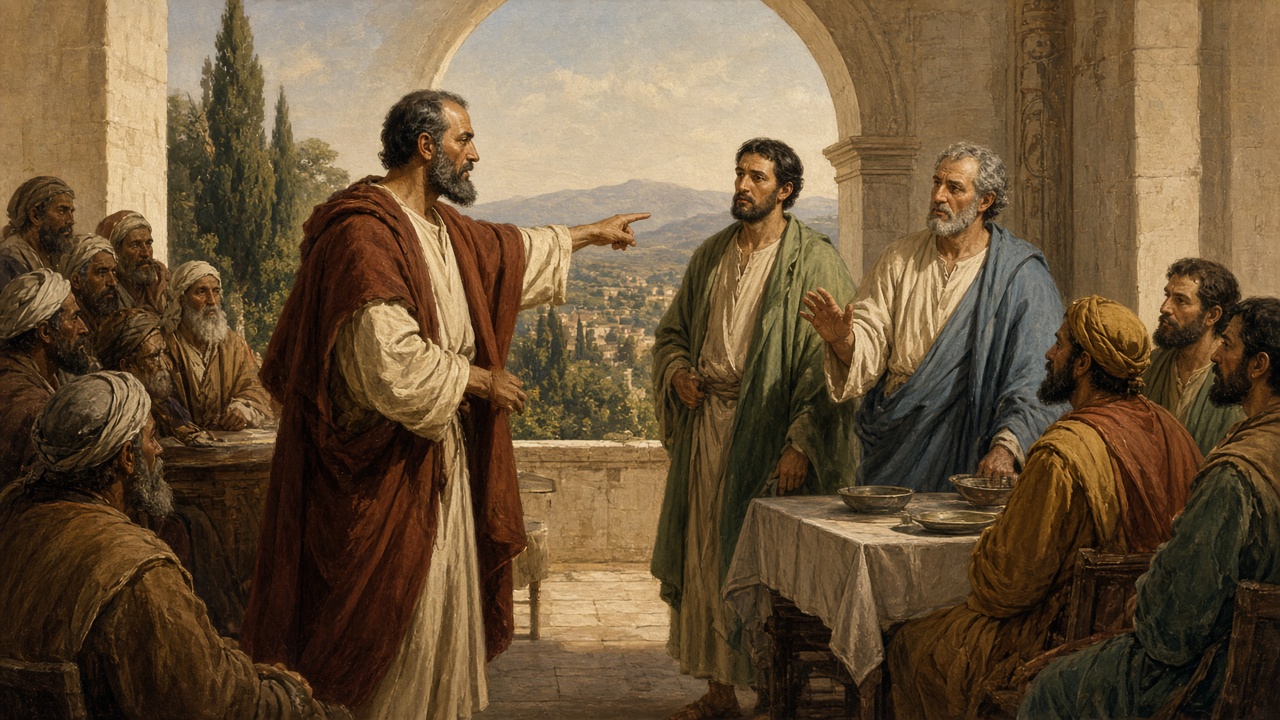
¿Sabías que…?
Gentiles, comunión y un enfrentamiento en Antioquía
- Tito fue con Pablo y Bernabé a Jerusalén. El Easton's Bible Dictionary (1897) dice que parece haber sido gentil y que su nombre no aparece en Hechos. Pablo escribe que Tito, aunque era griego, no fue obligado a circuncidarse.Fuentes: Titus · el propio texto bíblico
- El enfrentamiento posterior tuvo lugar en Antioquía de Siria, a orillas del Orontes, a unas trescientas millas al norte de Jerusalén. La ciudad ocupaba el tercer lugar entre las ciudades del Imperio romano, después de Roma y Alejandría, y fue allí donde a los creyentes se les llamó cristianos por primera vez.Fuentes: Antioch (Syria) · el propio texto bíblico
- El Easton's Bible Dictionary (1897) describe a Santiago, nombrado con Cefas y Juan como uno de los pilares, como cabeza de la iglesia en Jerusalén, donde presidió el concilio sobre los gentiles. Pablo dice que, antes de que llegaran ciertos hombres de parte de Santiago, Cefas solía comer con los gentiles, pero luego se apartó por temor al grupo de la circuncisión.Fuentes: James (Brother of Jesus) · el propio texto bíblico
Notas escritas con ayuda de IA a partir de fuentes abiertas (Theographic Bible Metadata, CC BY-SA 4.0; Easton’s Bible Dictionary, dominio público) y revisadas antes de publicarse.
Lugares de este capítulo
- Jerusalem · 31.777, 35.234 · versículo 1
- Antioch · Hoy: Antioch on the Orontes · 36.227, 36.172 · versículo 11
Solo aparecen lugares identificados con alta confianza (90 % o más según las fuentes académicas reunidas por OpenBible). Mapa de la época: DARE (Digital Atlas of the Roman Empire), CC BY 4.0; mapa actual: © colaboradores de OpenStreetMap; lugares: OpenBible.info (CC BY 4.0).
Créditos y licencia de esta traducción
Bib Sen An
The Holy Bible in Haitian Creole, 2023 update
copyright © 2017-2023 Ron Smith
Language: Kreyòl Ayisyen (Haitian)
Translation by: Ron Smith
Contributor: Felix Nixon
This translation is made available to you under the terms of the
Creative Commons Attribution Share-Alike license 4.0.
You have permission to share and redistribute this Bible translation in any format and to make reasonable revisions and adaptations of this translation, provided that:
You include the above copyright and source information.
If you make any changes to the text, you must indicate that you did so in a way that makes it clear that the original licensor is not necessarily endorsing your changes.
If you redistribute this text, you must distribute your contributions under the same license as the original.
Pictures included with Scriptures and other documents on this site are licensed just for use with those Scriptures and documents.
For other uses, please contact the respective copyright owners.
Note that in addition to the rules above, revising and adapting God's Word involves a great responsibility to be true to God's Word. See Revelation 22:18-19.
2026-06-11
Fuente: http://ebible.org/hatbsa/ · eBible.org