Génesis 32
Nacom Pejume Diwesi po diwesi pena jume diwesi xua Jesucristo yabara tinatsi · Toca un versículo para ver sus referencias cruzadas.
Jacob Esaúwan Katønrrab Inrrab Tamørøb
1Inchen Jacobpe nui yamigwan legucha iben, nune Tiuswei kan angelesmera katønrrab werruben, 2Jacobpe truilan ashabe, trenchibig køn: “Yube Tius nui angeles søtømeraba kørrømisra pasrainug køn” cha. Incha treekkurri truyube Mahanaim cha wamabig køn. 3Incha Jacobpe tru Edom pirau tru Seirsrømay wan sruar merrab amrrai ørøbig køn, Esaúwan katønrrabelø tru nabe punrrab arrumønrrun cha, nui nuneg eshkanrrabelø.
4Incha øyeeg chinrrai karua ørøbig køn:
—“Ñi nai mayur nuneg Esaúwan Jacob na ñi maig chiben megabiibe, trendan cha: ‘Nabe møi øyangatig Labanba kørrømisra tsua, 5møimbe waaramera køben, burrumera køben, ubishamera køben, cabramera køben, karuig melabelø møguelø køben ishumburmera køben, tøgaig kur’ tan chinrrai. Pøs ñi nai mayur nunewan nabe ñun øyeeg eshkawa ørar cha, ñi nan truba tabig utig pasramig kønrrai.”—
6Inchen tru wam srua ambubeløbe Jacobweimay katøle amrrua, trenchibelø køn:
—Ñui nuneg Esaú waisrø ashchab amber cha. Nøgucha ñun katønrrab arrun cha, møguelø cuatrocientos lincha peraig.—
7Inchen Jacob øyeeg taigwan mørabe, truba kørig kui inchib, truba isuin kørrømisra, nøbe tru nui misag lincha perayailan pa søtø pirishibig køn, tru ubishameran, cabramera køben, waarameran, camellomeran chigucha. 8Pøs nøbe treeg isubig køn: “Inchippa Esaú kan søtøwan kwayanrrab megambuingucha, katøgan søtøbe lulrrain” cha.
9Incha Jacobpe Tiuswan trenchib miabig køn:
—Nai møskai Abrahamwei Tius, nai møskai Isaacwei Tius: “Tru nai pirausrømay, nai yau misaameraisrømay katøle nan inrrø cha. Ñune truba truba tøgaig misrøb inrrai maramønrrun” cha, ñi nan trendaig kuig køn cha. 10Na ñi karuigwan marøb megabiibe ñi larrø tab indigwanba, ñi trendø treeg tabig køppe treeg mariilanba na truigwan utab pasramibe nabe trengatig truburab kømuinatan cha. Pøs, nabe i Jordan nu piyu larreb urasbe i pøtønain tsiizhiitø srua pasraig køben, trune møimbe nuingui, nuingui pa søtø tarømara pasramig tøga pasrar cha. 11Nai nuneg Esaúwei taskugurri chi kømønrrai marøbsrumuguh cha. Nane kørig køtan cha, inchippa nanba, usralmeranba, ureemeranba kweecha petønrraitamab. 12Ñitøwei nane trendaig køn cha: “Nane maya nuguen tabig nebuig kønrrai mara, nainukkurri amrrub misaamerabe purø nørrø køptø, mar menda kan pisrum lataig kønrrun cha, mundamguengaikke.”—
13Incha tru yembe Jacobpe truyu kia, nø truyu chi tøgaguigwan nui nuneg Esaúwan ketamig lawa wesrabig køn. 14Cabramera doscientas, pib trattrø turmøg cabramera, ubishamera doscientas, turmøg ubishamera pib trattrø, 15Camellasmera ureg perarcheelø treinta, waaramera cuarenta, toro-ureemera pa trattrø, asnasmera pib trattrø, pa trattrø burrusmera. 16Incha tru nui karuig mendig melabelai tasku tru ushameran nuingui kan søtø, kan søtø pønsra, tru nui mendig melabelane trenchibig køn:
—Nai merrab ambay cha. Incha tru tarømarig søtømerane kanguetøtø kømøtø, yabsrø, yabsrø merranrrigay— cha.
17Incha Jacobpe tru ke srøsrø merrana ibigwane trencha karua ørøbig køn:
—Nai nuneg Esaú ñun kata: “¿Ñibe muinukkurriig kugu chib, chumay inrrab arrugu? chib. ¿Ñi merrana yaig ushamerabe muielø kø?” chib payene, 18ñibe øyah chib løtønrrig cha: “Ñun ketamig ñi nai ashib karubig ñi Esaúwein køn cha, iilane ñi maig chiben marøb megabig, tru Jacob, keta trana øran cha, nui ushamerayugurri. Inchagucha nøbe namui wendau arrun” chinrrig— chibig køn.
19Incha tru srøsriigwei wendau ibigwan lata, pøn kønrrabyu ibigwan lata, tru wendau ambubelan møilandøgucha treetø, treetø chinrrai karua pasrig køn. Esaúwan katabe, øyeetøh chinrrigay cha. 20Incha katø trenchinrrigay cha: “Ñui karuig megabig Jacobpe namui wendau arrun” cha. Kaguen Jacobpe treeg isubig køn: ‘Tru na keta trana øriilanmerrig nun pungaruabe, tru nø namig kørrømisrig købig yandø kuchi tammisren, trugurrimbe nui maløwan asamønrrun’ cha. 21Inchen tru keta tranameløbe merrab chab amben, Jacobpe tru nui misaameraba, nui ushamerabañau kørrømisra tsuinug kinrrab kørrømisrøbig køn.
Jacob Angelba Melambub Kemøriyab
22Incha tru yemdøwei Jacobpe kurra, nui pagatø sralanba, nui pagatø linchatø melab ishumburmeranba, pa trattrø y kan tru nui nusrkalanba, Jaboc taig nu piyu larraambubelø køn. 23Incha yandø truilan chab larrøørabe, katø chine købigwan kerrigu larrøørøbig køn. 24Incha Jacobpe tru misaameraba, nui ushameraba kørrømisra tsuinug nøtø kørrømisra, kan møøba tør-rramnegatig kwayab tranrriyabelø køn. 25Inchen tru møøbe Jacobwane chinchaguen kullaaranamgaig kui ashabe, srøptsim merrarrab srølwan kebachen safabig køn, tru kemøriyab tranrriyabyu. 26Inchen tru møøbe trenchibig køn:
—Yandø chab tør-rrab køn cha. ¡Elatcha!— cha.
Inchene Jacobpe trenchibig køn:
—Ñi nan maya nuguen tabig nebunrrabigwan tranmubene, nabe lelachimumønrrun— cha.
27Inchene tru møøbe:
—¿Ñibe chi munchi kugu?— cha payen,
Nøbe:
—Jacob munchi kur— chibig køn.
28Inchene tru møøbe trenchibig køn:
—Ñibe yandø Jacob cha wamig kønrrabig kømøtø, Israel cha wamig kønrrabig køn cha. Kaguende ñibe Tiusba, møgueløba truba melambuyab tranrriyaigu, ñibe kullaaramøn— cha.
29Inchene Jacobpe trencha payibig køn:
—¿Ñibe chi munchi kugu?— cha.
Inchene tru møøbe trenchibig køn:
—¿Nai munchiwane nane chinchab paygu?— cha.
Inchen tru møøbe truyutøwei tru mayanguen tabig nebuig kønrrabigwan nune tranøbig køn.
30Incha Jacobpe truyube Peniel cha wamabig køn; kaguen nøbe trendaig køn: “Nabe Tiuswan malaugue ashendø, katøgucha ka øsig pasrainatan” cha. 31Inchen Jacob Penielsrøngurri puraiben, pørrbe neeshib arrubig køn. Inchen nui pøytañig safaig pusrkwaben, Jacobpe kebeñiptø, kebeñib arrubig køn. 32Incha treekkurri Israelweinukkurri amrrub misaamerabe møingatig tru ushamerayu pøytañig kemørøb srølwane mameelø køn, kaguen Jacobwane tru srølyu kebatig kuig kua.
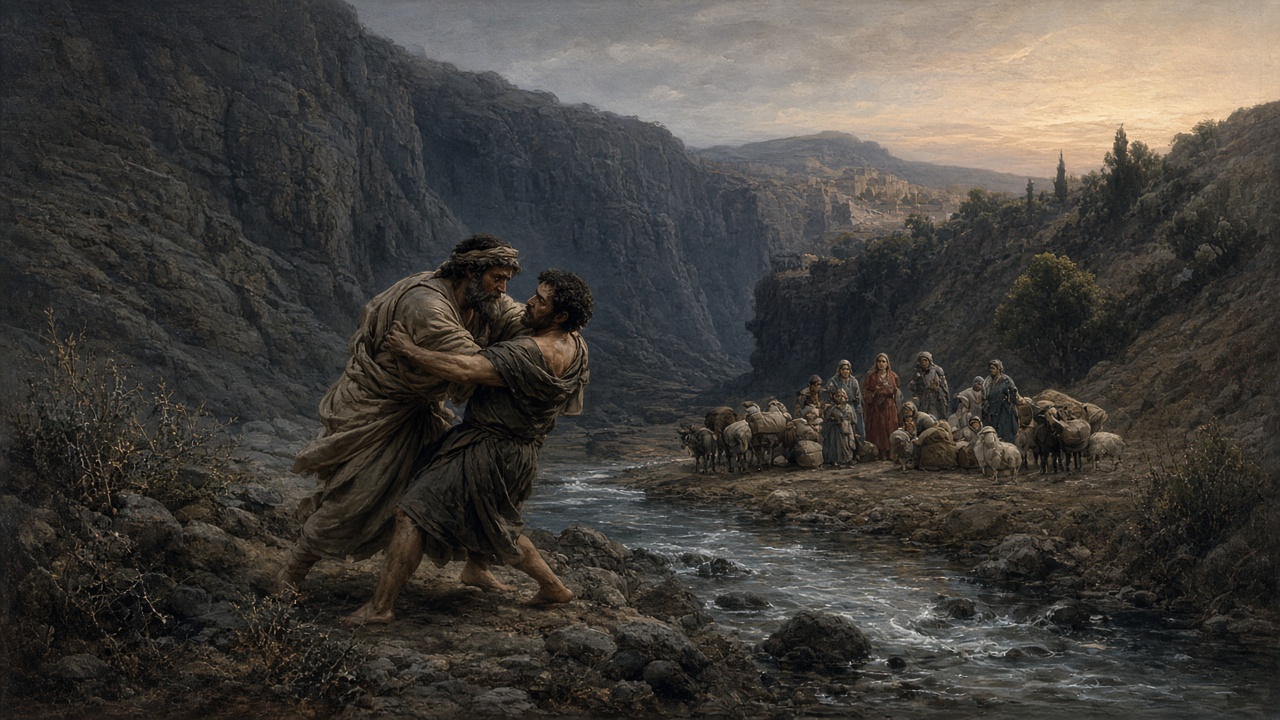
¿Sabías que…?
En el Jaboc, camino de Esaú
- Mahanaim significa “dos campamentos”. Jacob le dio ese nombre al lugar cerca del Jaboc, más allá del Jordán, cuando los ángeles de Dios salieron a su encuentro y él dijo: “Este es el campamento de Dios”. Allí también dividió a su gente, los rebaños, los ganados y los camellos en dos campamentos, con la esperanza de que uno escapara si Esaú atacaba al otro.Fuentes: Mahanaim · el propio texto bíblico
- El Jaboc, cuyo nombre se explica como “un derramamiento, o una lucha”, es un arroyo al este del Jordán. Desemboca en el Jordán más o menos a mitad de camino entre el mar de Galilea y el mar Muerto, tras un recorrido de unas 65 millas por un barranco agreste y profundo. En el vado, Jacob hizo cruzar a sus dos esposas, sus dos siervas, sus once hijos y todo lo que poseía, y quedó solo, luchando con un hombre hasta el amanecer.Fuentes: Jabbok · el propio texto bíblico
- Jacob envió mensajeros a Esaú en la tierra de Seir, el país de Edom, llamándolo señor y a sí mismo siervo. Seir es una región montañosa a lo largo del lado oriental del Arabah, desde el extremo sureste del mar Muerto hasta cerca de Akabah, el brazo oriental del mar Rojo; la ocupaban los edomitas, y fue asignada a los descendientes de Esaú. Esaú, el gemelo primogénito y cazador, había vendido la primogenitura por un guiso de lentejas rojas y también se llamaba Edom, “rojo”, mientras que Jacob —cuyo nombre significa “el que sigue los talones de otro”, o “suplantador”— había conspirado con su madre para engañar a Isaac.Fuentes: el propio texto bíblico · Seir · Esau (Edom) · Jacob (Israel)
Notas escritas con ayuda de IA a partir de fuentes abiertas (Theographic Bible Metadata, CC BY-SA 4.0; Easton’s Bible Dictionary, dominio público) y revisadas antes de publicarse.
Lugares de este capítulo
- Edom · 30.746, 35.604 · versículo 3
- Jordan · Hoy: Jordan River · 31.761, 35.558 · versículo 10
- Jabbok · Hoy: Zarqa River · 32.115, 35.543 · versículo 22
Solo aparecen lugares identificados con alta confianza (90 % o más según las fuentes académicas reunidas por OpenBible). Mapa de la época: DARE (Digital Atlas of the Roman Empire), CC BY 4.0; mapa actual: © colaboradores de OpenStreetMap; lugares: OpenBible.info (CC BY 4.0).
Créditos y licencia de esta traducción
Nacom Pejume Diwesi po diwesi pena jume diwesi xua Jesucristo yabara tinatsi
New Testament in Guambiano
copyright © 2010 Wycliffe Bible Translators, Inc.
Language: Guambiano
Translation by: Wycliffe Bible Translators, Inc.
Copyright Information
© 2010, Wycliffe Bible Translators, Inc. All rights reserved.
This translation text is made available to you under the
terms of the Creative Commons License: Attribution-Noncommercial-No Derivative Works.
( http://creativecommons.org/licenses/by-nc-nd/3.0/ )
In addition, you have permission to port the text to different file formats, as long as you
do not change any of the text or punctuation of the Bible.
You may share, copy, distribute, transmit, and extract portions
or quotations from this work, provided that you include the above copyright
information:
You must give Attribution to the work.
You do not sell this work for a profit.
You do not make any derivative works that change any of the actual words or punctuation of the Scriptures.
Permissions beyond the scope of this license may be
available if you contact
us with your request.
The New Testament
in Guambiano
© 2010, Wycliffe Bible Translators, Inc. All rights reserved.
This translation is made available to you under the terms of the
Creative Commons Attribution-Noncommercial-No Derivatives license 4.0.
You may share and redistribute this Bible translation or extracts from it in any format, provided that:
You include the above copyright and source information.
You do not sell this work for a profit.
You do not change any of the words or punctuation of the Scriptures.
Pictures included with Scriptures and other documents on this site are licensed just for use with those Scriptures and documents.
For other uses, please contact the respective copyright owners.
2014-04-25
Fuente: http://ebible.org/gum/ · eBible.org