Daniel 5
Geeshsha Maxaafa · Toca un versículo para ver sus referencias cruzadas.
Kawa Bilxasoora Gibira
1Issi gallas kawoy Bilxasoori mukulu gidiya ba shuumatas gibira giigisidi, entara issife woyne ushsha uyis. 2Bilxasoori woyne ushsha uyidi mathotida wode, iya aaway Nabukadanaxoori Yerusalaamen de7iya Xoossa keethafe ehida worqafenne birape oosetida ushsha miisheta ehana mela kiittis. I hessa oothiday I, iya shuumati, iya machetinne iya laggethoti ushsha he miishetan uyanaw koyida gishosa. 3Enti Yerusalaamen de7iya Xoossa keethafe ehida worqafe oosetida ushsha miisheta kawas ehidosona. Yaatin kawoy, iya shuumati, iya machetinne iya laggethoti he miishetan tigetida woyne ushsha uyidosona. 4Enti he woyne ushsha uyishe, worqafe birape, naase biratape, biratape, mithafenne shuchafe oosetida xoossata galatidosona.
5He wode qoponna de7ishin, asa kushe biradheti keyidi, xompe wothiya kocaa sinthan, meeshetida kawo gadho godaa bolla xaafidosona. He kushey xaafiya wode kawoy be7is. 6He wode iya som7oy laametidi, bido gidis; yashshan iya gaadey kokoris; iya gulbatay ixis.
7Kawoy ba qaala dhoqu oothidi, muranchota, marotanne xoolinto paydeyisata ehana mela kiittis. I, Babiloone cincatako haysada yaagis: “Ha xuufiya nabbabidi, iya birshethaa taw odiya oonika, ocha teera daaniya ma7uwa ma7ana; iya qoodhen worqa aathana; I, ta kawotetha haariya heedzantho asi gidana” yaagis.
8Babiloone cincati ubbay iya sinthe yidosna; shin entafe oonika he xuufiya nabbabanaw woyko iya birshethaa odanaw danda7ibeenna. 9Kawoy Bilxasoori kaseysafe aadhidi dagammin, iya som7oy kaseysafe aadhidi bido gidis. Iya shuumati haniyaba dhayidosona.
10Iya aayiya, kawanne iya shuumata palama si7ada, enti gibira miya keethaa gelada, haysada yaagasu: “Kawaw, merinaw kawota! Ha qofan daro dagammofa; ne som7oy laametofo. 11Geeshsha xoossata ayyaani iya bolla de7iya, issi asi ne kawotethaa giddon de7ees. Iyaw eratethi, akeekinne cincatethi de7ees. Kase ne aaway, kawoy Nabukadanaxoori iya, marota, muranchota, bitanchotanne xoolinto paydeyisata halaqa oothidi shuumis. 12I, lo77o ayyaani, erinne akeeki de7iya ase. I amuho birshanaw, qan7ishe odanawunne xuura qoncisanaw danda7ees. Kawoy Bilxasoora gidi sunthida Daanela xeega. I new xuufiya birshethaa odana” yaagasu.
13He wode Daanela kawako ehin, kawoy iyako haysada yaagis: “Daaneli nenee? Ta aaway, kawoy Yihudape di77idi ehidaysatape issoy nenee? 14Xoossata ayyaani nenan de7eysa, eri, akeekinne cincatethi new de7eysa ta si7as. 15Ha xuufiya nabbabanawunne iya birshethaa taw odanaw muranchotinne cincati yidosona; shin enti taw birshethaa odanaw danda7ibookona. 16Neeni birshethaa odanawunne deexo oysha ubbaa zaaranaw danda7eysa ta si7as. Hiza ne ha xuufiya nabbabanawunne iya birshethaa taw odanaw danda7iko, ocha teera daaniya ma7uwa mayzana; ne qoodhen worqa aathana; neeni, kawotetha haariya heedzantho ase gidana.”
17Daaneli kawas zaaridi, “Ne imoy new gido; ne woytuwa hara asas imma. Gidoshin, taani xuufiya kawas nabbabana; birshethaaka odana.”
18“Kawaw, Ubbaafe Dhoqa Xoossay ne aawa Nabukadanaxooras kawotethi, gitatethi, bonchonne teema immis. 19Iya gitatetha gaason derey, kawotethatinne dumma dumma doonan odetiya kochati iyaw yashshan kokoridosona. I wodhanaw koyeysa wodhees; ashshanaw koyeysa ashshees; shuumanaw koyeysa shuumees; kawushanaw koyeysa kawushshees. 20Shin I otortida wodenne iya wozanay muumida wode, ba araatape wodhis; iya bonchoyka qaaretis. 21Asa giddofe goodetis; iya kahay laametin do7a gidis. Boorada maata mishe demba haretara issife de7is. Iya asatethay salo akan laakis. Hessi haniday, Ubbaafe Dhoqa Xoossay asa nayta kawotetha ubbaa haareysanne ba koydaysas immeysa I erana melasa.
22“Shin Bilxasoora, neeni iya na7ay, ha ubbaa erashe ne nenatethaa kawushabaaka. 23Qassi salo Godaa bolla otortada, nenatethaa dhoqu dhoqu oothadasa. Iya keethaafe bonqetidi yida worqa miishetan neeni, ne shuumati, ne machetinne ne laggethoti, woyne ushsha uyideta. Qassi xeellanaw, si7anawunne eranaw danda7onna birape, worqafe, naase biratape, biratape, mithafenne shuchafe oosetida xoossata galatideta. Ne de7uwanne ne ogiya ba kushen oykida Xoossaa bonchabaaka. 24Hessa gisho, kushe biradheti iyape kiitetin, ha xuufey xaafetis.
25“Xuufey,
26“Aramike doonan iya birshethay haysa.
MAANE: (taybetis) ‘Xoossay ne kawota laytha taybidi wuranaada oothis’ guussu.
27TEQEL: (mazzanetis) ‘Mizaanen mazzanetada, kawuyada bentadasa’ guussu.
28PAARES: (shaaketis) ‘Ne kawotethay shaaketidi Meedonasinne Farses imetis’ ” guussu.
29He wode, Bilxasoora kiitan, ocha teera daaniya ma7uwa Daanela mayzidosona; iya qoodhen worqa aathidosona; qassi kawotetha haariya heedzantho asi gidana mela awaajidosona.
30He wode qamma morketi gelidi, Babiloone kawa Bilxasoora wodhidosona. 31Iya kawotethaa, laythi usupun tammanne nam7a gidida Meedona addey Daariyosi ekis.
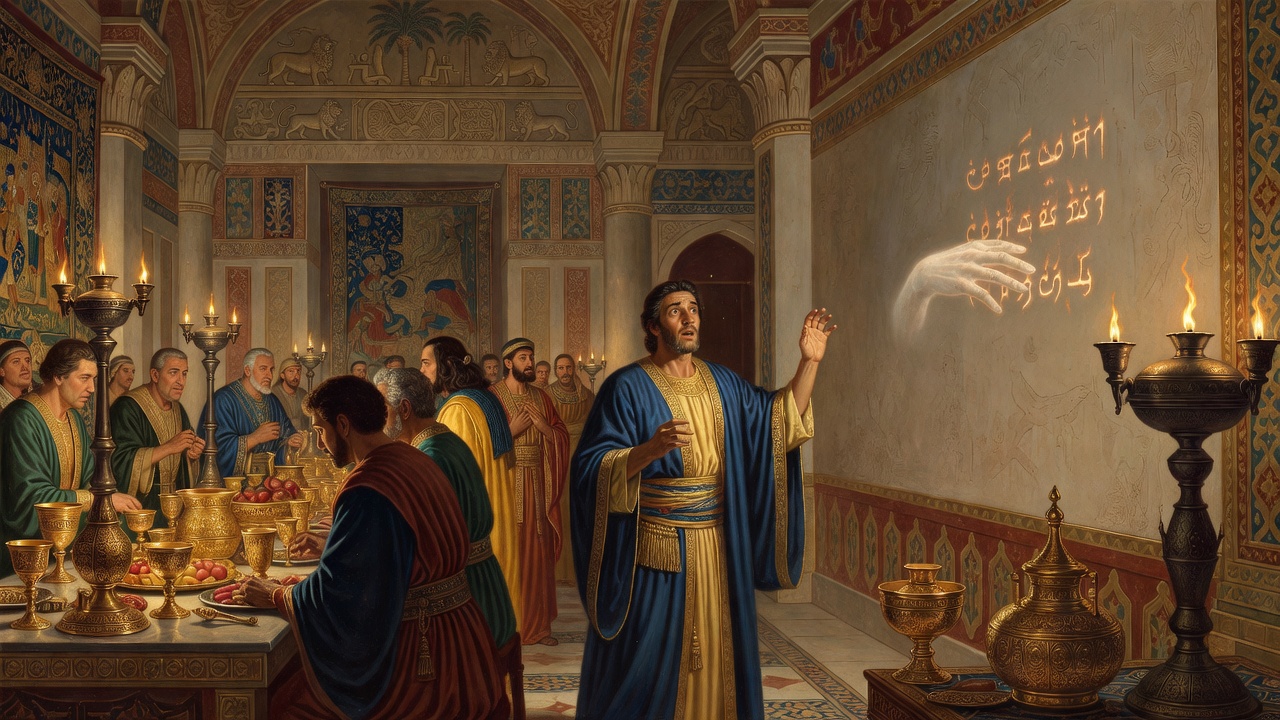
¿Sabías que…?
La escritura en la pared y la caída de Babilonia
- Aunque el texto llama repetidamente a Nabucodonosor padre de Belsasar, en el uso semítico antiguo el término podía denotar un antecesor o abuelo. Los registros históricos señalan que Belsasar era hijo del rey Nabonido y nieto de Nabucodonosor a través de su madre, Nitocris.Fuentes: Belshazzar · el propio texto bíblico
- Belsasar ofreció convertir a quien pudiera interpretar la misteriosa inscripción en el tercer gobernante del reino. Debido a que Belsasar era corregente con su padre Nabonido, la tercera posición era el rango más alto que podía otorgar.Fuentes: Belshazzar · el propio texto bíblico
- La profanación de los vasos sagrados de oro y plata traídos del templo de Jerusalén provocó el presagio divino sobre el yeso del palacio. Daniel interpretó la inscripción como el anuncio de que el reino babilónico había sido pesado, hallado falto y entregado a los medos y persas.Fuentes: Belshazzar · el propio texto bíblico
Notas escritas con ayuda de IA a partir de fuentes abiertas (Theographic Bible Metadata, CC BY-SA 4.0; Easton’s Bible Dictionary, dominio público) y revisadas antes de publicarse.
Lugares de este capítulo
- Jerusalem · 31.777, 35.234 · versículos 2, 3
- Babylon · 32.543, 44.422 · versículos 7, 11
- Chaldea · 30.962, 46.104 · versículos 7, 11
Solo aparecen lugares identificados con alta confianza (90 % o más según las fuentes académicas reunidas por OpenBible). Mapa de la época: DARE (Digital Atlas of the Roman Empire), CC BY 4.0; mapa actual: © colaboradores de OpenStreetMap; lugares: OpenBible.info (CC BY 4.0).
Créditos y licencia de esta traducción
Geeshsha Maxaafa
Gofa: Geeshsha Maxaafa (Bible) for Ethiopia, Latin script
copyright © 2024 The Word for the World International
Language: Goofa (Gofa)
Contributor: The Word for the World International
This translation is made available to you under the terms of the
Creative Commons Attribution Share-Alike license 4.0.
You have permission to share and redistribute this Bible translation in any format and to make reasonable revisions and adaptations of this translation, provided that:
You include the above copyright and source information.
If you make any changes to the text, you must indicate that you did so in a way that makes it clear that the original licensor is not necessarily endorsing your changes.
If you redistribute this text, you must distribute your contributions under the same license as the original.
Pictures included with Scriptures and other documents on this site are licensed just for use with those Scriptures and documents.
For other uses, please contact the respective copyright owners.
Note that in addition to the rules above, revising and adapting God's Word involves a great responsibility to be true to God's Word. See Revelation 22:18-19.
2025-05-03
Fuente: http://ebible.org/gofl/ · eBible.org