Cantares 4
Young's Literal Translation · Toca un versículo para ver sus referencias cruzadas.
Solomon Admires His Bride
The Bridegroom
1Lo, thou [art] fair, my friend, lo, thou [art] fair, Thine eyes [are] doves behind thy veil, Thy hair as a row of the goats That have shone from mount Gilead, 2Thy teeth as a row of the shorn ones That have come up from the washing, For all of them are forming twins, And a bereaved one is not among them. 3As a thread of scarlet [are] thy lips, And thy speech [is] comely, As the work of the pomegranate [is] thy temple behind thy veil, 4As the tower of David [is] thy neck, built for an armoury, The chief of the shields are hung on it, All shields of the mighty. 5Thy two breasts [are] as two fawns, Twins of a roe, that are feeding among lilies. 6Till the day doth break forth, And the shadows have fled away, I will get me unto the mountain of myrrh, And unto the hill of frankincense. 7Thou [art] all fair, my friend, And a blemish there is not in thee. Come from Lebanon, O spouse, 8Come from Lebanon, come thou in. Look from the top of Amana, From the top of Shenir and Hermon, From the habitations of lions, From the mountains of leopards. 9Thou hast emboldened me, my sister-spouse, Emboldened me with one of thine eyes, With one chain of thy neck. 10How wonderful have been thy loves, my sister-spouse, How much better have been thy loves than wine, And the fragrance of thy perfumes than all spices. 11Thy lips drop honey, O spouse, Honey and milk [are] under thy tongue, And the fragrance of thy garments [Is] as the fragrance of Lebanon. 12A garden shut up [is] my sister-spouse, A spring shut up — a fountain sealed. 13Thy shoots a paradise of pomegranates, With precious fruits, 14Cypresses with nard — nard and saffron, Cane and cinnamon, With all trees of frankincense, Myrrh and aloes, with all chief spices. 15A fount of gardens, a well of living waters, And flowings from Lebanon!
The Bride
16Awake, O north wind, and come, O south, Cause my garden to breathe forth, its spices let flow, Let my beloved come to his garden, And eat its pleasant fruits!
¿Sabías que…?
La belleza de la novia y el huerto de especias
- El poema invita a la novia a descender de las imponentes cordilleras del norte en el Líbano, que incluyen Amana, Senir y el monte Hermón. El monte Hermón es la cumbre más alta del Antilíbano, y las fuentes bíblicas señalan que Senir era el nombre amorreo para este monte.Fuentes: el propio texto bíblico · Hermon · Senir · Lebanon
- El cabello de la amada se compara con un rebaño de cabras que desciende por el monte Galaad, una región fértil y montañosa situada al este del río Jordán.Fuentes: el propio texto bíblico · Gilead
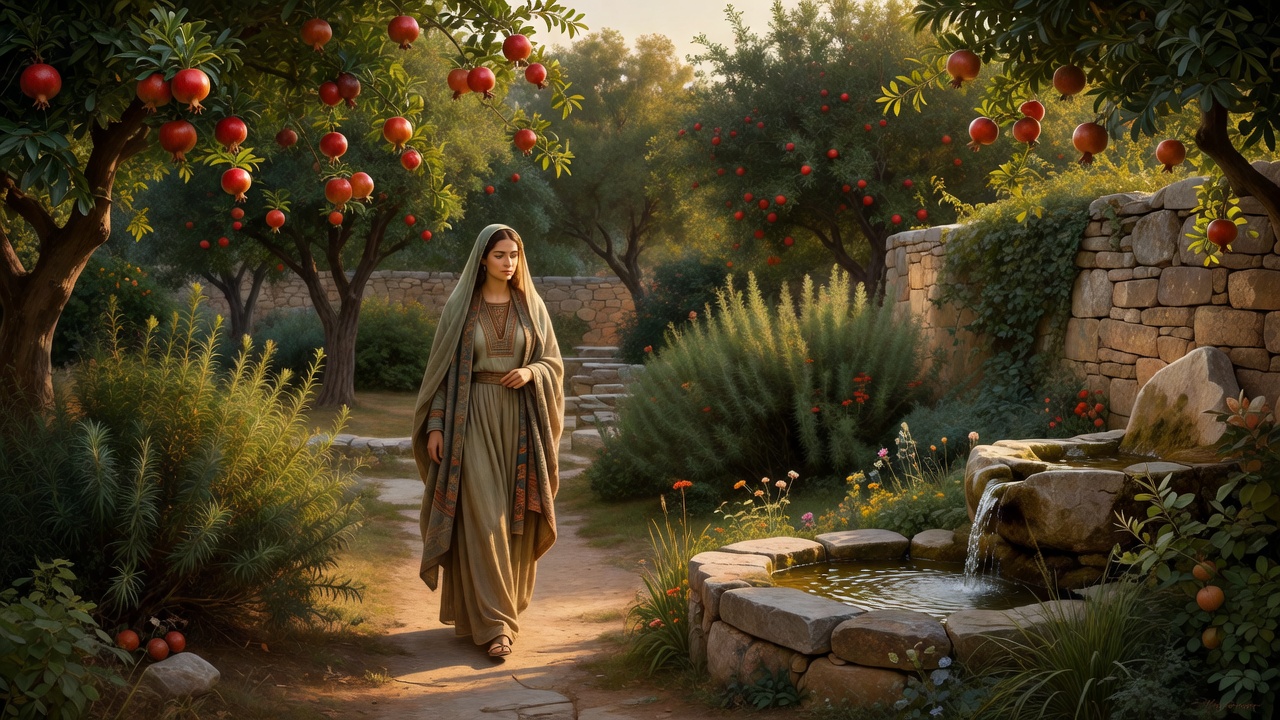
- La novia es descrita como un huerto cerrado, una fuente sellada y un vergel repleto de valiosas especias como nardo, azafrán, canela e incienso, lo que evoca exclusividad, frescura y fragancia.Fuentes: el propio texto bíblico
Notas escritas con ayuda de IA a partir de fuentes abiertas (Theographic Bible Metadata, CC BY-SA 4.0; Easton’s Bible Dictionary, dominio público) y revisadas antes de publicarse.
Lugares de este capítulo
- Gilead · Hoy: Gilead 1 · 32.187, 35.692 · versículo 1
- Lebanon · 33.540, 35.584 · versículos 8, 11, 15
- Mount Hermon · 33.400, 35.850 · versículo 8
- Senir · Hoy: Mount Hermon · 33.400, 35.850 · versículo 8
Solo aparecen lugares identificados con alta confianza (90 % o más según las fuentes académicas reunidas por OpenBible). Mapa de la época: DARE (Digital Atlas of the Roman Empire), CC BY 4.0; mapa actual: © colaboradores de OpenStreetMap; lugares: OpenBible.info (CC BY 4.0).
Créditos y licencia de esta traducción
Young's Literal Translation
Young's Literal Translation of the Holy Bible
Public Domain
Language: ENGLISH (English)
Dialect: archaic British
Translation by: Robert Young
This public domain Bible translation is brought to you courtesy of eBible.org.
If you would like to make a donation to help keep free Bible access like this going, please visit https://eBible.org/give.php .
2019-10-20
Títulos de sección adaptados de la Berean Standard Bible (dominio público); no forman parte del texto bíblico de esta traducción.
Fuente: http://ebible.org/engylt/ · eBible.org