Salmos 42
Young's Literal Translation · Toca un versículo para ver sus referencias cruzadas.
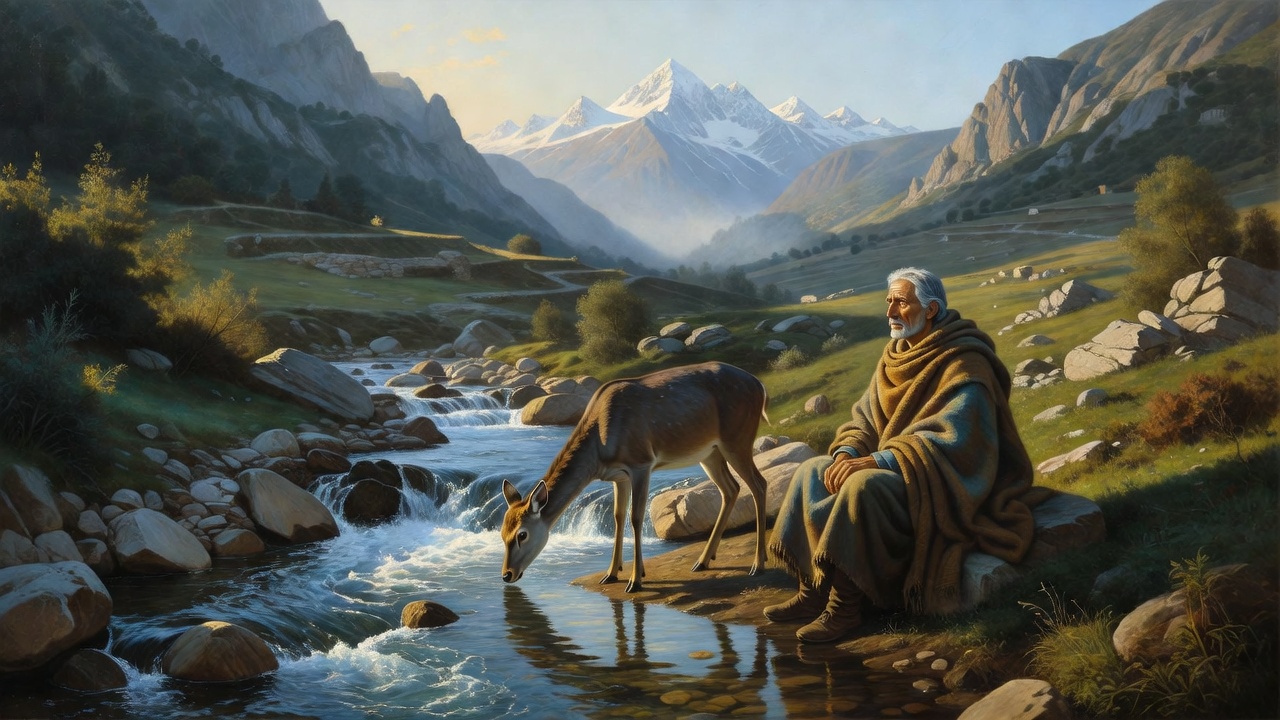
As the Deer Pants for the Water
1To the Overseer. — An Instruction. By sons of Korah. As a hart doth pant for streams of water, So my soul panteth toward Thee, O God. 2My soul thirsted for God, for the living God, When do I enter and see the face of God? 3My tear hath been to me bread day and night, In their saying unto me all the day, 'Where [is] thy God?' 4These I remember, and pour out my soul in me, For I pass over into the booth, I go softly with them unto the house of God, With the voice of singing and confession, The multitude keeping feast! 5What! bowest thou thyself, O my soul? Yea, art thou troubled within me? Wait for God, for still I confess Him: The salvation of my countenance — My God! 6In me doth my soul bow itself, Therefore I remember Thee from the land of Jordan, And of the Hermons, from the hill Mizar. 7Deep unto deep is calling At the noise of Thy water-spouts, All Thy breakers and Thy billows passed over me. 8By day Jehovah commandeth His kindness, And by night a song [is] with me, A prayer to the God of my life. 9I say to God my rock, 'Why hast Thou forgotten me? Why go I mourning in the oppression of an enemy? 10With a sword in my bones Have mine adversaries reproached me, In their saying unto me all the day, 'Where [is] thy God?' 11What! bowest thou thyself, O my soul? And what! art thou troubled within me? Wait for God, for still I confess Him, The salvation of my countenance, and my God!
¿Sabías que…?
La Sed de Dios Lejos del Hogar
- El salmo se presenta como un cántico de los hijos de Coré, una familia levítica descendiente del levita Coré que participaba en la música y el culto del templo.Fuentes: el propio texto bíblico · Korah (Levite)
- El autor anhela a Dios desde las tierras del norte, mencionando la región del Jordán, el monte Hermón y el monte Mizar. El Hermón es una imponente cordillera con varias cumbres de unos 2.800 metros de altitud, mientras que Mizar (que significa 'pequenez') alude a una elevación menor en sus alrededores.Fuentes: el propio texto bíblico · Hermon · Hill Mizar
- El poema recurre a vivas metáforas acuáticas, desde un ciervo sediento que brama por corrientes de agua hasta cascadas estruendosas y olas desbordantes que simbolizan una profunda aflicción emocional.Fuentes: el propio texto bíblico
Notas escritas con ayuda de IA a partir de fuentes abiertas (Theographic Bible Metadata, CC BY-SA 4.0; Easton’s Bible Dictionary, dominio público) y revisadas antes de publicarse.
Lugares de este capítulo
- Jordan · Hoy: Jordan River · 31.761, 35.558 · versículo 6
- Mount Hermon · 33.400, 35.850 · versículo 6
Solo aparecen lugares identificados con alta confianza (90 % o más según las fuentes académicas reunidas por OpenBible). Mapa de la época: DARE (Digital Atlas of the Roman Empire), CC BY 4.0; mapa actual: © colaboradores de OpenStreetMap; lugares: OpenBible.info (CC BY 4.0).
Créditos y licencia de esta traducción
Young's Literal Translation
Young's Literal Translation of the Holy Bible
Public Domain
Language: ENGLISH (English)
Dialect: archaic British
Translation by: Robert Young
This public domain Bible translation is brought to you courtesy of eBible.org.
If you would like to make a donation to help keep free Bible access like this going, please visit https://eBible.org/give.php .
2019-10-20
Títulos de sección adaptados de la Berean Standard Bible (dominio público); no forman parte del texto bíblico de esta traducción.
Fuente: http://ebible.org/engylt/ · eBible.org