Oseas 13
Young's Literal Translation · Toca un versículo para ver sus referencias cruzadas.
God’s Anger against Israel
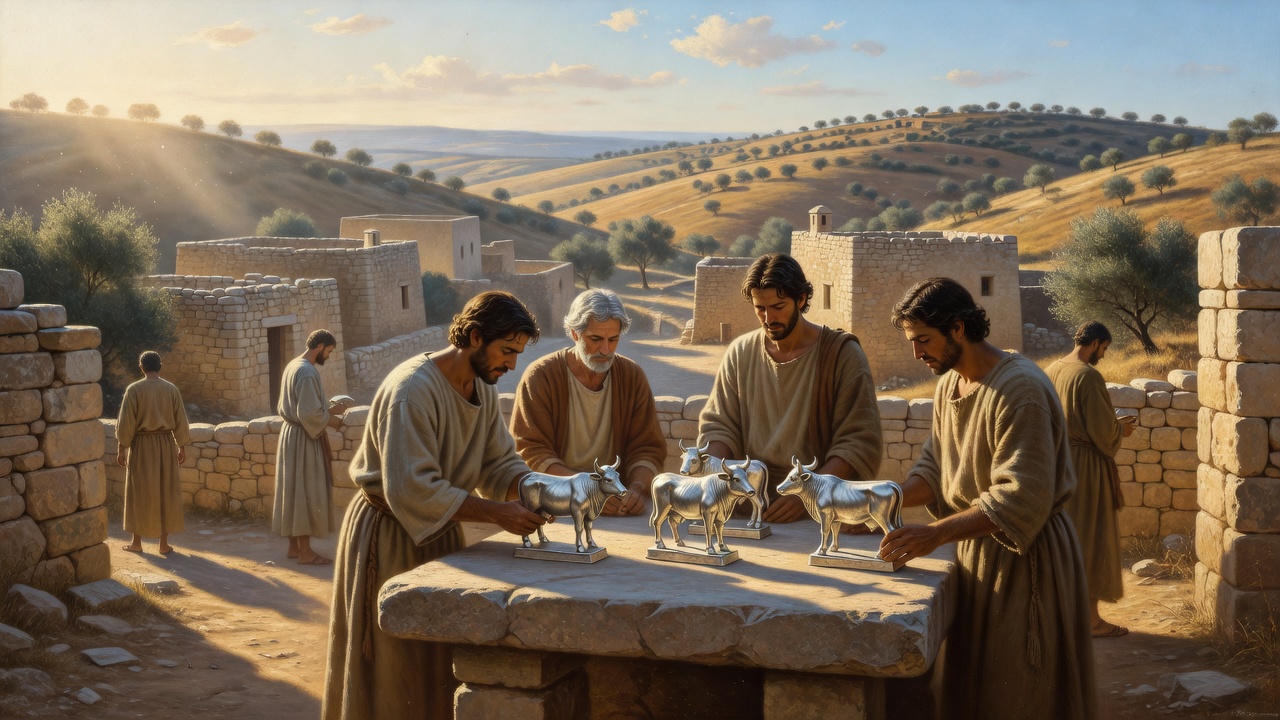
1When Ephraim speaketh tremblingly, He hath been lifted up in Israel, When he becometh guilty in Baal he dieth. 2And now do they add to sin, And make to them a molten image of their silver, By their own understanding — idols, A work of artisans — all of it, Of them they say, who [are] sacrificers among men, 'The calves let them kiss.' 3Therefore they are as a cloud of the morning, And as dew, rising early, going away, As chaff tossed about out of a floor, And as smoke out of a window. 4And I [am] Jehovah thy God from the land of Egypt, And a God besides Me thou dost not know, And a Saviour — there is none save Me. 5I — I have known thee in a wilderness, In a land of droughts. 6According to their feedings they are satiated, They have been satiated, And their heart is lifted up, Therefore they have forgotten Me, 7And I am to them as a lion, As a leopard by the way I look out. 8I do meet them as a bereaved bear, And I rend the enclosure of their heart.
Death and Resurrection
9And I consume them there as a lioness, A beast of the field doth rend them. 10Thou hast destroyed thyself, O Israel, But in Me [is] thy help, Where [is] thy king now — And he doth save thee in all thy cities? And thy judges of whom thou didst say, 'Give to me a king and heads?' 11I give to thee a king in Mine anger, And I take away in My wrath. 12Bound up [is] the iniquity of Ephraim, Hidden [is] his sin, 13Pangs of a travailing woman come to him, He [is] a son not wise, For he remaineth not the time for the breaking forth of sons. 14From the hand of Sheol I do ransom them, From death I redeem them, Where [is] thy plague, O death? Where thy destruction, O Sheol? Repentance is hid from Mine eyes.
Judgment on Samaria
15Though he among brethren produceth fruit, Come in doth an east wind, a wind of Jehovah, From a wilderness it is coming up, And it drieth up his fountain, And become dry doth his spring, It — it spoileth a treasure — every desirable vessel. 16Become desolate doth Samaria, Because she hath rebelled against her God, By sword they do fall, Their sucklings are dashed in pieces, And its pregnant ones are ripped up!
¿Sabías que…?
La caída de Efraín y Samaria
- Oseas 13 comienza recordando que Efraín, antes exaltado en Israel, provocó su propia ruina mediante la adoración a Baal. Baal era la principal divinidad masculina de los fenicios, y su culto influyó profundamente en las tribus del norte.Fuentes: el propio texto bíblico · Baal
- El capítulo recuerda que Dios había sido el Dios de Israel desde la tierra de Egipto y lo había cuidado en el desierto árido. Sin embargo, cuando el pueblo tuvo pastos y quedó saciado, su corazón se llenó de orgullo y olvidó a su protector.Fuentes: el propio texto bíblico · Egypt
- La profecía concluye con un anuncio de juicio contra Samaria, la ciudad capital establecida por el rey Omri en la colina de Somerón. Oseas declara que Samaria cargará con su culpa y sufrirá una violenta destrucción por haberse rebelado contra Dios.Fuentes: el propio texto bíblico · Samaria
Notas escritas con ayuda de IA a partir de fuentes abiertas (Theographic Bible Metadata, CC BY-SA 4.0; Easton’s Bible Dictionary, dominio público) y revisadas antes de publicarse.
Lugares de este capítulo
Solo aparecen lugares identificados con alta confianza (90 % o más según las fuentes académicas reunidas por OpenBible). Mapa de la época: DARE (Digital Atlas of the Roman Empire), CC BY 4.0; mapa actual: © colaboradores de OpenStreetMap; lugares: OpenBible.info (CC BY 4.0).
Créditos y licencia de esta traducción
Young's Literal Translation
Young's Literal Translation of the Holy Bible
Public Domain
Language: ENGLISH (English)
Dialect: archaic British
Translation by: Robert Young
This public domain Bible translation is brought to you courtesy of eBible.org.
If you would like to make a donation to help keep free Bible access like this going, please visit https://eBible.org/give.php .
2019-10-20
Títulos de sección adaptados de la Berean Standard Bible (dominio público); no forman parte del texto bíblico de esta traducción.
Fuente: http://ebible.org/engylt/ · eBible.org