Deuteronomio 21
Young's Literal Translation · Toca un versículo para ver sus referencias cruzadas.
Atonement for an Unsolved Murder
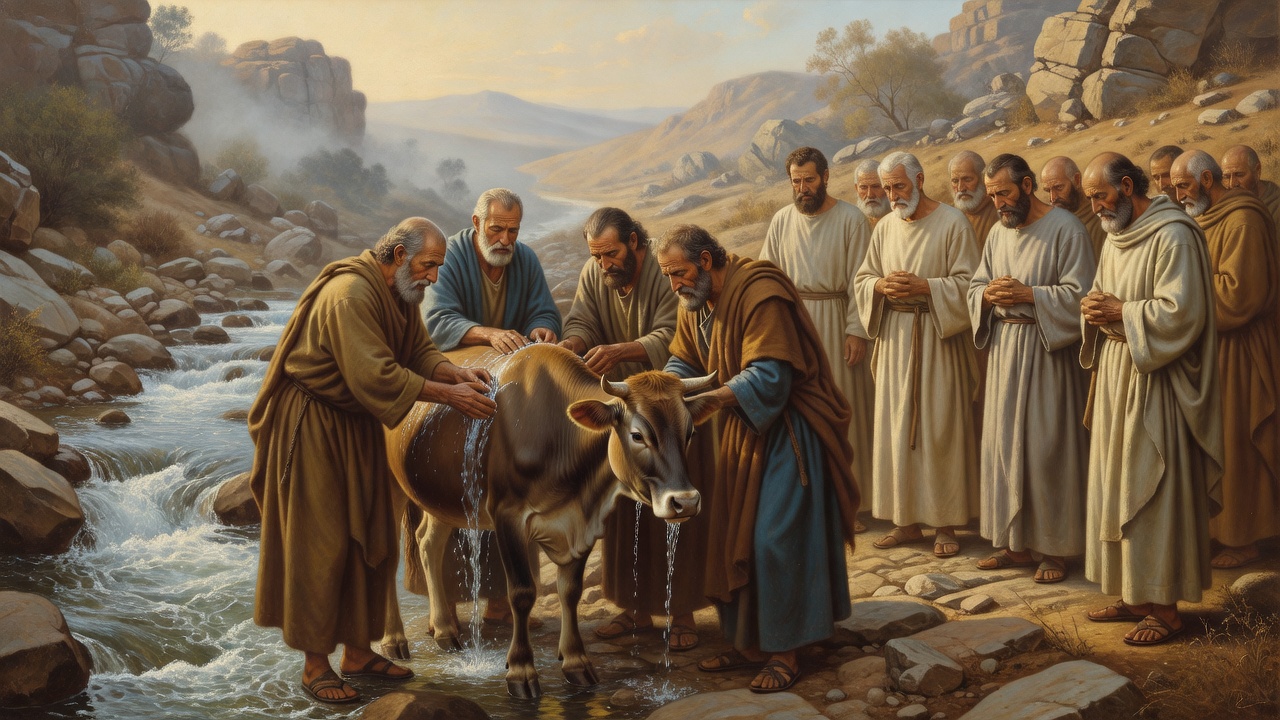
1'When one is found slain on the ground which Jehovah thy God is giving to thee to possess it — fallen in a field — it is not known who hath smitten him, 2then have thine elders and thy judges gone out and measured unto the cities which [are] round about the slain one, 3and it hath been, the city which [is] near unto the slain one, even the elders of that city have taken a heifer of the herd, which hath not been wrought with, which hath not drawn in the yoke, 4and the elders of that city have brought down the heifer unto a hard valley, which is not tilled nor sown, and have beheaded there the heifer in the valley. 5'And the priests, sons of Levi, have come nigh — for on them hath Jehovah thy God fixed to serve Him, and to bless in the name of Jehovah, and by their mouth is every strife, and every stroke — 6and all the elders of that city, who are near unto the slain one, do wash their hands over the heifer which is beheaded in the valley, 7and they have answered and said, Our hands have not shed this blood, and our eyes have not seen — 8receive atonement for Thy people Israel, whom Thou hast ransomed, O Jehovah, and suffer not innocent blood in the midst of Thy people Israel; and the blood hath been pardoned to them, 9and thou dost put away the innocent blood out of thy midst, for thou dost that which [is] right in the eyes of Jehovah.
Marrying a Captive Woman
10'When thou goest out to battle against thine enemies, and Jehovah thy God hath given them into thy hand, and thou hast taken captive its captivity, 11and hast seen in the captivity a woman of fair form, and hast delighted in her, and hast taken to thee for a wife, 12then thou hast brought her in unto the midst of thy household, and she hath shaved her head, and prepared her nails, 13and turned aside the raiment of her captivity from off her, and hath dwelt in thy house, and bewailed her father and her mother a month of days, and afterwards thou dost go in unto her and hast married her, and she hath been to thee for a wife: 14'And it hath been — if thou hast not delighted in her, that thou hast sent her away at her desire, and thou dost not at all sell her for money; thou dost not tyrannize over her, because that thou hast humbled her.
Inheritance Rights of the Firstborn
15'When a man hath two wives, the one loved and the other hated, and they have borne to him sons (the loved one and the hated one), and the first-born son hath been to the hated one; 16then it hath been, in the day of his causing his sons to inherit that which he hath, he is not able to declare first-born the son of the loved one, in the face of the son of the hated one — the first-born. 17But the first-born, son of the hated one, he doth acknowledge, to give to him a double portion of all that is found with him, for he [is] the beginning of his strength; to him [is] the right of the first-born.
A Rebellious Son
18'When a man hath a son apostatizing and rebellious — he is not hearkening to the voice of his father, and to the voice of his mother, and they have chastised him, and he doth not hearken unto them — 19then laid hold on him have his father and his mother, and they have brought him out unto the elders of his city, and unto the gate of his place, 20and have said unto the elders of his city, Our son — this one — is apostatizing and rebellious; he is not hearkening to our voice — a glutton and drunkard; 21and all the men of his city have stoned him with stones, and he hath died, and thou hast put away the evil out of thy midst, and all Israel do hear and fear.
Cursed Is Anyone Hung on a Tree
22'And when there is in a man a sin — a cause of death, and he hath been put to death, and thou hast hanged him on a tree, 23his corpse doth not remain on the tree, for thou dost certainly bury him in that day — for a thing lightly esteemed of God [is] the hanged one — and thou dost not defile thy ground which Jehovah thy God is giving to thee — an inheritance.
¿Sabías que…?
Justicia, derechos familiares y pureza comunitaria
- Cuando se encontraba a una persona asesinada en campo abierto sin que se supiera quién la mató, los ancianos de la ciudad más cercana debían realizar un ritual de expiación. En un valle no arado con agua corriente, se lavaban las manos sobre una novilla en presencia de los sacerdotes levitas para limpiar a la comunidad de la culpa de sangre.Fuentes: el propio texto bíblico
- Bajo las leyes de herencia, un padre no podía transferir los derechos de primogenitura a un hijo menor por favoritismo hacia una esposa amada. El hijo mayor, incluso si era de una esposa no amada, tenía la garantía legal de recibir una doble porción de los bienes de su padre.Fuentes: el propio texto bíblico
- Si el cuerpo de un criminal ejecutado era colgado de un árbol como advertencia pública, debía ser descolgado y enterrado antes del anochecer. La ley establecía que todo el que era colgado de un árbol estaba bajo la maldición de Dios, y dejar el cadáver durante la noche contaminaría la tierra.Fuentes: el propio texto bíblico
Notas escritas con ayuda de IA a partir de fuentes abiertas (Theographic Bible Metadata, CC BY-SA 4.0; Easton’s Bible Dictionary, dominio público) y revisadas antes de publicarse.
Créditos y licencia de esta traducción
Young's Literal Translation
Young's Literal Translation of the Holy Bible
Public Domain
Language: ENGLISH (English)
Dialect: archaic British
Translation by: Robert Young
This public domain Bible translation is brought to you courtesy of eBible.org.
If you would like to make a donation to help keep free Bible access like this going, please visit https://eBible.org/give.php .
2019-10-20
Títulos de sección adaptados de la Berean Standard Bible (dominio público); no forman parte del texto bíblico de esta traducción.
Fuente: http://ebible.org/engylt/ · eBible.org