Hechos 27
Young's Literal Translation · Toca un versículo para ver sus referencias cruzadas.
Paul Sails for Rome
1And when our sailing to Italy was determined, they were delivering up both Paul and certain others, prisoners, to a centurion, by name Julius, of the band of Sebastus, 2and having embarked in a ship of Adramyttium, we, being about to sail by the coasts of Asia, did set sail, there being with us Aristarchus, a Macedonian of Thessalonica, 3on the next [day] also we touched at Sidon, and Julius, courteously treating Paul, did permit [him], having gone on unto friends, to receive [their] care. 4And thence, having set sail, we sailed under Cyprus, because of the winds being contrary, 5and having sailed over the sea over-against Cilicia and Pamphylia, we came to Myria of Lycia, 6and there the centurion having found a ship of Alexandria, sailing to Italy, did put us into it, 7and having sailed slowly many days, and with difficulty coming over-against Cnidus, the wind not suffering us, we sailed under Crete, over-against Salmone, 8and hardly passing it, we came to a certain place called 'Fair Havens,' nigh to which was the city [of] Lasaea. 9And much time being spent, and the sailing being now dangerous — because of the fast also being already past — Paul was admonishing, 10saying to them, 'Men, I perceive that with hurt, and much damage, not only of the lading and of the ship, but also of our lives — the voyage is about to be;' 11but the centurion to the pilot and to the shipowner gave credence more than to the things spoken by Paul; 12and the haven being incommodious to winter in, the more part gave counsel to sail thence also, if by any means they might be able, having attained to Phenice, [there] to winter, [which is] a haven of Crete, looking to the south-west and north-west,
The Storm at Sea
13and a south wind blowing softly, having thought they had obtained [their] purpose, having lifted anchor, they sailed close by Crete, 14and not long after there arose against it a tempestuous wind, that is called Euroclydon, 15and the ship being caught, and not being able to bear up against the wind, having given [her] up, we were borne on, 16and having run under a certain little isle, called Clauda, we were hardly able to become masters of the boat, 17which having taken up, they were using helps, undergirding the ship, and fearing lest they may fall on the quicksand, having let down the mast — so were borne on. 18And we, being exceedingly tempest-tossed, the succeeding [day] they were making a clearing, 19and on the third [day] with our own hands the tackling of the ship we cast out, 20and neither sun nor stars appearing for more days, and not a little tempest lying upon us, thenceforth all hope was taken away of our being saved. 21And there having been long fasting, then Paul having stood in the midst of them, said, 'It behoved [you], indeed, O men — having hearkened to me — not to set sail from Crete, and to save this hurt and damage; 22and now I exhort you to be of good cheer, for there shall be no loss of life among you — but of the ship; 23for there stood by me this night a messenger of God — whose I am, and whom I serve — 24saying, Be not afraid Paul; before Caesar it behoveth thee to stand; and, lo, God hath granted to thee all those sailing with thee; 25wherefore be of good cheer, men! for I believe God, that so it shall be, even as it hath been spoken to me, 26and on a certain island it behoveth us to be cast.'
The Shipwreck
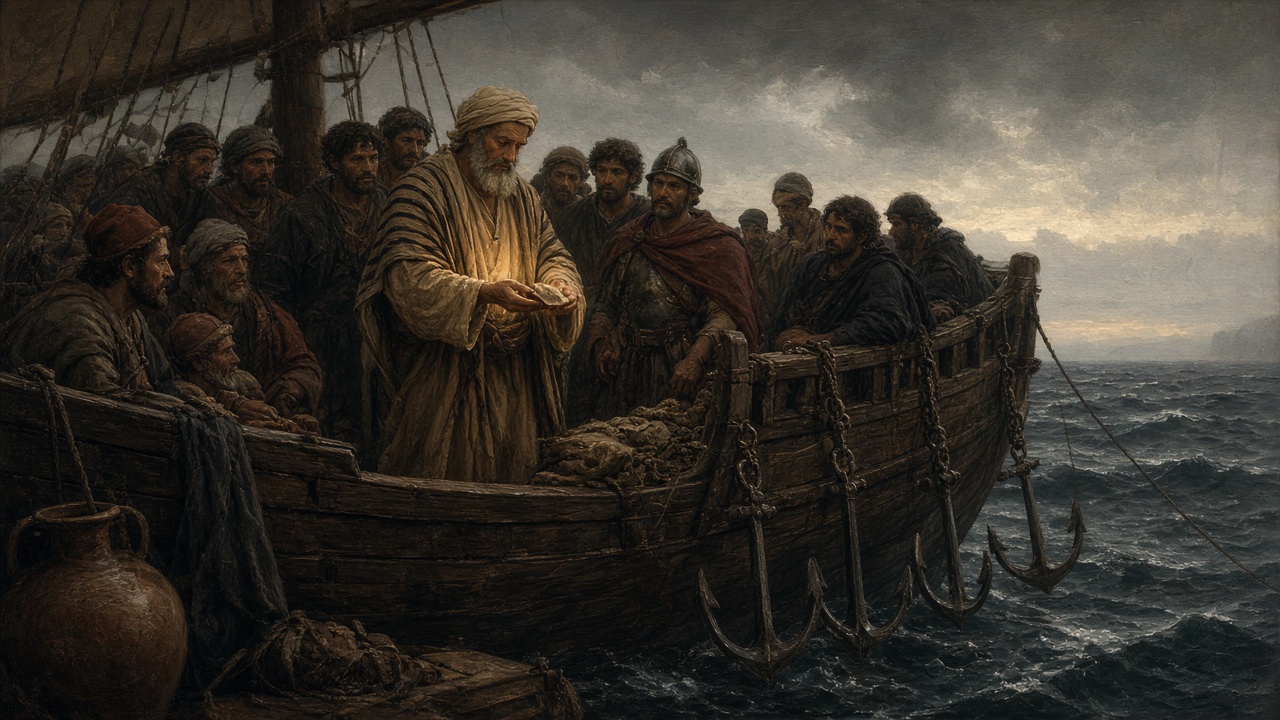
27And when the fourteenth night came — we being borne up and down in the Adria — toward the middle of the night the sailors were supposing that some country drew nigh to them; 28and having sounded they found twenty fathoms, and having gone a little farther, and again having sounded, they found fifteen fathoms, 29and fearing lest on rough places we may fall, out of the stern having cast four anchors, they were wishing day to come. 30And the sailors seeking to flee out of the ship, and having let down the boat to the sea, in pretence as [if] out of the foreship they are about to cast anchors, 31Paul said to the centurion and to the soldiers, 'If these do not remain in the ship — ye are not able to be saved;' 32then the soldiers did cut off the ropes of the boat, and suffered it to fall off. 33And till the day was about to be, Paul was calling upon all to partake of nourishment, saying, 'Fourteen days to-day, waiting, ye continue fasting, having taken nothing, 34wherefore I call upon you to take nourishment, for this is for your safety, for of not one of you shall a hair from the head fall;' 35and having said these things, and having taken bread, he gave thanks to God before all, and having broken [it], he began to eat; 36and all having become of good cheer, themselves also took food, 37(and we were — all the souls in the ship — two hundred, seventy and six), 38and having eaten sufficient nourishment, they were lightening the ship, casting forth the wheat into the sea. 39And when the day came, they were not discerning the land, but a certain creek were perceiving having a beach, into which they took counsel, if possible, to thrust forward the ship, 40and the anchors having taken up, they were committing [it] to the sea, at the same time — having loosed the bands of the rudders, and having hoisted up the mainsail to the wind — they were making for the shore, 41and having fallen into a place of two seas, they ran the ship aground, and the fore-part, indeed, having stuck fast, did remain immoveable, but the hinder-part was broken by the violence of the waves. 42And the soldiers' counsel was that they should kill the prisoners, lest any one having swam out should escape, 43but the centurion, wishing to save Paul, hindered them from the counsel, and did command those able to swim, having cast themselves out first — to get unto the land, 44and the rest, some indeed upon boards, and some upon certain things of the ship; and thus it came to pass that all came safe unto the land.
¿Sabías que…?
Tormenta y naufragio camino a Roma
- Pablo y los demás prisioneros no navegaron directo a Italia. En Cesarea abordaron un barco de Adramitio, ciudad de la costa de Misia, en Asia Menor, con rumbo a puertos a lo largo de la costa de Asia, nombre que el Easton's Bible Dictionary entiende en este versículo probablemente como Asia Menor, y ese barco los llevó solo hasta Mira, en Licia. Allí el centurión los hizo subir a un barco alejandrino que navegaba hacia Italia; el diccionario señala que era raro que un barco zarpara de cualquier puerto de Palestina directo a Italia.Fuentes: Adramyttium · Asia · el propio texto bíblico
- Los prisioneros fueron entregados a Julio, centurión del Regimiento Imperial. El Easton's Bible Dictionary lo identifica como centurión de la cohorte Augusta, o de la guardia personal del emperador, y describe el trato cortés que tuvo con Pablo. En Sidón, a unas veinticinco millas al norte de Tiro, le permitió visitar a sus amigos y recibir atención; más tarde impidió el plan de los soldados de matar a los prisioneros, para que se salvara la vida de Pablo.Fuentes: Julius · Sidon · el propio texto bíblico
- Después de Gnido, el barco avanzó a lo largo de Creta, una de las islas más grandes del Mediterráneo, de unas 140 millas de largo y 35 de ancho, que Pablo visitó en este viaje a Roma. El relato dice que el viaje ya se había vuelto peligroso porque era después del Ayuno, y que Buenos Puertos no era adecuado para invernar. Una cronología fecha el inicio del viaje a Roma en el año 56 d.C. y el naufragio en la tormenta en el 57 d.C.Fuentes: Crete · Journey to Rome begins · Paul is shipwrecked by a storm · el propio texto bíblico
Notas escritas con ayuda de IA a partir de fuentes abiertas (Theographic Bible Metadata, CC BY-SA 4.0; Easton’s Bible Dictionary, dominio público) y revisadas antes de publicarse.
Lugares de este capítulo
- Italy · 41.892, 12.485 · versículos 1, 6
- Adramyttium · Hoy: Oren · 39.501, 26.933 · versículo 2
- Asia · 38.400, 28.300 · versículo 2
- Thessalonica · Hoy: Thessaloniki · 40.638, 22.946 · versículo 2
- Sidon · Hoy: Sandikli archaeological site in Sidon · 33.561, 35.372 · versículo 3
- Cyprus · 35.000, 33.000 · versículo 4
- Cilicia · 36.913, 34.892 · versículo 5
- Lycia · 36.733, 29.900 · versículo 5
- Myra · 36.259, 29.985 · versículo 5
- Pamphylia · 37.000, 31.000 · versículo 5
- Alexandria · 31.183, 29.896 · versículo 6
- Cnidus · 36.686, 27.375 · versículo 7
- Crete · 35.310, 24.893 · versículos 7, 8, 12, 13, 14, 21
- Salmone · Hoy: Cape Sideros · 35.316, 26.312 · versículo 7
- Fair Havens · Hoy: Kaloi Limenes · 34.930, 24.800 · versículos 8, 12
- Lasea · Hoy: Lasaea · 34.941, 24.811 · versículo 8
- Cauda · Hoy: Gavdos · 34.833, 24.083 · versículo 16
- Syrtis · Hoy: Sidra · 31.500, 18.000 · versículo 17
- Adriatic Sea · Hoy: Adriatic and Ionian Seas · 38.000, 19.000 · versículo 27
Solo aparecen lugares identificados con alta confianza (90 % o más según las fuentes académicas reunidas por OpenBible). Mapa de la época: DARE (Digital Atlas of the Roman Empire), CC BY 4.0; mapa actual: © colaboradores de OpenStreetMap; lugares: OpenBible.info (CC BY 4.0).
Créditos y licencia de esta traducción
Young's Literal Translation
Young's Literal Translation of the Holy Bible
Public Domain
Language: ENGLISH (English)
Dialect: archaic British
Translation by: Robert Young
This public domain Bible translation is brought to you courtesy of eBible.org.
If you would like to make a donation to help keep free Bible access like this going, please visit https://eBible.org/give.php .
2019-10-20
Títulos de sección adaptados de la Berean Standard Bible (dominio público); no forman parte del texto bíblico de esta traducción.
Fuente: http://ebible.org/engylt/ · eBible.org