Marcos 12
Wycliffe's Bible with Modern Spelling (Enhanced) · Toca un versículo para ver sus referencias cruzadas.
The Parable of the Wicked Tenants
1And Jesus began to speak to them in parables. A man planted a vineyard, and set an hedge about it, and delved a pit, and builded a tower, and hired it (out) to earth-tillers, and went forth in pilgrimage, (or A man planted a vineyard, and set a hedge about it, and dug a hole for a winepress, and built a look-out tower, and hired it out to farmers, and went forth on a journey).
2And he sent to the earth-tillers in time a servant, to receive of the earth-tillers of the fruit of the vineyard. (And in time he sent a servant to the farmers, to receive from the farmers some of the fruit from the vineyard.)
3And they took him, and beat him, and left him void (or and let him go away empty).
4And again he sent to them another servant, and they wounded him in the head, and tormented him [or and punished him with chidings, or reprovings].
5And again he sent another, and they slew him, and others more, beating some, and slaying others [or soothly they killed others].
6But yet he had a most dearworthy son, and he sent him last to them, and said, Peradventure they shall dread [with reverence] my son, (or Perhaps they shall fear my son, or Surely they shall revere, or respect, my son).
7But the earth-tillers said together, [or Forsooth the tenants said to themselves], (or But the tenants said to each other), This is the heir; come ye, slay we him, and the heritage shall be ours. (But the farmers said to each other, He is the heir; come, let us kill him, and then the inheritance shall be ours.)
8And they took him, and killed him, and casted him out without the vineyard (or and threw him out of the vineyard).
9Then what shall the lord of the vineyard do? He shall come, and lose the earth-tillers (or and destroy the farmers), [or He shall come, and lose the tenants (or and destroy the tenants)], and give the vineyard to others.
10Whether ye have not read this scripture, The stone which the builders have despised, this is made into the head of the corner?
11This thing is done of the Lord, and it is wonderful in our eyes.
12And they sought to (take) hold (of) him, and they dreaded the people (or but they feared the people); for they knew that to them he (had) said this parable; and (so) they left him, and they went away.
Paying Taxes to Caesar
13And they sent to him some of the Pharisees and (some) of the Herodians, to take him in word (or to catch him with his own words).
14Which came, and said to him, Master, (or Teacher), we know that thou art soothfast, and reckest not (or takest no heed) of any man; for neither thou beholdest into the face of any man, but thou teachest the way of God in truth. Is it leaveful that tribute be given to the emperor, or we shall not give? (or Is it lawful to pay taxes to Caesar, or should we not pay them?)
15Which witting their privy falseness, said to them, What tempt ye me, [hypocrites]? (or Why do you hypocrites test me?) bring ye to me a penny, (so) that I (can) see (it).
16And they brought (it) to him. And he said to them, Whose is this image, and the writing above (or upon it)? And they say to him, The emperor’s [or Caesar’s].
17And Jesus answered and said to them, Then yield ye to the emperor those things that be the emperor’s [or Therefore yield ye to Caesar those things that be of Caesar]; and to God those things that be of God. And they wondered of him (or And they wondered about him).
The Sadducees and the Resurrection
18And (some) Sadducees, that say that there is no resurrection, came to him, and asked him, and said,
19Master, (or Teacher), Moses wrote to us, that if the brother of a man were dead, and left his wife, and have no sons, his brother take his wife, and raise up seed to his brother.
20Then seven brethren there were, [or Therefore seven brethren were], (or And so there were seven brothers); and the first took a wife, and died, and left no seed.
21And the second took her, and died, and neither he left seed. And the third also.
22And in like manner the seven took her, and left no seed. And the woman the last of all died.
23Then in the resurrection, when they shall rise again, whose wife of these shall she be? for seven had her to wife.
24And Jesus answered, and said to them, Whether ye err not therefore, that ye know not [the] scriptures, neither the virtue of God? (And Jesus answered, and said to them, And so do ye not err, because ye know not the Scriptures, nor the power of God?)
25For when they shall rise again from death, neither they shall wed, nor shall be wedded, but they shall be as (the) angels of God in heavens. [+Forsooth when they shall rise again from (the) dead, neither they shall wed, neither shall be wedded, but they shall be as (the) angels of God in heaven.]
26And of dead men, that they rise again, have ye not read in the book of Moses, on the bush (or in the bush), how God spake to him, and said, I am God of Abraham, and God of Isaac, and God of Jacob?
27He is not (the) God of dead men, but of living men; therefore ye err much.
The Greatest Commandment
28And one of the scribes, that had heard them disputing together, came nigh, and saw that Jesus had well-answered them, and asked him, [or and seeing that he had answered them well, asked him], which was the first commandment of all (or which is the first, or the greatest, commandment of all?).
29And Jesus answered to him, That the first commandment of all is, Hear thou, Israel, thy Lord God is one God, [or Hear, Israel, the Lord thy God is one God]; (And Jesus answered to him, The first, or the greatest, commandment of all is this, Hear O Israel, the Lord thy God is one God;)
30and thou shalt love thy Lord God of all thine heart, and of all thy soul, and of all thy mind, and of all thy might, [or and thou shalt love the Lord thy God of all thine heart, and of all thy soul, and of all thy mind, and of all thy virtue, or might, or strength]. This is the first commandment (or This is the first, or the greatest, commandment of all).
31And the second is like to this, Thou shalt love thy neighbour as thyself. There is none other commandment greater than these.
32And the scribe said to him, Master, (or Teacher), in truth thou hast well said; for one God is (or for there is but one God), and there is none other, except him;
33[and] that he be loved of all the heart, and of all the mind, and of all the understanding, and of all the soul, and of all the strength, and to love the neighbour as himself, is greater, [or and to love thy neighbour as himself, is more], than all burnt offerings and sacrifices.
34And Jesus seeing that he had answered wisely, said to him, Thou art not far from the kingdom of God. And then no man durst ask him more anything (or And then no one dared to ask him anything more).
Whose Son Is the Christ?
35And Jesus answered and said, teaching in the temple, How say [the] scribes, that Christ is the son of David? (And Jesus said, teaching in the Temple, How can the scribes say, that the Messiah is the Son of David?)
36For David himself said in the Holy Ghost, The Lord said to my lord, Sit [thou] on my right half, till I put thine enemies the stool of thy feet. (For David himself said by the Holy Spirit, The Lord said to my Lord, Sit thou at my right hand, or on my right side, until I make thine enemies thy footstool.)
37Then if David himself calleth him Lord, how then is he his son? And much people gladly heard him.
Beware of the Scribes
38And he said to them in his teaching, Be ye ware of (the) scribes, that will wander [or that will go] (about) in stoles, and be saluted in [the] chapping (or and be respectfully greeted at the market),
39and sit in synagogues in the first chairs [or and sit in the first chairs in synagogues], and in the first sitting places in suppers;
40which devour the houses of widows under [the] colour of long prayer; they shall take the longer doom, [either (the longer) damnation], (or they shall receive the greater condemnation).
The Widow’s Offering
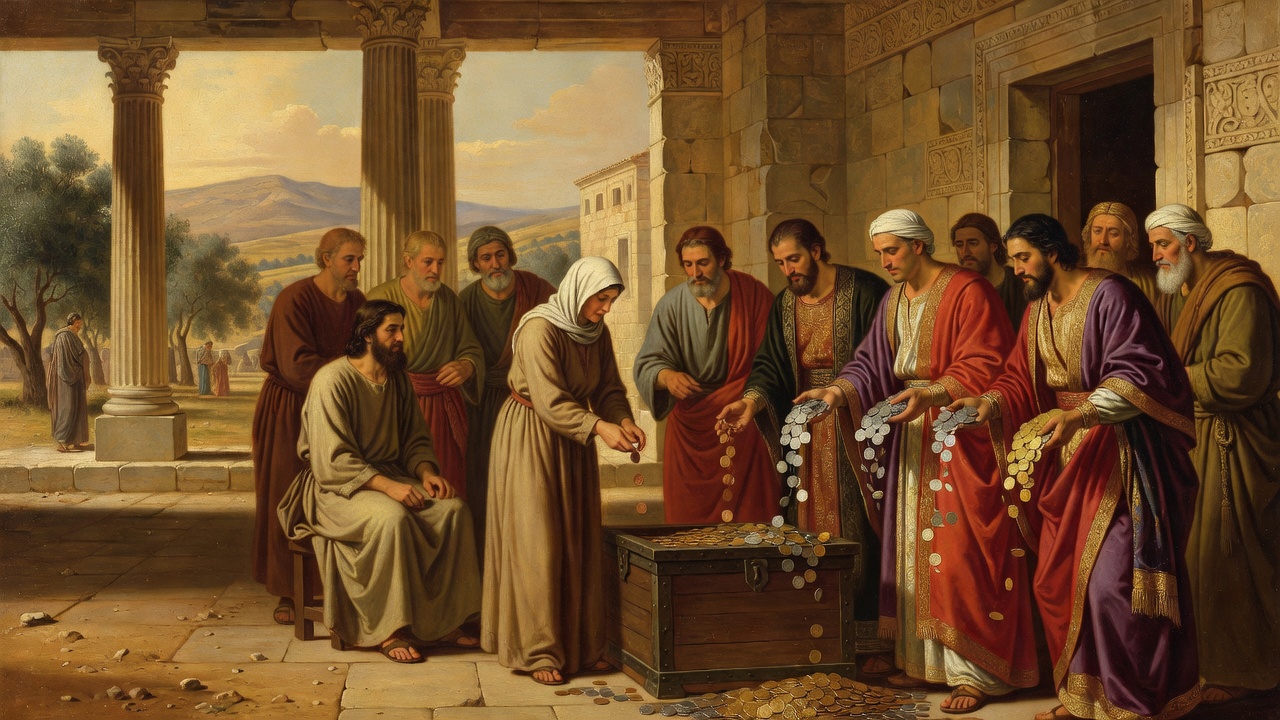
41And Jesus sitting against (or opposite) the treasury, beheld how the people cast money into the treasury; and many rich men casted many things.
42But when a poor widow was come, she cast two minutes (or she threw in two mites), that is, a farthing.
43And he called together his disciples, and said to them, Truly I say to you (or I tell you the truth), that this poor widow cast more than all, that cast into the treasury.
44For all they cast of that thing that they had plenty of; but this (out) of her poverty cast all things that she had, all her livelode, [or all her lifelode], (or all her livelihood).
¿Sabías que…?
Debates en el templo
- Los saduceos, que dicen que no hay resurrección, interrogan a Jesús sobre siete hermanos y una viuda, apelando a lo que escribió Moisés. Él los remite a la zarza ardiente en el Libro de Moisés, donde Dios dice: “Yo soy el Dios de Abraham, el Dios de Isaac y el Dios de Jacob”. Abraham, “padre de una multitud”, era hijo de Taré; Isaac era el único hijo de Abraham con Sara; y Jacob era el segundo de los hijos gemelos de Isaac y Rebeca.Fuentes: el propio texto bíblico · Abraham · Isaac · Jacob (Israel)
- Cuando le preguntan cuál es el mandamiento más importante, Jesús comienza: “Oye, Israel, el Señor nuestro Dios, el Señor es uno”, y añade: “Ama a tu prójimo como a ti mismo”. Israel es otro nombre de Jacob, el segundo de los gemelos de Isaac y Rebeca; el nombre Jacob se explica como el que sigue los talones de otro, o suplantador.Fuentes: el propio texto bíblico · Jacob (Israel)
- Mientras enseña en los atrios del templo, Jesús pregunta cómo pueden decir los escribas que el Cristo es el Hijo de David, si el propio David lo llama “Señor”. David, cuyo nombre significa “Amado”, era el octavo y el menor de los hijos de Isaí, ciudadano de Belén, y su primera ocupación fue cuidar las ovejas de su padre en las tierras altas de Judá.Fuentes: el propio texto bíblico · David
Notas escritas con ayuda de IA a partir de fuentes abiertas (Theographic Bible Metadata, CC BY-SA 4.0; Easton’s Bible Dictionary, dominio público) y revisadas antes de publicarse.
Créditos y licencia de esta traducción
Wycliffe's Bible with Modern Spelling (Enhanced)
English: Wycliffe's Bible Modern Spelling (Enhanced) (with Deuterocanon)
Copyright © 2001,2010,2011,2012,2013,2015 Terry Noble
Language: English
Dialect: Archaic
Translation by: Terry Noble
Wycliffe's Bible with Modern Spelling (Enhanced)
Wycliffe’s Bible with Modern Spelling (Enhanced) is a composite of my Wycliffe’s Bible, a modern-spelling version of the 14th century Middle English translation, consisting of Wycliffe’s Old Testament and Wycliffe’s New Testament, and my modern-spelling version of Wycliffe’s Apocrypha. These books contain literally tens of thousands of rewritten verses, presented in parentheses “( ) “, to provide help in comprehending the 14th century Middle English vocabulary and grammar. Wycliffe’s Apocrypha also includes the books of the Apocrypha from the 1st edition of the King James Version of the Bible.
This translation is made available to you under the terms of the
Creative Commons Attribution-Noncommercial-No Derivatives license 4.0.
You may share and redistribute this Bible translation or extracts from it in any format, provided that:
You include the above copyright and source information.
You do not sell this work for a profit.
You do not change any of the words or punctuation of the Scriptures.
Pictures included with Scriptures and other documents on this site are licensed just for use with those Scriptures and documents.
For other uses, please contact the respective copyright owners.
2019-09-25
Títulos de sección adaptados de la Berean Standard Bible (dominio público); no forman parte del texto bíblico de esta traducción.
Fuente: http://ebible.org/engwyc2018/ · eBible.org