Lucas 7
Wycliffe's Bible with Modern Spelling (Enhanced) · Toca un versículo para ver sus referencias cruzadas.
The Faith of the Centurion
1And when he had fulfilled all his words into the ears of the people (or And when he had finished all his words to the people), he entered into Capernaum.
2But a servant of a centurion, that was precious to him, was sick, and drawing to the death.
3And when he had heard of Jesus, he sent to him the elder men of (the) Jews, and prayed him (or beseeched him), that he would come, and heal his servant.
4And when they came to Jesus, they prayed him busily (or they earnestly beseeched him), and said to him, For he is worthy, (so) that thou grant to him this thing;
5for he loveth our folk, and he builded to us a synagogue. (for he loveth our nation and our people, and he hath built a synagogue for us.)
6And Jesus went with them. And when he was not far from the house, the centurion sent to him (his) friends, and said, Lord, do not thou be travailed, (or And when he was not far from the house, the centurion sent his friends to him, and said, Lord, do not be troubled), for I am not worthy, that thou enter under my roof;
7for which thing I deemed not myself worthy, that I come to thee; but say thou by word, and my child shall be healed. (for that reason I judged myself not worthy, that I should come to thee; but say thou the word, and my servant shall be healed.)
8For I am a man ordained under power, and have knights under me (or and have soldiers under me); and I say to this, Go, and he goeth, and to another, Come, and he cometh, and to my servant, Do this thing, and he doeth [it].
9And when this thing was heard, Jesus wondered; [and he turned], and said to the people (pur)suing him, Truly I say to you, neither in Israel (have) I found so great faith, [or not in Israel (have) I found so great faith], (or and he turned, and said to the people following him, I tell you the truth, I have not found such great faith in Israel).
10And they that were sent, turned again home, and found the servant whole, that was sick. (And they who were sent, returned home, and found the servant healed, who was sick.)
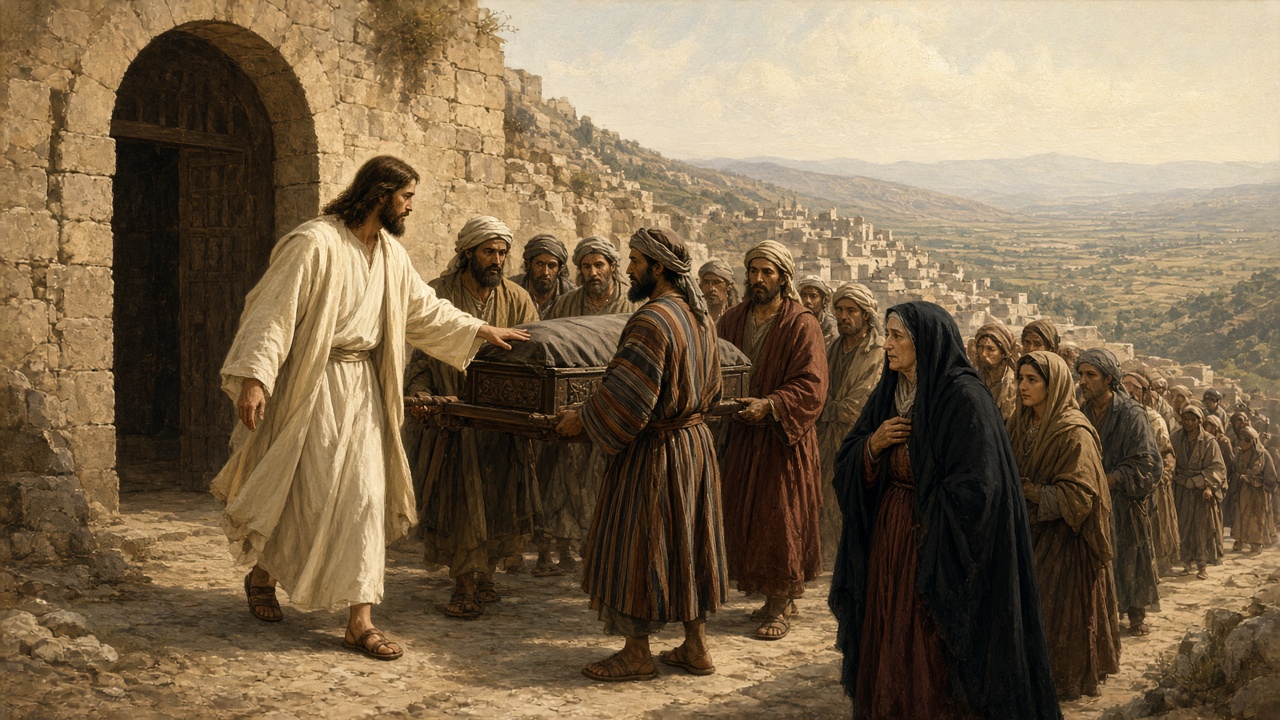
Jesus Raises a Widow’s Son
11And it was done afterward, Jesus went into a city, that is called Nain, and his disciples; and full great people went with him. [+And it was done afterward Jesus went into a city, that is called Nain, and his disciples went with him, and a full great company of people.]
12And when he came nigh to the gate of the city (or And when he came near to the city gate), lo! the son of a woman that had no more children, was borne out dead, [or lo! an only son of his mother was borne out dead]; and this was a widow; and much people of the city [was] with her.
13And when the Lord Jesus had seen her, he had ruth on her, [or he (was) moved by mercy on her], (or he had compassion for her), and said to her, Do not thou weep.
14And he came nigh, and touched the bier; and they that bare the bier stood (there). And he said, Young man, I say to thee, rise up.
15And he that was dead sat up again [or And he that was dead sat up], and began to speak; and he gave him (back) to his mother.
16And dread took all men (or And fearful reverence took hold of everyone), and they magnified God, and said, For a great prophet is risen among us, and, For God hath visited his people.
17And this word went out of him into all Judea (or And this story about him went out into all Judea), and into all the country (side) about.
John’s Inquiry
18And John’s disciples told him of all these things.
19And John called twain of his disciples, and sent them to Jesus, and said, Art thou he that is to come, or abide we another? (or Art thou he who is to come, or do we wait for another?)
20And when the men came to him, they said, John (the) Baptist sent us to thee, and said, Art thou he that is to come, or (do) we abide another?
21And in that hour he healed many men of their sicknesses, and wounds, and [of] evil spirits (or and from evil spirits); and he gave sight to many blind men.
22And Jesus answered, and said to them, Go ye again, and tell ye to John those things that ye have heard and seen; blind men see, crooked men go, mesels be made clean, deaf men hear, dead men rise again, poor men be taken to preaching of the gospel, (or the blind see, the lame walk, the lepers be cleansed, the deaf hear, the dead rise again, the poor be taken to the preaching of the Gospel or the Good News).
23And he that shall not be caused to stumble in me, is blessed.
Jesus Testifies about John
24And when the messengers of John were gone forth, he began to say of John to the people, What went ye out into (the) desert to see? a reed wagged with the wind? [And when the messengers of John had gone away, he began to say of John to the companies, What went ye out into (the) desert to see? a reed waved with the wind?]
25But what went ye out to see? a man clothed with soft clothes? Lo! they that be in [a] precious cloth, (or Behold! those who wear expensive clothing), and (be) in delights, be in kings’ houses.
26But what went ye out to see? a prophet? Yea, I say to you, and more than a prophet.
27This is he, of whom it is written, Lo! I send mine angel before thy face, which shall make ready thy way before thee.
28Certainly I say to you, there is no man a more prophet among the children of women, than is John (the) Baptist, [or Soothly I say to you, among the children of women, no man is (a) more prophet (or is a greater prophet) than John (the) Baptist]; but he that is less in the kingdom of heavens, is more than he. (Truly I say to you, or I tell you the truth, no man is a greater prophet among the children of women, than is John the Baptist; but whoever is the least in the Kingdom of Heaven, is greater than he.)
29And all the people hearing, and publicans (or and tax-collectors), that had been baptized with the baptism of John, justified God;
30but the Pharisees and the wise men of the law, that were not baptized of him, despised the counsel of God against themselves. (but the Pharisees and the men wise in the Law, who were not baptized by him, rejected God’s plan or purpose for themselves.)
31And the Lord said, Therefore to whom shall I say men of this generation like, and to whom be they like?
32They be like to children sitting in the chapping (or at the market), and speaking together, and saying, We have sung to you with pipes, and ye have not danced; we have made mourning [or lamentation] and ye have not wept.
33For John (the) Baptist came, neither eating bread, nor drinking wine, and ye say, He hath a fiend, (or He hath a devil, or a demon).
34Man’s Son came eating and drinking, and ye say, Lo! a man a devourer [or a glutton], and drinking wine, a friend of publicans, and of sinful men, (or and ye say, Behold! a glutton, and a wine imbiber, a friend of tax-collectors, and of sinners).
35And wisdom is justified of [all] her sons. (And wisdom is justified by all of her sons.)
A Sinful Woman Anoints Jesus
36But one of the Pharisees prayed Jesus, that he should eat with him. And he entered into the house of the Pharisee, and sat at the meat. (But one of the Pharisees beseeched Jesus, that he would eat with him. And so he entered into the house of the Pharisee, and sat down for the meal.)
37And lo! a sinful woman, that was in the city, as she knew, that Jesus sat at [the] meat (or sat down for a meal) in the house of the Pharisee, she brought an alabaster box of ointment;
38and she stood behind beside his feet, and began to moist (en) his feet with (her) tears, and wiped [them] with the hairs of her head, and kissed his feet, and anointed (them) with ointment.
39And the Pharisee seeing, that had called him, said within himself, saying, If this were a prophet, he should know, who and what manner woman it were that toucheth him, [or If this were a prophet, soothly he should know, who and what manner woman it is that toucheth him], for she is a sinful woman.
40And Jesus answered, and said to him, Simon, I have something to say to thee. And he said, Master, say thou, (or Teacher, tell me).
41And he answered, Two debtors were to one lender; and one owed five hundred pence, and the other fifty;
42but when they had not whereof to yield, he forgave [freely] to both. Who [of them] then loveth him more?
43Simon answered, and said, I guess, that he to whom he forgave more. And he answered to him, Thou hast deemed rightly (or Thou hast judged correctly).
44And he turned to the woman, and said to Simon, Seest thou this woman? I entered into thine house, thou gavest no water to my feet (or thou gavest me no water for my feet); but this [woman] hath moist (en)ed my feet with (her) tears, and wiped (them) with her hairs.
45Thou hast not given to me a kiss; but this [woman], since she entered [or since I entered], ceased not to kiss my feet.
46Thou anointedest not mine head with oil; but this anointed my feet with ointment.
47For which thing I say to thee, many sins be forgiven to her, for she hath loved much; and to whom is less forgiven, he loveth less.
48And Jesus said to her, Thy sins be forgiven to thee.
49And they that sat together at the meat (or And they who sat together at the meal), began to say within themselves, Who is this that [also], (or who even), forgiveth sins.
50But he said to the woman, Thy faith hath made thee safe; go thou in peace, (or Thy faith hath saved thee; go in peace).
¿Sabías que…?
Fe, compasión y la pregunta de un profeta
- El Easton's Bible Dictionary (1897) describe Capernaúm como una ciudad de Galilea que no se menciona en el Antiguo Testamento y que llegó a ser la ciudad que Jesús trataba como suya después de ser expulsado de Nazaret, escenario de muchos episodios de su vida. En este capítulo llega allí y encuentra al siervo muy estimado de un centurión a punto de morir; unos ancianos judíos ruegan, diciendo que el oficial ama a su nación y ha construido su sinagoga.Fuentes: Capernaum · el propio texto bíblico
- El Easton's Bible Dictionary (1897) relaciona el nombre Naín con una palabra hebrea que significa pastos verdes o hermoso, e identifica el pueblo con la aldea de Nein, en la ladera noroeste del Jebel ed-Duhy, llamado también la colina de Moré o el Pequeño Hermón, a unas cuatro millas de Tabor y veinticinco millas al suroeste de Capernaúm, sobre la llanura de Esdraelón. A la puerta del pueblo, Jesús se encontró con el funeral del hijo único de una viuda, y el asombro se extendió por la multitud.Fuentes: Nain · el propio texto bíblico
- Juan el Bautista es presentado como el precursor del Señor y como hombre de linaje sacerdotal: su padre, Zacarías, era sacerdote del turno de Abías, y su madre, Elisabet, era una de las hijas de Aarón. Su misión se describe como objeto de profecía, y en este capítulo Jesús dice a las multitudes que Juan es más que un profeta, el mensajero enviado por delante para preparar el camino, mientras los discípulos de Juan preguntan si Jesús es el que había de venir.Fuentes: John the Baptist · el propio texto bíblico
Notas escritas con ayuda de IA a partir de fuentes abiertas (Theographic Bible Metadata, CC BY-SA 4.0; Easton’s Bible Dictionary, dominio público) y revisadas antes de publicarse.
Lugares de este capítulo
- Nain · Hoy: Nein · 32.631, 35.350 · versículo 11
- Judea · Hoy: Judea 1 · 31.777, 35.234 · versículo 17
Solo aparecen lugares identificados con alta confianza (90 % o más según las fuentes académicas reunidas por OpenBible). Mapa de la época: DARE (Digital Atlas of the Roman Empire), CC BY 4.0; mapa actual: © colaboradores de OpenStreetMap; lugares: OpenBible.info (CC BY 4.0).
Créditos y licencia de esta traducción
Wycliffe's Bible with Modern Spelling (Enhanced)
English: Wycliffe's Bible Modern Spelling (Enhanced) (with Deuterocanon)
Copyright © 2001,2010,2011,2012,2013,2015 Terry Noble
Language: English
Dialect: Archaic
Translation by: Terry Noble
Wycliffe's Bible with Modern Spelling (Enhanced)
Wycliffe’s Bible with Modern Spelling (Enhanced) is a composite of my Wycliffe’s Bible, a modern-spelling version of the 14th century Middle English translation, consisting of Wycliffe’s Old Testament and Wycliffe’s New Testament, and my modern-spelling version of Wycliffe’s Apocrypha. These books contain literally tens of thousands of rewritten verses, presented in parentheses “( ) “, to provide help in comprehending the 14th century Middle English vocabulary and grammar. Wycliffe’s Apocrypha also includes the books of the Apocrypha from the 1st edition of the King James Version of the Bible.
This translation is made available to you under the terms of the
Creative Commons Attribution-Noncommercial-No Derivatives license 4.0.
You may share and redistribute this Bible translation or extracts from it in any format, provided that:
You include the above copyright and source information.
You do not sell this work for a profit.
You do not change any of the words or punctuation of the Scriptures.
Pictures included with Scriptures and other documents on this site are licensed just for use with those Scriptures and documents.
For other uses, please contact the respective copyright owners.
2019-09-25
Títulos de sección adaptados de la Berean Standard Bible (dominio público); no forman parte del texto bíblico de esta traducción.
Fuente: http://ebible.org/engwyc2018/ · eBible.org