Lucas 15
Wycliffe's Bible with Modern Spelling (Enhanced) · Toca un versículo para ver sus referencias cruzadas.
The Parable of the Lost Sheep
1And publicans and sinful men were nighing to him, to hear him. (And tax-collectors and sinners were coming near to him, to listen to him.)
2And the Pharisees and (the) scribes grudged, saying, For this [man] receiveth sinful men, and eateth with them. (And the Pharisees and the scribes grumbled, saying, For this man welcometh sinners, and eateth with them.)
3And he spake to them this parable, and said,
4What man of you that hath an hundred sheep, and if he hath lost one of them, whether he leaveth not ninety and nine in (the) desert, and goeth to it that perished, till he find it? (or and goeth after that which is lost, until he find it?)
5And when he hath found it, he joyeth, and layeth [or putteth] it on his shoulders;
6and he cometh home, and calleth together his friends and neighbours, and saith to them, Be ye glad with me, for I have found my sheep, that had perished [or that I had lost].
7And I say to you, so joy shall be in heaven on one sinful man doing penance, more than on ninety and nine just, that have no need to penance [or that have no need of penance]. (And I tell you, there shall be more joy in heaven over one sinner repenting, than over ninety-nine righteous men, who have no need of repentance.)
The Parable of the Lost Coin
8Or what woman having ten bezants [or ten drachmas], and if she hath lost one bezant [or one drachma], whether she tendeth not [or she lighteth not] a lantern, and turneth upside-down the house, and seeketh diligently, till she find it?
9And when she hath found (it), she calleth together (her) friends and neighbours, and saith, Be ye glad with me, for I have found the bezant [or the drachma] that I had lost.
10So I say to you, joy shall be before the angels of God on one sinful man doing penance. (So I tell you, there is joy among the angels of God over one sinner repenting.)
The Parable of the Prodigal Son
11And he said, A man had two sons;
12and the younger of them said to the father [or and the younger said to his father], Father, give me the portion of (the) chattel [or of (the) substance] that falleth to me. And he parted to them the chattel [or the substance], (or And he divided the goods between them).
13And not after many days, when all things were gathered together, the younger son went forth in pilgrimage into a far country; and there he wasted his goods [or his substance] in living lecherously.
14And after that he had ended all things, a strong hunger was made in that country, and he began to have need.
15And he went, and drew him (self) to one of the citizens of that country. And he sent him into his town, to feed swine, (or to feed his pigs), [or (so) that he should feed hogs].
16And he coveted to fill his womb of the pods that the hogs ate, and no man gave (anything) to him. (And he desired to fill his belly with the pods which the pigs ate, but no one gave him anything to eat.)
17And he turned again to himself, and said, How many hired men in my father’s house have plenty of loaves; and I perish here through hunger.
18I shall rise up, and go to my father, and I shall say to him, Father, I have sinned (up) into heaven [or I have sinned against heaven], and before thee;
19and now I am not worthy to be called thy son, make me as one of thine hired men.
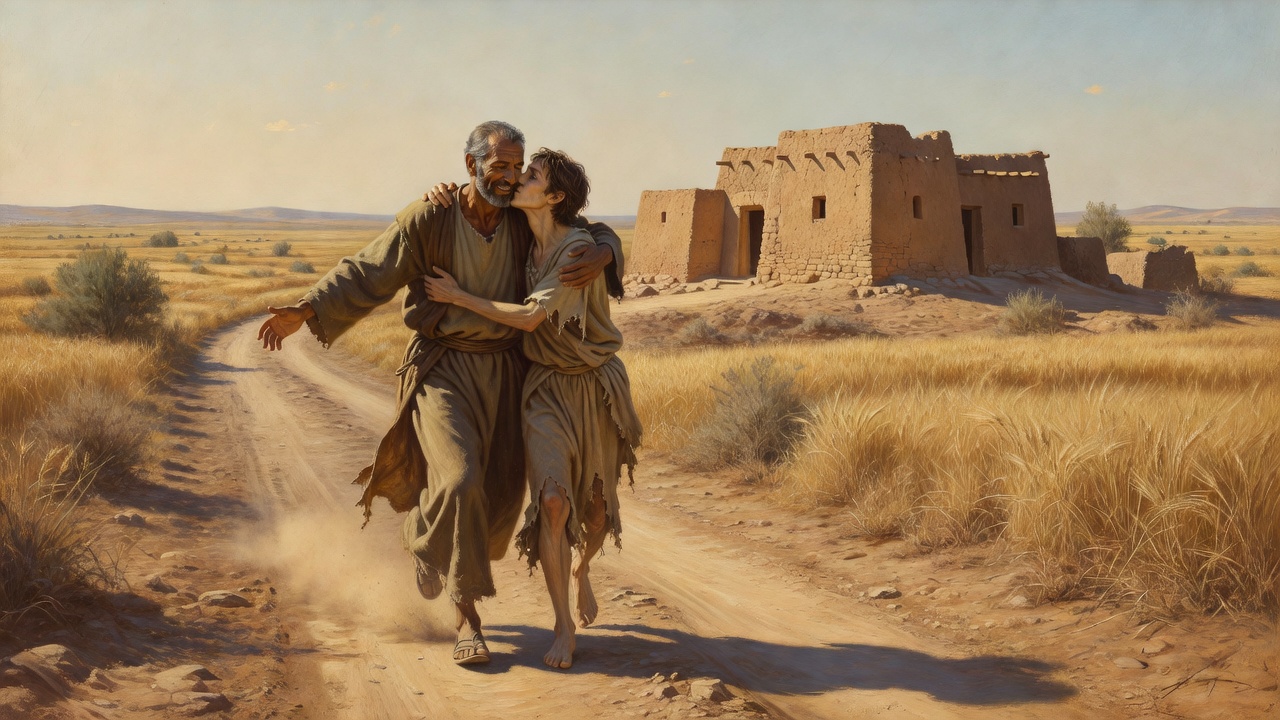
20And he rose up, and came to his father. And when he was yet afar, his father saw him, and was stirred by mercy. And he ran, and fell on his neck, and kissed him.
21And the son said to him, Father, I have sinned (up) into heaven [or I have sinned against heaven], and before thee; and now I am not worthy to be called thy son.
22And the father said to his servants, Swiftly bring ye forth the first stole, and clothe ye him, and give ye a ring in his hand (or and put a ring on his finger), and shoes on his feet;
23and bring ye a fat calf [or and bring ye a calf made fat], and slay ye, and eat we, and make we feast.
24For this my son was dead, and hath lived again; he perished (or he was lost), and is found. And all men began to eat [gladly].
25But his elder son was in the field; and when he came, and nighed to the house (or and approached the house), he heard a symphony and a crowd.
26And he called one of the servants, and asked, what these things were.
27And he said to him, Thy brother is come (home), and thy father slew a fat calf [or and thy father hath slain a fatted calf], for he received him safe (again).
28And he was wroth, and would not come in. Therefore his father went out, and began to pray him (or And so his father went out to him, and began to beseech him).
29And he answered to his father, and said, Lo! so many years I serve thee, and I never brake thy commandment (s); and thou never gave to me a kid, that I with my friends should have eaten.
30But after that this thy son, that hath devoured his substance with whores, came, thou hast slain to him a fat calf [or a fatted calf], (or thou hast killed a fatted calf for him).
31And he said to him, Son, thou art (for)evermore with me, (or Son, thou art always with me), and all my things be thine.
32But it behooved to make feast, and to have joy; for this thy brother was dead, and lived again [or and liveth again]; he perished, and is found, (or for thy brother was dead, but now he liveth again; he was lost, but now he is found).
¿Sabías que…?
Perdido y encontrado
- Los recaudadores de impuestos y los pecadores se estaban reuniendo para escuchar a Jesús, y los fariseos y los escribas comenzaron a murmurar que él acoge a los pecadores y come con ellos. Jesús entonces les contó parábolas sobre una oveja perdida, una moneda de plata perdida y un hijo perdido.Fuentes: el propio texto bíblico
- La enseñanza y la sanidad en Perea hacia Jerusalén se registran como comenzando en el año 30 d.C. con una duración de un día.Fuentes: Teaching and Healing in Perea to Jerusalem
Notas escritas con ayuda de IA a partir de fuentes abiertas (Theographic Bible Metadata, CC BY-SA 4.0; Easton’s Bible Dictionary, dominio público) y revisadas antes de publicarse.
Créditos y licencia de esta traducción
Wycliffe's Bible with Modern Spelling (Enhanced)
English: Wycliffe's Bible Modern Spelling (Enhanced) (with Deuterocanon)
Copyright © 2001,2010,2011,2012,2013,2015 Terry Noble
Language: English
Dialect: Archaic
Translation by: Terry Noble
Wycliffe's Bible with Modern Spelling (Enhanced)
Wycliffe’s Bible with Modern Spelling (Enhanced) is a composite of my Wycliffe’s Bible, a modern-spelling version of the 14th century Middle English translation, consisting of Wycliffe’s Old Testament and Wycliffe’s New Testament, and my modern-spelling version of Wycliffe’s Apocrypha. These books contain literally tens of thousands of rewritten verses, presented in parentheses “( ) “, to provide help in comprehending the 14th century Middle English vocabulary and grammar. Wycliffe’s Apocrypha also includes the books of the Apocrypha from the 1st edition of the King James Version of the Bible.
This translation is made available to you under the terms of the
Creative Commons Attribution-Noncommercial-No Derivatives license 4.0.
You may share and redistribute this Bible translation or extracts from it in any format, provided that:
You include the above copyright and source information.
You do not sell this work for a profit.
You do not change any of the words or punctuation of the Scriptures.
Pictures included with Scriptures and other documents on this site are licensed just for use with those Scriptures and documents.
For other uses, please contact the respective copyright owners.
2019-09-25
Títulos de sección adaptados de la Berean Standard Bible (dominio público); no forman parte del texto bíblico de esta traducción.
Fuente: http://ebible.org/engwyc2018/ · eBible.org