Job 15
Wycliffe's Bible with Modern Spelling (Enhanced) · Toca un versículo para ver sus referencias cruzadas.
Eliphaz: Job Does Not Fear God
1Then Eliphaz (the) Temanite answered, and said,
2Whether a wise man shall answer, as speaking against the wind, and shall fill his stomach with burning, that is ire? (Would a wise man answer someone, whose speaking is merely wind, and who filleth his stomach with hot air?)
3For thou reprovest him by words, which is not like thee, and thou speakest that, that speedeth not to thee. (For thou rebukest him with worthless words, and thou speakest, what profiteth thee not.)
4As much as is in thee, thou hast avoided dread; and thou hast taken away thy prayers before God. (As much as is possible, thou hast avoided fearing God or revering God; and thou hast not presented thy prayers to God.)
5For [thy] wickedness hath taught thy mouth, and thou followest the tongue of blasphemers.
6Thy tongue [or Thy mouth], and not I, shall condemn thee, and thy lips shall answer (against) thee.
7Whether thou art born the first man, and whether thou art formed before (the) little hills? (Art thou the first man born, and wast thou formed before the little hills?)
8Whether thou hast heard the counsel of God, and whether his wisdom is lower than thou? (or and is his wisdom less than thine?)
9What thing knowest thou, which we know not? What thing understandest thou, which we know not?
10Both wise men and eld (men), much elder than thy fathers (or much older than thy father), be among us.
11Whether it is great, that God comfort thee? But thy shrewd words forbid this. (Is it not wonderful, that God comforteth thee? But thy depraved words forbid this.)
12What raiseth thine heart thee, and thou as thinking great things hast eyes astonished? (What raiseth up thy heart, to think such great things? and why be thine eyes astonished?)
13What swelleth thy spirit against God, that thou bring forth of thy mouth such words? (What swelleth thy spirit against God, so that thou bring forth such words out of thy mouth?)
14What is a man, that he be without wem, and that he, born of a woman, appear just? (What is a man, is he ever pure, or without fault? yea, he, who is born of a woman, is he ever truly right before God?)
15Lo! none among his saints is unchangeable, (or Behold! no one among his saints is trustworthy), and (even the) heavens be not clean in his sight.
16How much more is a man abominable and unprofitable, that drinketh wickedness as water? (Then how much more abominable and unprofitable is man, who drinketh wickedness like water?)
17I shall show to thee, hear thou me; I shall tell to thee that, that I saw, (or I shall tell thee, what I saw).
18Wise men acknowledge, and hide (it) not their fathers. (The wise acknowledge it, and their forefathers hide it not.)
19To which wise men alone the earth is given, and an alien shall not pass by them. (To whom alone the land was given; and no foreigner lived among them.)
20A wicked man is proud in all his days; and the number of his years and of his tyranny is uncertain.
21The sound of dread is ever [more] in his ears, and when peace is, he supposeth ever [more] treasons. (A fearful sound is forever in his ears, and even when there is peace, he always expecteth an attack.)
22He believeth not that he may turn again from darknesses to light; and he beholdeth about on each side (for) a sword.
23When he stirreth him [self] to seek bread, he knoweth, that the day of darknesses is made ready in his hand, (or he knoweth that the day of darkness is at hand).
24Tribulation shall make him afeared, and anguish shall (en)compass him, as a king which is made ready to battle. (Tribulation shall make him afraid, and anguish shall surround him, like a king who is made ready for battle.)
25For he held forth his hand against God, and he was made strong against Almighty God. (For he put forth his hand against God, and he made himself strong against Almighty God.)
26He ran with his neck raised up against God, and he was armed with a fat noll. (He ran with his head raised up against God, and he was armed with a stiff neck, or he was stubborn.)
27Fatness, that is, pride of temporal abundance, covered his face, or understanding, and outward fatness, that is, unshamefastness, hangeth down of his sides (or hangeth down on his sides). [Fatness covered his face, and of his sides grease hangeth. (Fatness covered his face, and grease hangeth down on his sides.)]
28He shall dwell in desolate cities (or He shall live in empty cities), and in deserted houses, that be turned into burials.
29He shall not be made rich, neither his chattel shall dwell steadfastly (nor shall his substance, or his possessions, endure); neither he shall send his root into the earth,
30neither he shall go away from darknesses. Flame shall make dry his branches, and he shall be taken away by the spirit of his mouth. (nor shall he go away from darkness. The flame shall dry up his branches, and then he shall be taken away by the wind.)
31Believe he not vainly which is deceived by error, that he shall be again-bought by any price. (He, who is deceived by error, vainly believeth that he shall be bought back, or redeemed, at any price.)
32Before that his days be [ful] filled, he shall perish, and his hands shall wax dry;
33he shall be hurt as a vine in the first flower of his grape, and as an olive tree casting away his flower. (he shall be like a vine that droppeth off its unripe grapes, or like an olive tree that casteth away its flowering buds.)
34For the gathering together of an hypocrite is barren, and fire shall devour the tabernacles of them, that take gifts willfully. (For hypocrites, one and all, be barren, and fire shall devour the tents of those, who willingly take gifts.)
35He conceived sorrow, and childed wickedness, and his womb maketh ready treacheries.
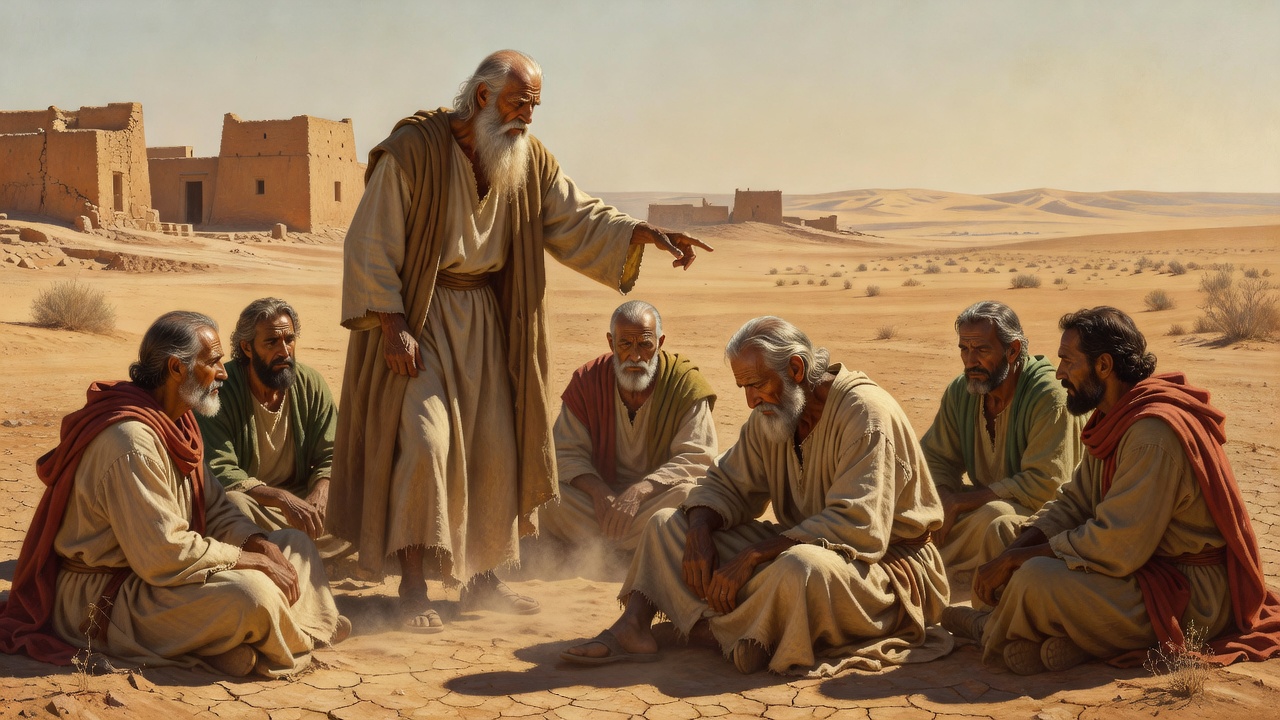
¿Sabías que…?
El segundo discurso de Elifaz y la sabiduría ancestral
- Elifaz acusa a Job de llenar su vientre con el viento del este, utilizando una conocida metáfora del antiguo Oriente Próximo sobre el viento abrasador del desierto que marchita la vegetación y trae devastación en lugar de sustento.Fuentes: el propio texto bíblico
- Para respaldar su postura de que los malvados sufren inevitablemente la ruina, Elifaz apela a la autoridad de ancianos de cabellos canos y a tradiciones transmitidas desde tiempos anteriores a la influencia de pueblos extranjeros.Fuentes: el propio texto bíblico · Eliphaz
Notas escritas con ayuda de IA a partir de fuentes abiertas (Theographic Bible Metadata, CC BY-SA 4.0; Easton’s Bible Dictionary, dominio público) y revisadas antes de publicarse.
Créditos y licencia de esta traducción
Wycliffe's Bible with Modern Spelling (Enhanced)
English: Wycliffe's Bible Modern Spelling (Enhanced) (with Deuterocanon)
Copyright © 2001,2010,2011,2012,2013,2015 Terry Noble
Language: English
Dialect: Archaic
Translation by: Terry Noble
Wycliffe's Bible with Modern Spelling (Enhanced)
Wycliffe’s Bible with Modern Spelling (Enhanced) is a composite of my Wycliffe’s Bible, a modern-spelling version of the 14th century Middle English translation, consisting of Wycliffe’s Old Testament and Wycliffe’s New Testament, and my modern-spelling version of Wycliffe’s Apocrypha. These books contain literally tens of thousands of rewritten verses, presented in parentheses “( ) “, to provide help in comprehending the 14th century Middle English vocabulary and grammar. Wycliffe’s Apocrypha also includes the books of the Apocrypha from the 1st edition of the King James Version of the Bible.
This translation is made available to you under the terms of the
Creative Commons Attribution-Noncommercial-No Derivatives license 4.0.
You may share and redistribute this Bible translation or extracts from it in any format, provided that:
You include the above copyright and source information.
You do not sell this work for a profit.
You do not change any of the words or punctuation of the Scriptures.
Pictures included with Scriptures and other documents on this site are licensed just for use with those Scriptures and documents.
For other uses, please contact the respective copyright owners.
2019-09-25
Títulos de sección adaptados de la Berean Standard Bible (dominio público); no forman parte del texto bíblico de esta traducción.
Fuente: http://ebible.org/engwyc2018/ · eBible.org