Jueces 17
Wycliffe's Bible with Modern Spelling (Enhanced) · Toca un versículo para ver sus referencias cruzadas.
Micah’s Idolatry
1In that time was a man, that was called Micah, of the hill of Ephraim. (At that time there was a man, who was called Micah, of the hill country of Ephraim.)
2And he said to his mother, Lo! I have a thousand and an hundred pieces of silver, which thou separatedest to thee, and on which thou cursedest, while I heard; and those be with me. To whom she answered, Blessed be my son of the Lord. (And he said to his mother, Thou haddest a thousand and a hundred pieces of silver that were taken from thee, and I heard thou curse him who robbed thee; behold! I was the one who took them. And she quickly said, May the Lord bless my son!)
3Therefore he yielded those to his mother; and she said to him, I hallowed and avowed this silver to the Lord, that my son receive (it out) of mine hand, and make (with it) a graven image and a molten image; and now I give it to thee. (And so he gave the silver back to his mother; and she said, I now hallow and vow this silver to the Lord, to protect my son from the curse, and I ask that ye, my son, have a carved idol, and a cast image, made from it; and now I give it to thee.)
4Therefore he yielded to his mother; and she took two hundred pieces of (the) silver, and gave those to a workman of silver, that he should make of those a graven image and (a) molten (image), that was (to be put) in the house of Micah. (And so he gave the silver back to his mother; and she took two hundred pieces of the silver, and gave them to a craftsman of silver, so that he could make them into a carved idol, and a cast image; and they were put in Micah’s house.)
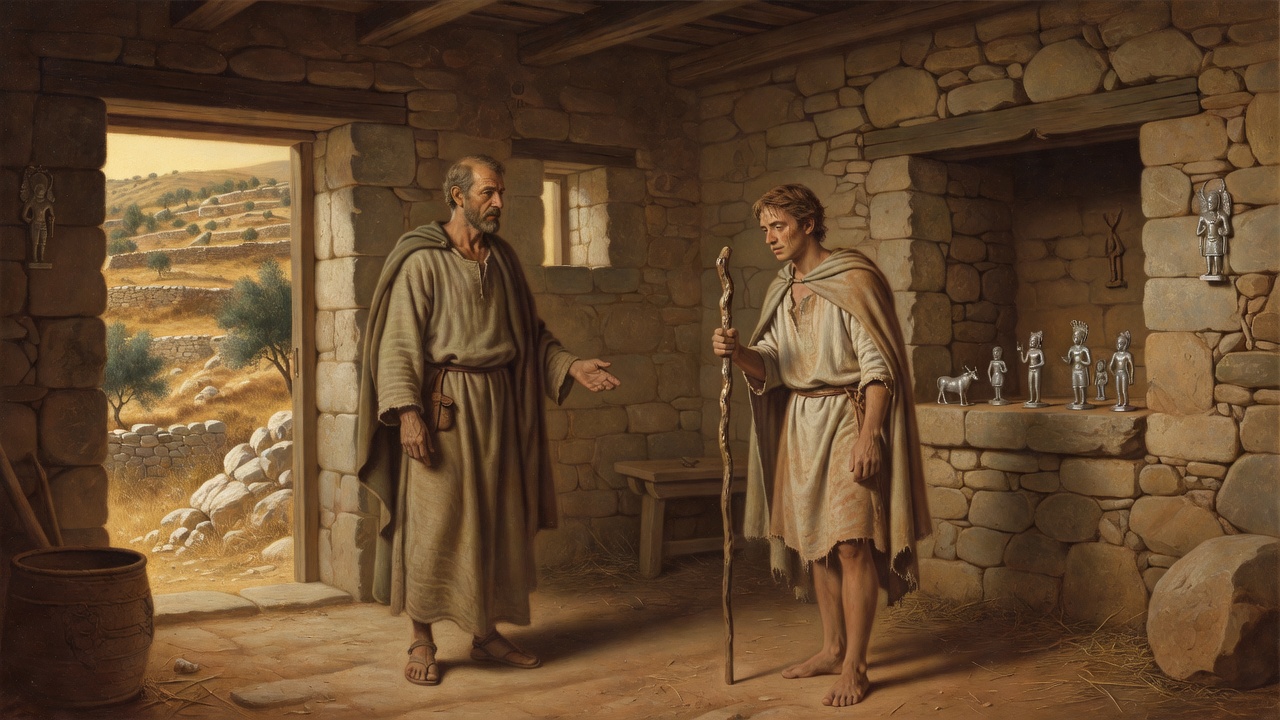
5And Micah also separated a little house, or an oratory, therein to God; and made (an) ephod, and teraphim, that is, a priest’s cloth (or cloak), and idols; and he filled the hand of one of his sons, and he was made a priest to him (or and he consecrated, or dedicated, one of his sons, and he became his priest).
6In those days was no king in Israel, but each man did that, that seemed rightful to himself. (In those days there was no king in Israel, but each person did what seemed right to himself.)
7Also another young waxing man was of Bethlehem of Judah, of the kindred of Judah, and he was a deacon, and dwelled there. (And there was a young man of Bethlehem in Judah, of the tribe of Judah, and he was a Levite, and lived there.)
8And he went out of the city of Bethlehem, and would be a pilgrim, wherever he found (it) profitable to himself. And when he made journey, and had come into the hill of Ephraim, and had bowed [down] a little into the house of Micah, (And he went out of the city of Bethlehem, and would be a visitor, wherever he found it profitable for himself. And when he had made a journey, and had come to the hill country of Ephraim, and had rested a little at Micah’s house,)
9Micah asked him, From whence comest thou? Which answered, I am a deacon of Bethlehem of Judah, and I go, that I dwell where I may, and where I see that it is profitable to me. (Micah asked him, Where comest thou from? And he answered, I am a Levite of Bethlehem in Judah, and I go, so that I can live where I may, and where I see that it is profitable for me.)
10And Micah said, Dwell thou with me, and be thou to me a father and priest; and I shall give to thee by each year ten pieces of silver, and a double clothing, and those things that be necessary to lifelode. [And] He assented, (And Micah said, Stay thou with me, and be thou a father and a priest to me; and each year I shall give thee ten pieces of silver, and thy clothes, and thy food, or sustenance. And he agreed,)
11and dwelled with that man; and he was to that man as one of his sons. (and lived with that man; and he was like one of his sons to that man.)
12And Micah filled his hand (or And Micah consecrated, or dedicated, him), and he had the young man (become his) priest, (and abide, or dwell), with him,
13and he said, Now I know, that God shall do well to me, having a priest of the kin of Levi. (and he said, Now I know that God shall make things go well for me, for I have my own priest of the tribe of Levi.)
¿Sabías que…?
El santuario doméstico de Micaías
- Micaías, un hombre de la región montañosa de Efraín, estableció un santuario privado con imágenes de plata talladas y fundidas, un efod e ídolos domésticos. Al principio consagró a uno de sus propios hijos como sacerdote antes de contratar a un levita viajero para atender su santuario.Fuentes: el propio texto bíblico · Micah
- La narración señala que en aquellos días no había rey en Israel y cada cual hacía lo que le parecía bien ante sus propios ojos. Este relato ilustra la anarquía y la confusión religiosa del período previo a la monarquía.Fuentes: el propio texto bíblico · Micah
- Un levita errante procedente de Belén de Judá aceptó servir como sacerdote de Micaías a cambio de sustento, ropa y un salario anual de diez siclos de plata.Fuentes: el propio texto bíblico
Notas escritas con ayuda de IA a partir de fuentes abiertas (Theographic Bible Metadata, CC BY-SA 4.0; Easton’s Bible Dictionary, dominio público) y revisadas antes de publicarse.
Lugares de este capítulo
Solo aparecen lugares identificados con alta confianza (90 % o más según las fuentes académicas reunidas por OpenBible). Mapa de la época: DARE (Digital Atlas of the Roman Empire), CC BY 4.0; mapa actual: © colaboradores de OpenStreetMap; lugares: OpenBible.info (CC BY 4.0).
Créditos y licencia de esta traducción
Wycliffe's Bible with Modern Spelling (Enhanced)
English: Wycliffe's Bible Modern Spelling (Enhanced) (with Deuterocanon)
Copyright © 2001,2010,2011,2012,2013,2015 Terry Noble
Language: English
Dialect: Archaic
Translation by: Terry Noble
Wycliffe's Bible with Modern Spelling (Enhanced)
Wycliffe’s Bible with Modern Spelling (Enhanced) is a composite of my Wycliffe’s Bible, a modern-spelling version of the 14th century Middle English translation, consisting of Wycliffe’s Old Testament and Wycliffe’s New Testament, and my modern-spelling version of Wycliffe’s Apocrypha. These books contain literally tens of thousands of rewritten verses, presented in parentheses “( ) “, to provide help in comprehending the 14th century Middle English vocabulary and grammar. Wycliffe’s Apocrypha also includes the books of the Apocrypha from the 1st edition of the King James Version of the Bible.
This translation is made available to you under the terms of the
Creative Commons Attribution-Noncommercial-No Derivatives license 4.0.
You may share and redistribute this Bible translation or extracts from it in any format, provided that:
You include the above copyright and source information.
You do not sell this work for a profit.
You do not change any of the words or punctuation of the Scriptures.
Pictures included with Scriptures and other documents on this site are licensed just for use with those Scriptures and documents.
For other uses, please contact the respective copyright owners.
2019-09-25
Títulos de sección adaptados de la Berean Standard Bible (dominio público); no forman parte del texto bíblico de esta traducción.
Fuente: http://ebible.org/engwyc2018/ · eBible.org