Gálatas 2
Wycliffe's Bible with Modern Spelling (Enhanced) · Toca un versículo para ver sus referencias cruzadas.
The Council at Jerusalem
1And since fourteen years after [or Afterward after fourteen years], again I went up to Jerusalem with Barnabas, and took with me Titus.
2I went up by revelation, and spake with them the evangel [or the gospel], which I preach among the heathen, (or I went up by revelation, and spoke, or shared, the Gospel, or the Good News, with them, which I preach among the Gentiles); and by themselves to these that seemed to be somewhat, lest I run [or lest peradventure I should run], or had run in vain.
3And neither Titus, that had been with me, while he was heathen, was compelled to be circumcised; (And Titus, who had been with me, while he was a Gentile, was not compelled to be circumcised;)
4but for false brethren that were brought in, which had [privily] entered to espy our freedom [or our liberty], which we have in Jesus Christ, to bring us [or to drive us] into servage (or to drive us into servitude, or into slavery).
5But we gave no place to subjection, that the truth of the gospel should dwell with you. (But we did not submit to their domination, so that the truth of the Gospel or the Good News would remain with you.)
6But of these that seemed to be somewhat (or to be esteemed); which they were sometime, it pertaineth not to me, for God taketh not the person of (a) man (or for God favoureth not any person); for they that seemed to be somewhat (or to be esteemed), gave me nothing.
7But on the contrary, when they had seen, that the evangel of (the) prepuce (or for the uncircumcision) was given to me [or that the gospel of heathen men is betaken to me], as the evangel of (the) circumcision was given to Peter; (But on the contrary, when they had seen, that the Gospel, or the Good News, for the uncircumcised, or the heathen, or the Gentiles, was given to me, like the Gospel, or the Good News, for the circumcised, or the Jews, was given to Peter;)
8for he that wrought to Peter in apostlehood of (the) circumcision, wrought also to me among the heathen; (for he who made Peter the apostle to the circumcised, also made me the apostle to the Gentiles;)
9and when they had known the grace of God, that was given to me, James, and Peter [or Cephas], and John, which were seen to be the pillars, they gave the right hand of fellowship to me and to Barnabas, that we [preach] among the heathen (or that we preach among the Gentiles), and they into the circumcision;
10only that we had mind of, [or that we should be mindful of], (the) poor men, the which thing I was full busy to do. (only that we should remember the poor, which I already was always doing.)
Paul Confronts Cephas
11But when Peter was come to Antioch, I against-stood him in the face, (or I stood up against him, or I opposed him, to his face), for he was worthy to be reproved.
12For before that there came some men from James [or Forsooth before that some came from James], he ate with heathen men; but when they were come, he withdrew, and departed him (self), dreading them that were of (the) circumcision. (For before that some men came from James, he ate with the Gentiles; but when they had come, he withdrew, and separated himself, fearing those who were of the circumcision.)
13And the other Jews assented [or consented] to his feigning, so that Barnabas was drawn of (or by) them into that feigning.
14But when I saw, that they walked not rightly to the truth of the gospel, I said to Peter [or to Cephas] before all men, If thou, that art a Jew, livest heathen-like, and not Jew-like, how constrainest thou heathen men to become Jews? (or how can thou compel Gentiles to become Jews?)
15We Jews of kind, and not sinful men of the heathen, (We Jews by kind, or naturally, and not of the sinners of the Gentiles, as they be called,)
16know that a man is not justified of the works of the law, but by the faith of Jesus Christ; and we believe in Jesus Christ, that we be justified of [or by] the faith of Christ, and not of the works of the law. Wherefore of the works of the law each flesh shall not be justified. (know that a man is not justified by the works of the Law, but by faith in Jesus Christ; and we believe in Jesus Christ, that we be justified by faith in the Messiah, and not by doing the works of the Law. And so by doing the works of the Law each flesh shall not be justified.)
17And if we seek to be justified in Christ, we ourselves be found sinful men [or to be sinners], whether Christ be (a) minister of sin? God forbid. (And if we seek to be justified in the Messiah, and we ourselves be found to be sinners, then is the Messiah a servant of sin? God forbid.)
18And if I build again things that I have destroyed, I make myself a trespasser.
19For by the law I am dead to the law, [For by the law I am dead to the law, that I live to God;]
20and I am fixed to the cross, that I live to God with Christ. And now live not I, but Christ liveth in me, (or and I am fixed to the cross, so that I live to God with the Messiah. But now I do not live, but the Messiah who liveth in me). But that I live now in (the) flesh, I live in the faith of God’s Son, that loved me, and gave himself for me. [with Christ I am fixed to the cross. Forsooth I live now, not I, but Christ liveth in me. Forsooth that I live now in (the) flesh, I live in the faith of God’s son, the which loved me, and betook (or delivered) himself for me.]
21I cast not away the grace of God; for if rightwiseness be through (the) law [or for if rightwiseness is by the law], then Christ died without cause. (I do not throw away God’s grace; because if righteousness can be gained through the Law, then the Messiah died without any reason or for no purpose.)
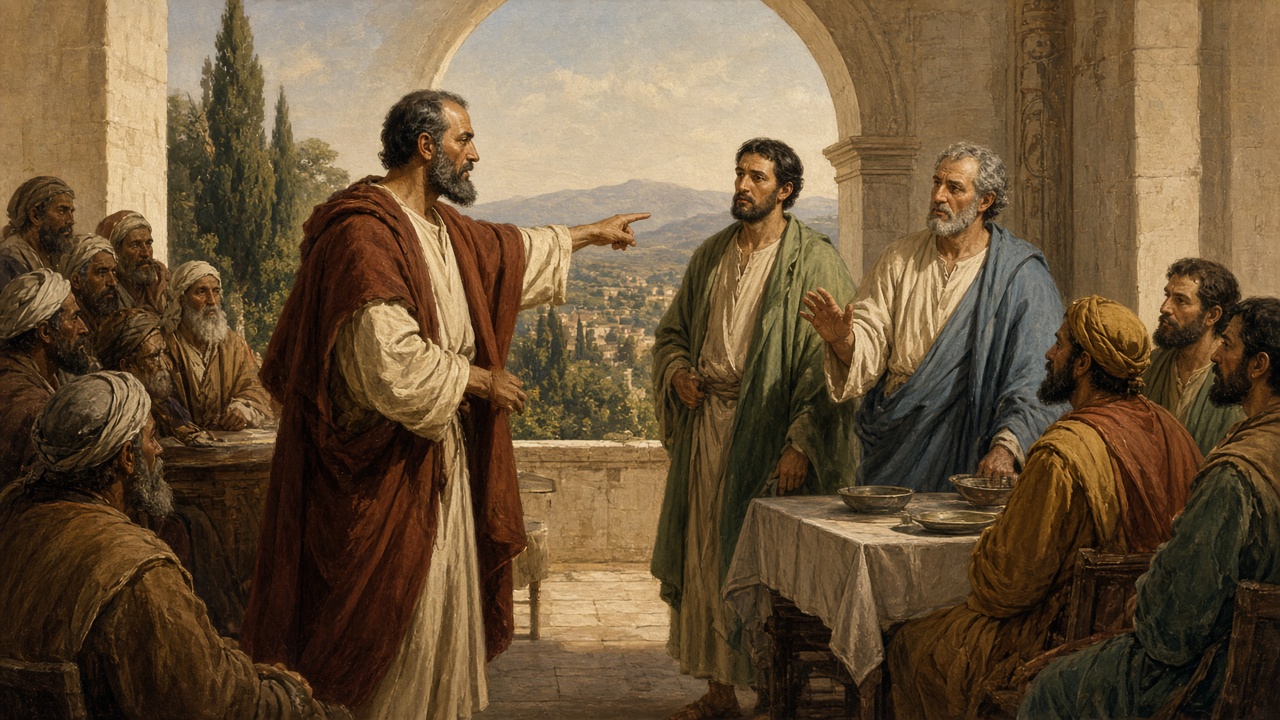
¿Sabías que…?
Gentiles, comunión y un enfrentamiento en Antioquía
- Tito fue con Pablo y Bernabé a Jerusalén. El Easton's Bible Dictionary (1897) dice que parece haber sido gentil y que su nombre no aparece en Hechos. Pablo escribe que Tito, aunque era griego, no fue obligado a circuncidarse.Fuentes: Titus · el propio texto bíblico
- El enfrentamiento posterior tuvo lugar en Antioquía de Siria, a orillas del Orontes, a unas trescientas millas al norte de Jerusalén. La ciudad ocupaba el tercer lugar entre las ciudades del Imperio romano, después de Roma y Alejandría, y fue allí donde a los creyentes se les llamó cristianos por primera vez.Fuentes: Antioch (Syria) · el propio texto bíblico
- El Easton's Bible Dictionary (1897) describe a Santiago, nombrado con Cefas y Juan como uno de los pilares, como cabeza de la iglesia en Jerusalén, donde presidió el concilio sobre los gentiles. Pablo dice que, antes de que llegaran ciertos hombres de parte de Santiago, Cefas solía comer con los gentiles, pero luego se apartó por temor al grupo de la circuncisión.Fuentes: James (Brother of Jesus) · el propio texto bíblico
Notas escritas con ayuda de IA a partir de fuentes abiertas (Theographic Bible Metadata, CC BY-SA 4.0; Easton’s Bible Dictionary, dominio público) y revisadas antes de publicarse.
Lugares de este capítulo
- Jerusalem · 31.777, 35.234 · versículo 1
- Antioch · Hoy: Antioch on the Orontes · 36.227, 36.172 · versículo 11
Solo aparecen lugares identificados con alta confianza (90 % o más según las fuentes académicas reunidas por OpenBible). Mapa de la época: DARE (Digital Atlas of the Roman Empire), CC BY 4.0; mapa actual: © colaboradores de OpenStreetMap; lugares: OpenBible.info (CC BY 4.0).
Créditos y licencia de esta traducción
Wycliffe's Bible with Modern Spelling (Enhanced)
English: Wycliffe's Bible Modern Spelling (Enhanced) (with Deuterocanon)
Copyright © 2001,2010,2011,2012,2013,2015 Terry Noble
Language: English
Dialect: Archaic
Translation by: Terry Noble
Wycliffe's Bible with Modern Spelling (Enhanced)
Wycliffe’s Bible with Modern Spelling (Enhanced) is a composite of my Wycliffe’s Bible, a modern-spelling version of the 14th century Middle English translation, consisting of Wycliffe’s Old Testament and Wycliffe’s New Testament, and my modern-spelling version of Wycliffe’s Apocrypha. These books contain literally tens of thousands of rewritten verses, presented in parentheses “( ) “, to provide help in comprehending the 14th century Middle English vocabulary and grammar. Wycliffe’s Apocrypha also includes the books of the Apocrypha from the 1st edition of the King James Version of the Bible.
This translation is made available to you under the terms of the
Creative Commons Attribution-Noncommercial-No Derivatives license 4.0.
You may share and redistribute this Bible translation or extracts from it in any format, provided that:
You include the above copyright and source information.
You do not sell this work for a profit.
You do not change any of the words or punctuation of the Scriptures.
Pictures included with Scriptures and other documents on this site are licensed just for use with those Scriptures and documents.
For other uses, please contact the respective copyright owners.
2019-09-25
Títulos de sección adaptados de la Berean Standard Bible (dominio público); no forman parte del texto bíblico de esta traducción.
Fuente: http://ebible.org/engwyc2018/ · eBible.org