Proverbios 16
Wycliffe's Bible with Modern Spelling · Toca un versículo para ver sus referencias cruzadas.
The Reply of the Tongue Is from the LORD
1It pertaineth to man to make ready the soul; and it pertaineth to the Lord to govern the tongue.
2All the ways of men be open to the eyes of God; the Lord is a weigher of spirits, that is, of wills, yielding to man after his deservings.
3Show thy works to the Lord; and thy thoughts shall be addressed.
4The Lord wrought all things for himself; and he made ready a wicked man to the evil day.
5Abomination of the Lord is each proud man; yea, though the hand is to the hand, he shall not be innocent. The beginning of [the] good way is to do rightwiseness; forsooth it is more acceptable with God, than to offer sacrifices.
6Wickedness is again-bought by mercy and truth; and men boweth away from evil by the dread of the Lord.
7When the ways of a man please the Lord, he shall convert, yea, his enemies to peace.
8Better is a little with rightfulness [or rightwiseness], than many fruits with wickedness.
9The heart of a man shall dispose his way; but it pertaineth to the Lord to dress his steps.
10Divining is in the lips of a king; his mouth shall not err in doom.
11The dooms of the Lord be weight and balance; and his works be all the stones of the world.
12They that do wickedly be abominable to the king; for the throne of the realm is made steadfast by rightfulness [or rightwiseness].
13The will of kings is just [or rightwise] lips; he that speaketh rightful [or right] things, shall be addressed.
14[The] Indignation of the king is messengers of death; and a wise man shall please him.
15Life is in gladness of the king’s cheer; and his mercy is as rain coming late.
16Wield thou wisdom, for it is better than gold; and get thou prudence, for it is preciouser than silver.
17The path of just [or rightwise] men boweth away from evils; the keeper of his soul keepeth his way.
18Pride goeth before sorrow; and the spirit shall be enhanced before falling.
19It is better to be made meek with mild men, than to part spoils with proud men.
20A learned man in word shall find goods; and he that hopeth in the Lord is blessed.
21He that is wise in heart, shall be called prudent; and he that is sweet in speech, shall find greater things.
22The well of life is the learning of him that wieldeth; the teaching of fools is folly.
23The heart of a wise man shall teach his mouth; and shall increase grace to his lips.
24Words well-set together is a comb of honey; health of bones is the sweetness of soul.
25A way there is that seemeth rightful [or right] to a man; and the last things thereof lead to death.
26The soul of a man travailing travaileth to himself; for his mouth compelled him.
27An unwise man diggeth for evil; and fire burneth in his lips.
28A wayward man raiseth strives; and a man full of words separateth princes.
29A wicked man flattereth his friend; and leadeth him by a way not good.
30He that thinketh shrewd things with eyes astonied, biteth his lips, and performeth evil.
31A crown of dignity is eld age, that shall be found in the ways of rightfulness [or rightwiseness].
32A patient man is better than a strong man; and he that is lord of his soul, is better than an overcomer of cities.
33Lots be sent into the bosom; but they be tempered of the Lord.
¿Sabías que…?
Guía Divina y Sabiduría Práctica
- Proverbios 16 resalta el contraste entre las intenciones humanas y la dirección divina, señalando que, aunque las personas planifiquen su camino y echen suertes, la decisión final pertenece al Señor.Fuentes: el propio texto bíblico
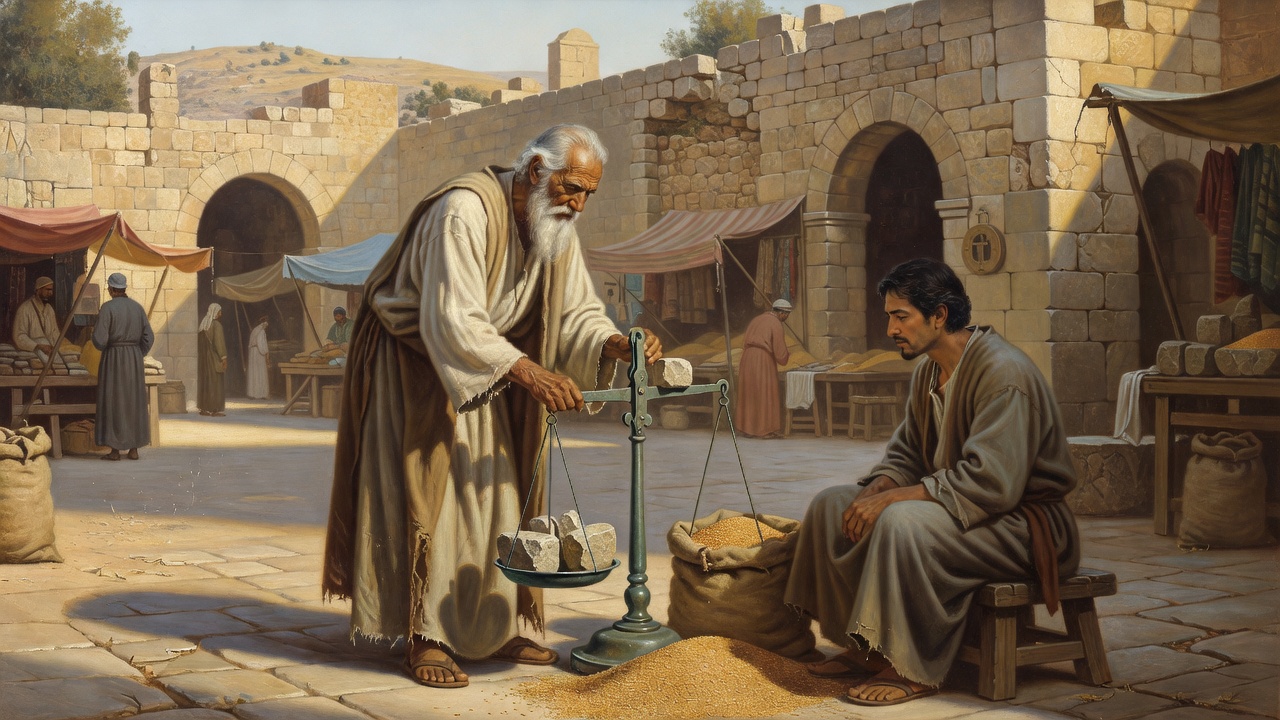
- El capítulo vincula el comercio justo con la rectitud, afirmando que las balanzas honestas y todas las pesas que el comerciante lleva en su bolsa son de directo interés del Señor.Fuentes: el propio texto bíblico
- El hablar sabio y el dominio propio reciben un énfasis especial en esta colección, comparando las palabras amables con un panal de miel y declarando que controlar la ira es mayor que conquistar una ciudad fortificada.Fuentes: el propio texto bíblico
Notas escritas con ayuda de IA a partir de fuentes abiertas (Theographic Bible Metadata, CC BY-SA 4.0; Easton’s Bible Dictionary, dominio público) y revisadas antes de publicarse.
Créditos y licencia de esta traducción
Wycliffe's Bible with Modern Spelling
English: Wycliffe's Bible Modern Spelling (with Deuterocanon)
Copyright © 2001,2010,2011,2012,2013,2015 Terry Noble
Language: English
Dialect: Archaic
Translation by: Terry Noble
Wycliffe’s Bible with Modern Spelling, was made in response to requests from readers who wanted my Wycliffe’s Old and New Testaments and Apocrypha in one volume. Printing limitations dictated the number of pages available to me and the letter size. In my previous books, Wycliffe’s Bible, Wycliffe’s Old Testament, Vols. 1 amp 2, Wycliffe’s New Testament, and Wycliffe’s Apocrypha, I have tens of thousands of rewritten verses, presented in parentheses “( )”, to provide help in comprehending the 14th century Middle English vocabulary and grammar. In this present volume, with space at a premium, those “helps” had to be eliminated, to make room for the text of the Apocrypha.
This translation is made available to you under the terms of the
Creative Commons Attribution-Noncommercial-No Derivatives license 4.0.
You may share and redistribute this Bible translation or extracts from it in any format, provided that:
You include the above copyright and source information.
You do not sell this work for a profit.
You do not change any of the words or punctuation of the Scriptures.
Pictures included with Scriptures and other documents on this site are licensed just for use with those Scriptures and documents.
For other uses, please contact the respective copyright owners.
2019-09-26
Títulos de sección adaptados de la Berean Standard Bible (dominio público); no forman parte del texto bíblico de esta traducción.
Fuente: http://ebible.org/engwyc2017/ · eBible.org