Números 11
Wycliffe's Bible with Modern Spelling · Toca un versículo para ver sus referencias cruzadas.
The Complaints of the People
1In the meantime grutching of the people, as of men sorrowing for travail, rose against the Lord. And when Moses had heard this thing, he was wroth; and the fire of the Lord was kindled upon them, and devoured the last part of the tents.
2And when the people had cried to Moses, Moses prayed [to] the Lord, and the fire was quenched.
3And he called the name of that place Burning, for the fire of the Lord was kindled against them.
4And the common people of men and women, that had gone up with them, burnt with desire of flesh, and they sat, and wept, with the sons of Israel joined together with them, and said, Who shall give us flesh to eat?
5We think upon the fish that we ate in Egypt freely; gourds, and melons, and leeks, and onions, and garlic come into our minds;
6our soul is dry; our eyes behold none other thing than manna.
7Soothly manna was as the seed of coriander, of the colour of bdellium, which is white, and bright as crystal.
8And the people went about, and gathered it, and brake it with a quernstone, either pounded it in a mortar, and seethed it in a pot; and made thereof little cakes of the savour as of bread made with oil.
9And when [the] dew came down in the night upon the tents, also manna came down together therewith.
The Complaint of Moses
10Then Moses heard the people weeping by meines, and each of them by the doors of their tents; and the strong vengeance of the Lord was wroth greatly, but also the grutching was seen unsufferable to Moses.
11And he said to the Lord, Why hast thou tormented thy servant? why find I not grace before thee? and why hast thou put the burden of all this people onto me?
12whether I have conceived all this multitude, either have begotten it, that thou say to me, Bear thou them in thy bosom, as a nurse is wont to bear a little young child, and bear thou this people into the land for the which thou swore to their fathers?
13whereof be meats to me, that I feed so great a multitude? They weep before me, and say, Give us flesh, that we eat;
14I may not alone sustain all this people, for it is grievous to me.
15If in other manner it seemeth to thee, I beseech thee, that thou slay me, and that I find grace in thine eyes, that I be not punished, or travailed, with so great evils.
Seventy Elders Anointed
16And the Lord said to Moses, Gather thou to me seventy men of the elder men of Israel, whom thou knowest to be elder men, and masters of the people; and thou shalt lead them to the door of the tabernacle of [the] bond of peace, and thou shalt make them to stand there with thee,
17that I come down, and speak to thee; and I shall take away of thy spirit, and I shall give to them, that they sustain with thee the burden of the people, and not thou alone be grieved.
18And thou shalt say to the people, Be ye hallowed; tomorrow ye shall eat flesh; for I heard you say, Who shall give us the meats of flesh? it was well to us in Egypt; that the Lord give you flesh,
19and ye eat not only one day, either twain [or two], either five, either ten, soothly neither twenty days,
20but till to a month of days, till it go out by your nostrils, and turn into loathing; for by your grutching ye have put away the Lord, which is in the midst of you, and ye wept before him, and said, Why went we out of Egypt?
21And Moses said to the Lord, Six hundred thousand of footmen be of this people, and thou sayest, I shall give them to eat flesh an whole month.
22Whether the multitude of sheep and of oxen shall be able to be slain, that it may suffice this people to meat, either whether all the fishes of the sea shall be gathered together, that those [ful] fill them?
23To whom the Lord answered, Whether the Lord’s hand is unmighty? right now thou shalt see, whether my word shall be fulfilled in work.
24Therefore Moses came, and told the people the words of the Lord; and he gathered seventy men of the elders of Israel, which he made stand about the tabernacle.
25And the Lord came down by a cloud, and spake to Moses, and took away of the spirit that was in Moses, and gave to the seventy men; and when the spirit had rested in them, they prophesied, and moreover they ceased not.
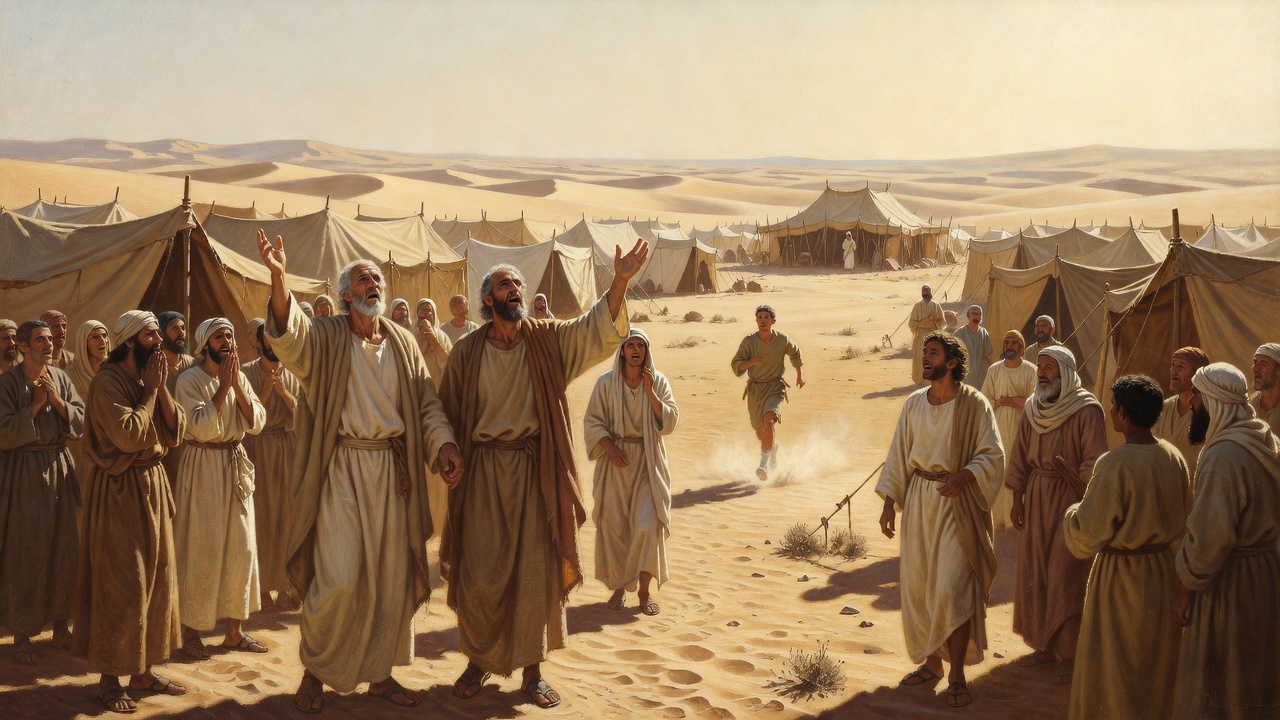
26Forsooth two men dwelled still in the tents, of which men one was called Eldad, and the tother Medad, on which the spirit rested; for also they were described, or ordained, or chosen, and they went not out to the tabernacle. And when they prophesied in the tents,
27a young man ran, and told to Moses, and said, Eldad and Medad prophesy in the tents.
28Anon Joshua, the son of Nun, the servant of Moses, and chosen of many, said, My lord Moses, forbid thou them.
29And Moses said, What, hast thou envy for me? who giveth, whether not God, that all the people prophesy, and that God give his spirit to them?
30And Moses turned again, and the elder men in birth of Israel, into the tents.
The Quail and the Plague
31Forsooth a wind went forth from the Lord, and it took curlews, and brought them over the sea, and he left them in the tents, in journey, as much as may be performed in one day, by each part of the tents by compass; and they flew in the air by two cubits in height above the earth.
32Therefore the people rose in all that day, and that night, and into the tother day, and gathered a multitude of curlews; he that gathered little, gathered ten cors; and they dried those curlews by compass of the tents.
33Yet flesh was in their teeth, and such meat failed them not; and lo! the wrath of the Lord was raised against his people, and he smote it with a full great vengeance.
34And that place was called The Sepulchres of Covetousness, or Lust, for there they buried the people that desired flesh.
35Soothly they went forth from The Sepulchres of Covetousness, or Lust, and came into Hazeroth, and dwelled there.
¿Sabías que…?
Quejas, codornices y el Espíritu en el campamento
- Los lugares mencionados en este capítulo deben sus nombres a sucesos de la travesía: Taberá significa "ardor" o "fuego", nombrada tras el fuego que consumió las afueras del campamento, mientras que Kibrot-hataavá significa "tumbas de la codicia" o del deseo, donde sepultaron a quienes ansiaban carne.Fuentes: Taberah · Kibroth-hattaavah · el propio texto bíblico
- Aunque setenta ancianos fueron elegidos para ayudar a Moisés en el liderazgo, Eldad y Medad se quedaron en el campamento en lugar de acudir a la Tienda de Reunión, pero el Espíritu reposó sobre ellos y profetizaron. Cuando Josué pidió a Moisés que los detuviera, Moisés respondió deseando que todo el pueblo del Señor fuera profeta.Fuentes: Eldad · Joshua · el propio texto bíblico
- El texto describe el maná como semejante a la semilla de cilantro y a la resina, el cual los israelitas recogían, molían en molinos de mano o machacaban en morteros, y cocían en ollas o preparaban en tortas con sabor a panecillos horneados con aceite.Fuentes: el propio texto bíblico
Notas escritas con ayuda de IA a partir de fuentes abiertas (Theographic Bible Metadata, CC BY-SA 4.0; Easton’s Bible Dictionary, dominio público) y revisadas antes de publicarse.
Lugares de este capítulo
Solo aparecen lugares identificados con alta confianza (90 % o más según las fuentes académicas reunidas por OpenBible). Mapa de la época: DARE (Digital Atlas of the Roman Empire), CC BY 4.0; mapa actual: © colaboradores de OpenStreetMap; lugares: OpenBible.info (CC BY 4.0).
Créditos y licencia de esta traducción
Wycliffe's Bible with Modern Spelling
English: Wycliffe's Bible Modern Spelling (with Deuterocanon)
Copyright © 2001,2010,2011,2012,2013,2015 Terry Noble
Language: English
Dialect: Archaic
Translation by: Terry Noble
Wycliffe’s Bible with Modern Spelling, was made in response to requests from readers who wanted my Wycliffe’s Old and New Testaments and Apocrypha in one volume. Printing limitations dictated the number of pages available to me and the letter size. In my previous books, Wycliffe’s Bible, Wycliffe’s Old Testament, Vols. 1 amp 2, Wycliffe’s New Testament, and Wycliffe’s Apocrypha, I have tens of thousands of rewritten verses, presented in parentheses “( )”, to provide help in comprehending the 14th century Middle English vocabulary and grammar. In this present volume, with space at a premium, those “helps” had to be eliminated, to make room for the text of the Apocrypha.
This translation is made available to you under the terms of the
Creative Commons Attribution-Noncommercial-No Derivatives license 4.0.
You may share and redistribute this Bible translation or extracts from it in any format, provided that:
You include the above copyright and source information.
You do not sell this work for a profit.
You do not change any of the words or punctuation of the Scriptures.
Pictures included with Scriptures and other documents on this site are licensed just for use with those Scriptures and documents.
For other uses, please contact the respective copyright owners.
2019-09-26
Títulos de sección adaptados de la Berean Standard Bible (dominio público); no forman parte del texto bíblico de esta traducción.
Fuente: http://ebible.org/engwyc2017/ · eBible.org