Mateo 13
Wycliffe's Bible with Modern Spelling · Toca un versículo para ver sus referencias cruzadas.
The Parable of the Sower
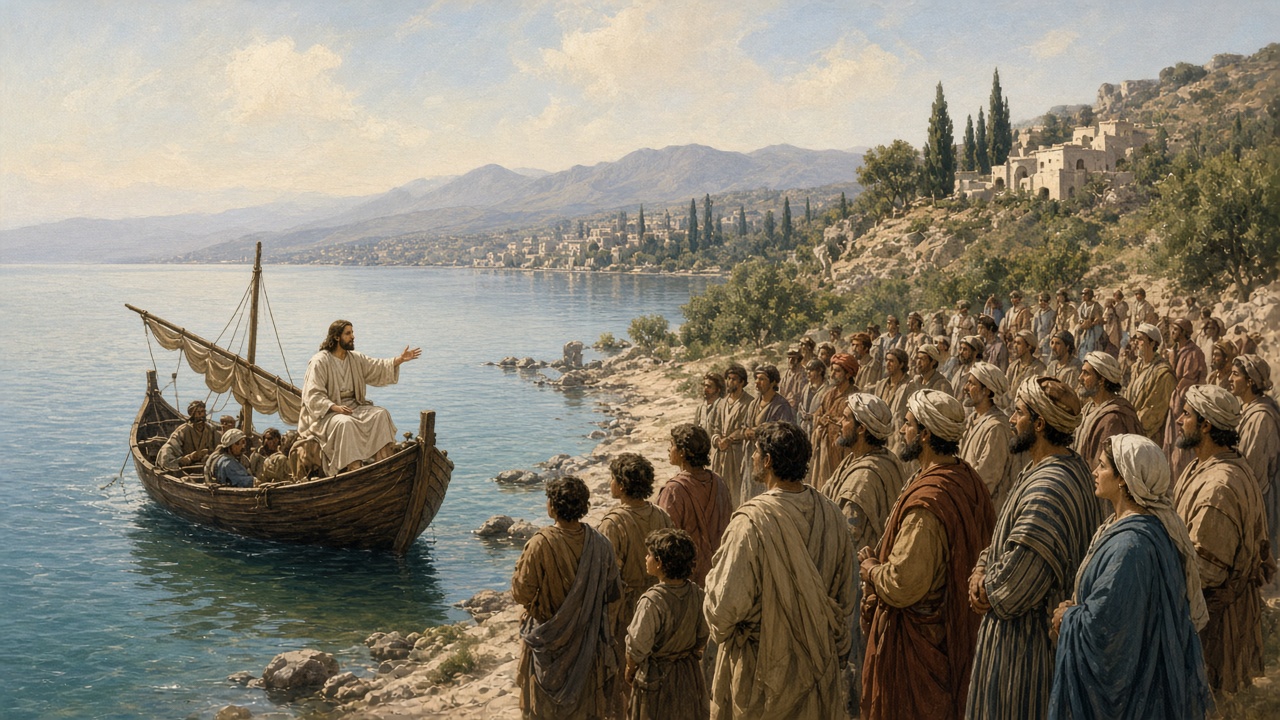
1In that day Jesus went out of the house, and sat beside the sea.
2And much people was gathered to him, so that he went up into a boat, and sat; and all the people stood on the brink.
3And he spake to them many things in parables, and said, Lo! he that soweth, went out to sow his seed.
4And while he soweth, some seeds felled beside the way, and birds of the air came, and ate them.
5But other seeds felled into stony places, where they had not much earth; and anon they sprung up, for they had not deepness of earth.
6But when the sun was risen, they sweltered [or they burned for the heat], and for they had not root, they dried up.
7And other seeds felled among thorns; and the thorns waxed up, and strangled them.
8But other seeds felled into good land, and gave fruit; some an hundred-fold, another sixtyfold, another thirty-fold.
9He that hath ears of hearing, hear he.
The Purpose of Jesus’ Parables
10And the disciples came nigh, and said to him, Why speakest thou in parables to them?
11And he answered, and said to them, For to you it is given to know the privates [or mysteries] of the kingdom of heavens; but it is not given to them.
12For it shall be given to him that hath, and he shall have plenty; but if a man hath not, also that thing that he hath shall be taken away from him.
13Therefore I speak to them in parables, for they seeing see not, and they hearing hear not, neither under-stand;
14that the prophecy of Isaiah saying be fulfilled in them, With hearing ye shall hear, and ye shall not under-stand; and ye seeing shall see, and ye shall not see;
15for the heart of this people is greatly fatted, and they heard heavily with ears, and they have closed their eyes, lest sometime they see with eyes, and with ears hear, and under-stand in heart, and they be converted, and I heal them.
16But your eyes that see be blessed, and your ears that hear.
17Forsooth I say to you, that many prophets and just men coveted to see those things that ye see, and they saw not, and to hear those things that ye hear, and they heard not.
The Parable of the Sower Explained
18Therefore hear ye the parable of the sower.
19Each that heareth the word of the realm, and understandeth not, the evil spirit cometh, and ravisheth that that is sown in his heart; this it is [or this is he], that is sown beside the way.
20But this [or he] that is sown on the stony land, this it is [or is this], that heareth the word of God, and anon with joy taketh it.
21And he hath not root in himself, but is temporal. For when tribulation and persecution is made for the word, anon he is caused to stumble.
22But he that is sown in thorns, is this that heareth the word, and the busyness of this world, and the fallacy [or the falseness] of riches strangleth the word, and it is made without fruit.
23But he that is sown into good land, is this that heareth the word, and understandeth, and bringeth forth fruit. And some maketh an hundred-fold, truly another sixtyfold and another thirtyfold.
The Parable of the Weeds
24Another parable Jesus put forth to them, and said, The kingdom of heavens is made like to a man, that sowed good seed in his field.
25And when men slept, his enemy came, and sowed above tares, [or darnels, or cockles], in the middle of wheat, and went away.
26But when the herb was grown, and made fruit, then the tares, [or the darnels, or cockles], appeared.
27And the servants of the husband-man came, and said to him, Lord, whether hast thou not sown good seed in thy field? whereof then hath it tares, [or darnels, or cockles]?
28And he said to them, An enemy hath done this thing. And the servants said to him, Wilt thou that we go, and gather them?
29And he said, Nay, lest peradven-ture ye in gathering tares, [or the darnels, or cockles], draw up with them [also] the wheat by the root.
30Suffer ye them both to wax into reaping time; and in the time of ripe corn, I shall say to the reapers, First gather ye together the tares, [or the darnels, or cockles], and bind them together in knitches, [or small bundles], to be burnt, but gather ye the wheat into my barn.
The Parable of the Mustard Seed
31Another parable Jesus put forth to them, and said, The kingdom of heavens is like to a corn of sinapi, which a man took, and sowed in his field.
32Which [truly] is the least of all seeds, but when it hath waxen, it is the most of all worts, and is made a tree; so that [the] birds of the air come, and dwell in the boughs [or the branches] thereof.
The Parable of the Leaven
33Another parable Jesus spake to them [or He spake another parable to them], The kingdom of heavens is like to sourdough, which a woman took, and hid in three measures of meal, till it were all soured.
I Will Open My Mouth in Parables
34Jesus spake all these things in parables to the people, and he spake not to them without parables,
35that it should be fulfilled, that is said by the prophet, saying, I shall open my mouth in parables; I shall tell out hid things [or things hid] from the making of the world.
The Parable of the Weeds Explained
36Then he left the people, and came into an house; and his disciples came to him, and said, Expound to us the parable of the tares, [or the darnels, or cockles], of the field.
37Which answered, and said, He that soweth good seed is man’s Son;
38the field is the world; but the good seed, these be the sons of the kingdom, but tares, these be evil children, [or forsooth darnels, or cockles, these be evil sons or sons of the wicked];
39the enemy that soweth them is the fiend [or the devil]; and the ripe corn is the ending of the world, the reapers be angels.
40Therefore as tares, [or darnels, or cockles], be gathered together, and be burnt in [the] fire, so it shall be in the ending of the world.
41Man’s Son shall send his angels, and they shall gather from his realm all causes of stumbling, and them that do wickedness;
42and they shall send them into the chimney of fire; there shall be weeping, and beating together of teeth.
43Then just men shall shine as the sun, in the realm of their Father. He that hath ears of hearing, hear he.
The Parables of the Treasure and the Pearl
44The kingdom of heavens is like to treasure hid in a field, which a man that findeth, hideth; and for joy of it he goeth, and selleth all things that he hath, and buyeth that field.
45Again the kingdom of heavens is like to a merchant, that seeketh good margarites [or good pearls];
46but when he hath found one precious margarite, he went, and sold all things that he had, and bought it.
The Parable of the Net
47Again the kingdom of heavens is like to a net cast into the sea, and that gathereth together of all kinds of fishes;
48which when it was full, they drew it up, and sat by the brink, and chose the good into their vessels, but the evil they cast out.
49So it shall be in the end of the world. Angels shall go out, and shall separate evil men from the middle [or the midst] of just men.
50And they shall send them into the chimney of fire; there shall be weeping, and grinding of teeth.
51Have ye understood all these things? They say to him, Yea.
52He saith to them, Therefore every wise man of [the] law [taught] in the kingdom of heavens, is like to an husbandman, that bringeth forth of his treasure new things and old.
The Rejection at Nazareth
53And it was done, when Jesus had ended these parables, he passed from thence.
54And he came into his country, and taught them in their synagogues, so that they wondered, and said, From whence this wisdom and virtues came to this? [or to him?]
55Whether this is not the son of a carpenter? Whether his mother be not said Mary? and his brethren, James, and Joseph, and Simon, and Judas?
56and his sisters, whether they all be not among us? From whence then all these things come or came to this? [or to him?]
57And so they were offended in him. But Jesus said to them, A prophet is not without honour, but in his own country, and in his own house.
58And he did not there many virtues, for the unbelief of them.
¿Sabías que…?
Parábolas del Reino de los Cielos
- El día que describe este capítulo, Jesús salió de la casa y se sentó junto al mar. La multitud creció tanto que subió a una barca y enseñó desde allí, mientras la gente permanecía de pie en la orilla, y no les habló nada sino en parábolas. Una cronología fecha estas parábolas junto al mar en el año 28 d.C.Fuentes: el propio texto bíblico · Seaside Parables and Miracle
- Cuando los discípulos preguntaron por qué hablaba al pueblo en parábolas, Jesús respondió que el conocimiento de los misterios del reino de los cielos se les había dado a ellos, pero no a las multitudes. Dijo que la profecía de Isaías se cumplía en las multitudes: seguirían oyendo y viendo, pero jamás entenderían ni percibirían, porque su corazón se había endurecido. El Easton’s Bible Dictionary (1897) describe a Isaías como hijo de Amoz, que profetizó durante los reinados de Uzías, Jotam, Acaz y Ezequías.Fuentes: el propio texto bíblico · Isaiah
- Más tarde, Jesús llegó a su ciudad natal, enseñó en la sinagoga, y la gente se ofendió por causa de él. Preguntaron si era el hijo del carpintero, nombraron a su madre María y a sus hermanos Jacobo, José, Simón y Judas, y señalaron que sus hermanas vivían entre ellos; a causa de la incredulidad de ellos, no hizo muchos milagros allí. María es identificada como esposa de José y madre de Jesús, Simón como uno de los hermanos del Señor, y una cronología fecha este segundo rechazo en Nazaret en el año 29 d.C.Fuentes: el propio texto bíblico · Mary (Mother of Jesus) · Simon · 2nd Rejection at Nazareth
Notas escritas con ayuda de IA a partir de fuentes abiertas (Theographic Bible Metadata, CC BY-SA 4.0; Easton’s Bible Dictionary, dominio público) y revisadas antes de publicarse.
Lugares de este capítulo
- Nazareth · 32.702, 35.298 · versículo 54
Solo aparecen lugares identificados con alta confianza (90 % o más según las fuentes académicas reunidas por OpenBible). Mapa de la época: DARE (Digital Atlas of the Roman Empire), CC BY 4.0; mapa actual: © colaboradores de OpenStreetMap; lugares: OpenBible.info (CC BY 4.0).
Créditos y licencia de esta traducción
Wycliffe's Bible with Modern Spelling
English: Wycliffe's Bible Modern Spelling (with Deuterocanon)
Copyright © 2001,2010,2011,2012,2013,2015 Terry Noble
Language: English
Dialect: Archaic
Translation by: Terry Noble
Wycliffe’s Bible with Modern Spelling, was made in response to requests from readers who wanted my Wycliffe’s Old and New Testaments and Apocrypha in one volume. Printing limitations dictated the number of pages available to me and the letter size. In my previous books, Wycliffe’s Bible, Wycliffe’s Old Testament, Vols. 1 amp 2, Wycliffe’s New Testament, and Wycliffe’s Apocrypha, I have tens of thousands of rewritten verses, presented in parentheses “( )”, to provide help in comprehending the 14th century Middle English vocabulary and grammar. In this present volume, with space at a premium, those “helps” had to be eliminated, to make room for the text of the Apocrypha.
This translation is made available to you under the terms of the
Creative Commons Attribution-Noncommercial-No Derivatives license 4.0.
You may share and redistribute this Bible translation or extracts from it in any format, provided that:
You include the above copyright and source information.
You do not sell this work for a profit.
You do not change any of the words or punctuation of the Scriptures.
Pictures included with Scriptures and other documents on this site are licensed just for use with those Scriptures and documents.
For other uses, please contact the respective copyright owners.
2019-09-26
Títulos de sección adaptados de la Berean Standard Bible (dominio público); no forman parte del texto bíblico de esta traducción.
Fuente: http://ebible.org/engwyc2017/ · eBible.org