Levítico 17
Wycliffe's Bible with Modern Spelling · Toca un versículo para ver sus referencias cruzadas.
The Place of Sacrifice
1And the Lord spake to Moses, and said,
2Speak thou to Aaron, and to his sons, and to all the sons of Israel, and say thou to them, This is the word which the Lord commanded, and said,
3Each man of the house of Israel shall be guilty of blood, or great sin, if he slayeth an ox, or a sheep, either a goat, in the tents, either out of the tents,
4and offereth not an offering to the Lord at the door of the tabernacle of witnessing; as if he shedded man’s blood, so he shall perish from the midst of his people.
5Therefore the sons of Israel owe to offer their sacrifices to the priest, which they slay in the field, that those [or they] be hallowed to the Lord, before the door of the tabernacle of witnessing, and that they offer those peaceable sacrifices to the Lord.
6And the priest shall pour out the blood upon the altar of the Lord, at the door of the tabernacle of witnessing; and he shall burn the inner fatness into odour of sweetness to the Lord.
7And they shall no more offer their sacrifices to fiends, with which they did fornication, that is, idolatry; it shall be a lawful thing everlasting to them, and to their after-comers.
8And thou shalt say to them, A man of the house of Israel, and of the comelings that be pilgrims among you, that offereth a burnt sacrifice, either a slain sacrifice,
9and bringeth it not to the door of the tabernacle of witnessing, that it be offered to the Lord, he shall perish from his people.
Laws against Eating Blood
10If any man of the sons of Israel, and of the comelings that be pilgrims among you, eateth any blood, I shall set fast my face against his soul, and I shall lose him from his people;
11for the life of flesh is in the blood, and I gave that blood to you, that ye cleanse therewith upon mine altar for your souls, and that the blood be sprinkled for [the] sin of the soul.
12Therefore I said to the sons of Israel, Each living man of you shall not eat blood, neither any of the comelings that be pilgrims among you.
13Whatever man of the sons of Israel, or of the comelings that be pilgrims with you, taketh a wild beast, either a bird, which it is leaveful to eat, whether by hunting, whether by hawking, pour he out the blood thereof, and cover it with earth;
14for the life of [all] flesh is in blood. Wherefore I said to the sons of Israel, Ye shall not eat the blood of any flesh, for the life of flesh is in the blood, and whoever eateth blood, shall perish.
15A man that eateth a thing dead by itself, either taken of a beast, as well of men born in the land, as of comelings, he shall wash his clothes, and himself in water, and he shall be defouled, till to eventide; and by this order, he shall be made clean;
16that if he washeth not his clothes, or his body, he shall bear his wicked-ness.
¿Sabías que…?
El sacrificio de animales y la santidad de la sangre
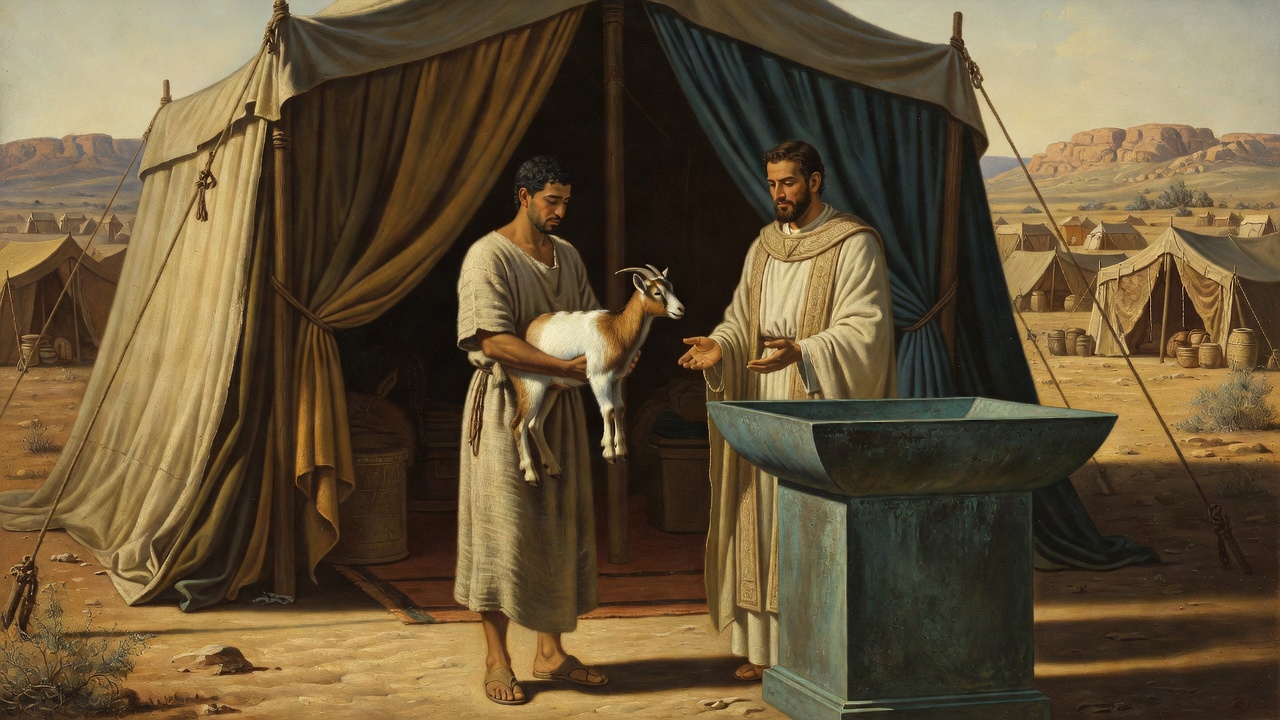
- Levítico ordena que los animales domésticos como bueyes, corderos y cabras sean llevados directamente a la entrada de la Tienda de Reunión en lugar de ser sacrificados en campo abierto. Esta regla aseguraba que los sacrificios se ofrecieran exclusivamente como ofrendas de paz al SEÑOR y ponía fin a los sacrificios ilícitos a demonios en forma de cabra.Fuentes: el propio texto bíblico
- Tanto a los israelitas nativos como a los extranjeros residentes se les prohibía estrictamente comer sangre, bajo pena de ser cortados de su pueblo. El texto fundamenta esta ley en el principio teológico de que la vida de la carne está en la sangre, la cual Dios dispuso específicamente para hacer expiación sobre el altar.Fuentes: el propio texto bíblico
- Al cazar animales salvajes o aves permitidas para el consumo, los israelitas y extranjeros debían drenar la sangre sobre el suelo y cubrirla con tierra. Esta instrucción reforzaba que la vida pertenece a Dios y preservaba la santidad de la sangre fuera del santuario sacrificial.Fuentes: el propio texto bíblico
Notas escritas con ayuda de IA a partir de fuentes abiertas (Theographic Bible Metadata, CC BY-SA 4.0; Easton’s Bible Dictionary, dominio público) y revisadas antes de publicarse.
Créditos y licencia de esta traducción
Wycliffe's Bible with Modern Spelling
English: Wycliffe's Bible Modern Spelling (with Deuterocanon)
Copyright © 2001,2010,2011,2012,2013,2015 Terry Noble
Language: English
Dialect: Archaic
Translation by: Terry Noble
Wycliffe’s Bible with Modern Spelling, was made in response to requests from readers who wanted my Wycliffe’s Old and New Testaments and Apocrypha in one volume. Printing limitations dictated the number of pages available to me and the letter size. In my previous books, Wycliffe’s Bible, Wycliffe’s Old Testament, Vols. 1 amp 2, Wycliffe’s New Testament, and Wycliffe’s Apocrypha, I have tens of thousands of rewritten verses, presented in parentheses “( )”, to provide help in comprehending the 14th century Middle English vocabulary and grammar. In this present volume, with space at a premium, those “helps” had to be eliminated, to make room for the text of the Apocrypha.
This translation is made available to you under the terms of the
Creative Commons Attribution-Noncommercial-No Derivatives license 4.0.
You may share and redistribute this Bible translation or extracts from it in any format, provided that:
You include the above copyright and source information.
You do not sell this work for a profit.
You do not change any of the words or punctuation of the Scriptures.
Pictures included with Scriptures and other documents on this site are licensed just for use with those Scriptures and documents.
For other uses, please contact the respective copyright owners.
2019-09-26
Títulos de sección adaptados de la Berean Standard Bible (dominio público); no forman parte del texto bíblico de esta traducción.
Fuente: http://ebible.org/engwyc2017/ · eBible.org