Job 5
Wycliffe's Bible with Modern Spelling · Toca un versículo para ver sus referencias cruzadas.
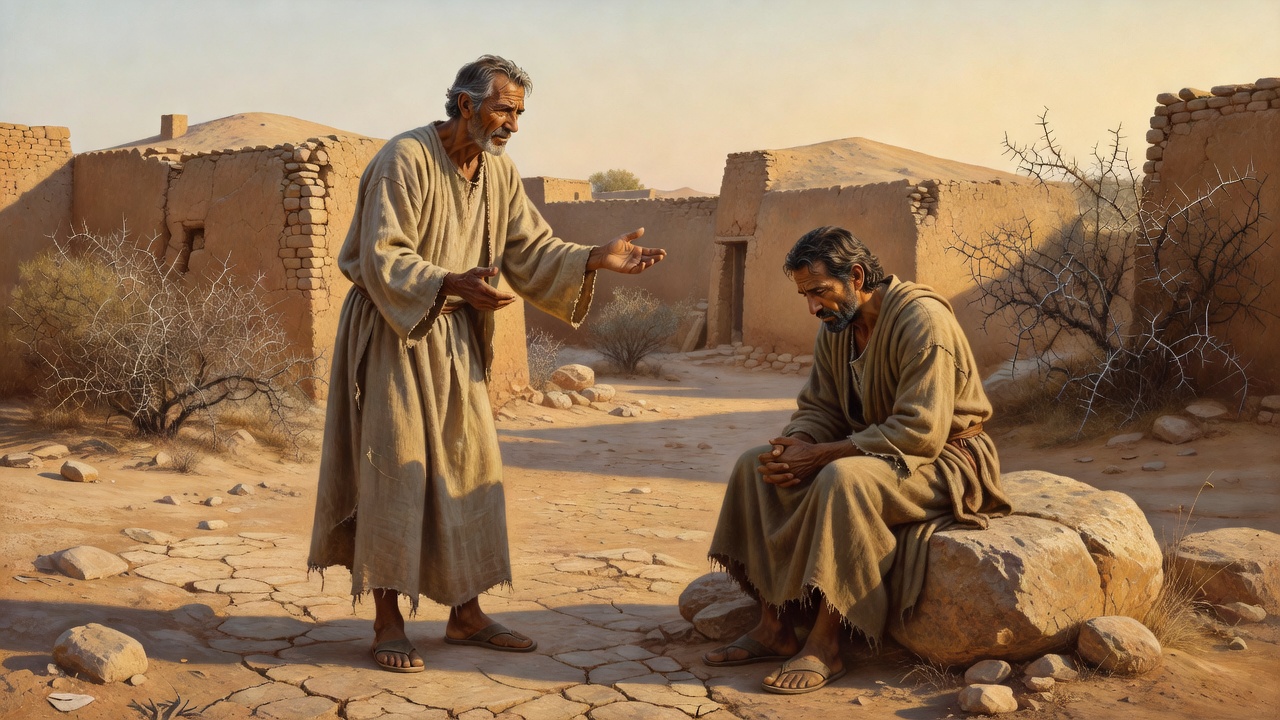
Eliphaz Continues: God Blesses those Who Seek Him
1Therefore, Job, call thou, if there is any man that shall answer thee, and turn thou to some of [the] saints.
2Wrathfulness slayeth a fond [or foolish] man, and envy slayeth a little child.
3I saw a fool with [a] steadfast root, and I cursed his fairness anon.
4His sons shall be made far from health, and they shall be defouled in the gate, and there shall be none that shall deliver them.
5Whose ripe corn an hungry man shall eat, and an armed man shall ravish him, and they, that thirst, shall drink his riches.
6Nothing is done in [the] earth with-out cause, and sorrow shall not go out of the earth, that is, adversity befalleth not to any man without cause.
7A man is born to labour, and a bird to flight.
8Wherefore I shall beseech the Lord, and I shall set [or put] my speech to my God.
9That maketh great things, and that may not be sought out, and wonder-ful things without number.
10The which God giveth rain upon the face of the earth, and moisteth all things with waters.
11Which setteth meek men on high, and raiseth with health them that mourn.
12Which destroyeth the thoughts of evil-willed men, that their hands may not fulfill those things that they have begun.
13Which taketh sly cautelous men in their own fellness, and he destroyeth the counsel of shrews or the depraved.
14By day they shall run into dark-nesses, and as in night, so they shall grope in midday.
15Certainly God shall make safe a needy man from the sword of their mouth, and a poor man from the hand of the violent, either raveners.
16And hope shall be to a needy man, but wickedness shall draw together his mouth.
17Blessed is the man, which is chastised of the Lord; therefore reprove thou not the blaming of the Lord.
18For he woundeth, and doeth medicine; he smiteth, and his hands shall make whole.
19In six tribulations he shall deliver thee, and in the seventh tribulation evil shall not touch thee.
20In hunger he shall deliver thee from death, and in battle from the power of sword.
21Thou shalt be hid from the scourge of an evil tongue, and thou shalt not dread mis-ease, either wretchedness, when it cometh.
22In destroying made of enemies and in hunger thou shalt laugh, and thou shalt not dread the beasts of [the] earth.
23But thy covenant shall be with the stones of earth, and beasts of earth shall be peaceable to thee.
24And thou shalt know, that thy tabernacle hath peace, and thou visiting thy fairness, that is, beholding thy prosperity, shalt not sin.
25And thou shalt know also, that thy seed shall be manyfold, and thy generation shall be as an herb of [the] earth.
26In abundance of years thou shalt go into the sepulchre, as an heap of wheat is borne [in] in his time.
27Lo! this thing is so, as we have sought; the which thing when thou hast heard, treat it in thy mind.
¿Sabías que…?
El Consejo de Elifaz sobre el Sufrimiento y la Corrección Divina
- Elifaz presenta el sufrimiento como una disciplina divina con propósito y no como una calamidad arbitraria, afirmando que la aflicción no brota del suelo sin causa. Por ello, exhorta a Job a no despreciar la corrección del Todopoderoso, quien hiere solo para vendar y sanar.Fuentes: el propio texto bíblico
- Al prometer rescate de seis calamidades e incluso de siete, Elifaz recurre a una fórmula poética tradicional de paralelismo numérico gradual. Este recurso, habitual en la literatura sapiencial del Antiguo Oriente Próximo, añade énfasis para expresar una protección cabal y absoluta.Fuentes: el propio texto bíblico
- Elifaz describe la restauración plena mediante imágenes agrícolas y pastoriles, imaginando una existencia en la que los animales del campo y las piedras del suelo dejan de ser hostiles. Anticipa una muerte en la vejez con vigor, semejante a una gavilla de grano recogida a su debido tiempo.Fuentes: el propio texto bíblico
Notas escritas con ayuda de IA a partir de fuentes abiertas (Theographic Bible Metadata, CC BY-SA 4.0; Easton’s Bible Dictionary, dominio público) y revisadas antes de publicarse.
Créditos y licencia de esta traducción
Wycliffe's Bible with Modern Spelling
English: Wycliffe's Bible Modern Spelling (with Deuterocanon)
Copyright © 2001,2010,2011,2012,2013,2015 Terry Noble
Language: English
Dialect: Archaic
Translation by: Terry Noble
Wycliffe’s Bible with Modern Spelling, was made in response to requests from readers who wanted my Wycliffe’s Old and New Testaments and Apocrypha in one volume. Printing limitations dictated the number of pages available to me and the letter size. In my previous books, Wycliffe’s Bible, Wycliffe’s Old Testament, Vols. 1 amp 2, Wycliffe’s New Testament, and Wycliffe’s Apocrypha, I have tens of thousands of rewritten verses, presented in parentheses “( )”, to provide help in comprehending the 14th century Middle English vocabulary and grammar. In this present volume, with space at a premium, those “helps” had to be eliminated, to make room for the text of the Apocrypha.
This translation is made available to you under the terms of the
Creative Commons Attribution-Noncommercial-No Derivatives license 4.0.
You may share and redistribute this Bible translation or extracts from it in any format, provided that:
You include the above copyright and source information.
You do not sell this work for a profit.
You do not change any of the words or punctuation of the Scriptures.
Pictures included with Scriptures and other documents on this site are licensed just for use with those Scriptures and documents.
For other uses, please contact the respective copyright owners.
2019-09-26
Títulos de sección adaptados de la Berean Standard Bible (dominio público); no forman parte del texto bíblico de esta traducción.
Fuente: http://ebible.org/engwyc2017/ · eBible.org