Job 41
Wycliffe's Bible with Modern Spelling · Toca un versículo para ver sus referencias cruzadas.
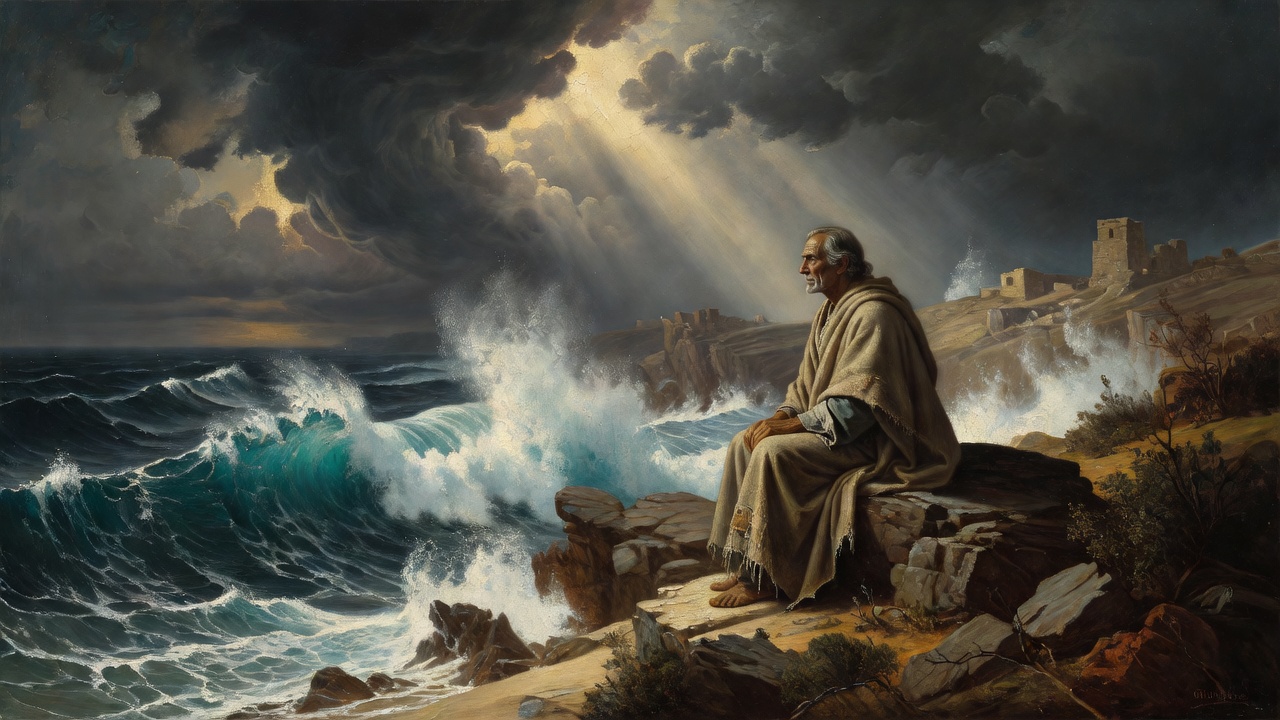
The LORD’s Power Shown in Leviathan
1Whether thou shalt be able to draw out Leviathan with an hook, and shalt bind with a rope his tongue?
2Whether thou shalt put a ring in his nostrils, either shalt pierce his cheek [bone] with an hook?
3Whether he shall multiply prayers to thee, either shall speak soft things to thee?
4Whether he shall make a covenant with thee, and shalt thou take him for a servant everlasting?
5Whether thou shalt scorn him as a bird, either shalt thou bind him to thine handmaidens?
6Shall friends carve him, shall merchants part him?
7Whether thou shalt fill nets with his skin, and a fish basket with his head?
8Shalt thou put thine hand upon him? have thou mind of the battle, and add thou no more to speak.
9Lo! his hope shall deceive him; and in the sight of all men he shall be cast down.
10I not as cruel shall raise him; for who may against-stand my face?
11And who gave to me before, that I yield to him? All things, that be under heaven, be mine.
12I shall not spare him for his mighty words, and made fair to beseech with.
13Who shall show the face of his clothing, and who shall enter into the midst of his mouth?
14Who shall open the gates of his cheer? fearedfulness is by the compass of his teeth.
15His body is as molten shields of brass, and joined together with scales overlaying themselves.
16One is joined to another; and soothly breathing goeth not through those [or them].
17One shall cleave to another, and those pieces holding together them-selves shall not be parted.
18His sneezing or snorting is as shining of fire, and his eyes be as eyelids of the morrowtide.
19Lights come forth of his mouth, as brands of fire, that be kindled.
20Smoke cometh forth of his nostrils, as a boiling pot set upon the fire.
21His breath maketh coals to burn, and flame goeth out of his mouth.
22Strength shall dwell in his neck, and neediness shall go away from before his face.
23The members of his flesh be cleaving together to themselves; God shall send floods against him, and those [or they] shall not be borne over to another place.
24His heart shall be made hard as a stone; and it shall be constrained together as the anvil of a smith.
25When he shall be taken away, angels shall dread; and they afeared shall be purged.
26When sword taketh him, it may not stand, neither spear, neither habergeon.
27For he shall areckon iron as chaff, and brass as rotten wood.
28A man archer shall not drive him away; [the] stones of a sling be turned into stubble to him.
29He shall areckon an hammer as stubble; and he shall scorn a flourishing spear.
30The beams of the sun shall be under him; and he shall strew to him-self gold as clay.
31He shall make the deep sea to boil as a pot; and he shall put it, as when ointments boil.
32A path shall shine after him; he shall guess the great ocean as waxing eld [or old].
33No power there is on earth, that shall be comparisoned to him; which is made, that he should dread nothing.
34He seeth all high thing [s]; he is king over all the sons of pride.
¿Sabías que…?
Leviatán y los Límites del Poder Humano
- El pasaje menciona herramientas antiguas de pesca y caza, como anzuelos, cuerdas, arpones y lanzas de pesca. El texto utiliza estos métodos convencionales para ilustrar que los seres humanos no pueden capturar, domesticar ni comercializar a Leviatán como a otros animales.Fuentes: el propio texto bíblico
- La descripción enumera una amplia variedad de armas antiguas, entre ellas espadas, lanzas, dardos, flechas, piedras de honda y garrotes. Se presenta a Leviatán como totalmente inmune a ellas, considerando el hierro como paja y el bronce como madera podrida.Fuentes: el propio texto bíblico
- Se describe a Leviatán como un ser sin temor, que hace hervir las profundidades del mar como una olla y reina sobre todos los seres orgullosos. La retórica plantea a Job que si ningún mortal puede enfrentarse a semejante criatura, nadie puede contender con su Creador.Fuentes: el propio texto bíblico
Notas escritas con ayuda de IA a partir de fuentes abiertas (Theographic Bible Metadata, CC BY-SA 4.0; Easton’s Bible Dictionary, dominio público) y revisadas antes de publicarse.
Créditos y licencia de esta traducción
Wycliffe's Bible with Modern Spelling
English: Wycliffe's Bible Modern Spelling (with Deuterocanon)
Copyright © 2001,2010,2011,2012,2013,2015 Terry Noble
Language: English
Dialect: Archaic
Translation by: Terry Noble
Wycliffe’s Bible with Modern Spelling, was made in response to requests from readers who wanted my Wycliffe’s Old and New Testaments and Apocrypha in one volume. Printing limitations dictated the number of pages available to me and the letter size. In my previous books, Wycliffe’s Bible, Wycliffe’s Old Testament, Vols. 1 amp 2, Wycliffe’s New Testament, and Wycliffe’s Apocrypha, I have tens of thousands of rewritten verses, presented in parentheses “( )”, to provide help in comprehending the 14th century Middle English vocabulary and grammar. In this present volume, with space at a premium, those “helps” had to be eliminated, to make room for the text of the Apocrypha.
This translation is made available to you under the terms of the
Creative Commons Attribution-Noncommercial-No Derivatives license 4.0.
You may share and redistribute this Bible translation or extracts from it in any format, provided that:
You include the above copyright and source information.
You do not sell this work for a profit.
You do not change any of the words or punctuation of the Scriptures.
Pictures included with Scriptures and other documents on this site are licensed just for use with those Scriptures and documents.
For other uses, please contact the respective copyright owners.
2019-09-26
Títulos de sección adaptados de la Berean Standard Bible (dominio público); no forman parte del texto bíblico de esta traducción.
Fuente: http://ebible.org/engwyc2017/ · eBible.org