Isaías 20
Wycliffe's Bible with Modern Spelling · Toca un versículo para ver sus referencias cruzadas.
A Sign against Egypt and Cush
1In the year wherein Tartan entered into Ashdod, when Sargon, the king of Assyrians, had sent him, and he had fought against Ashdod, and had taken it;
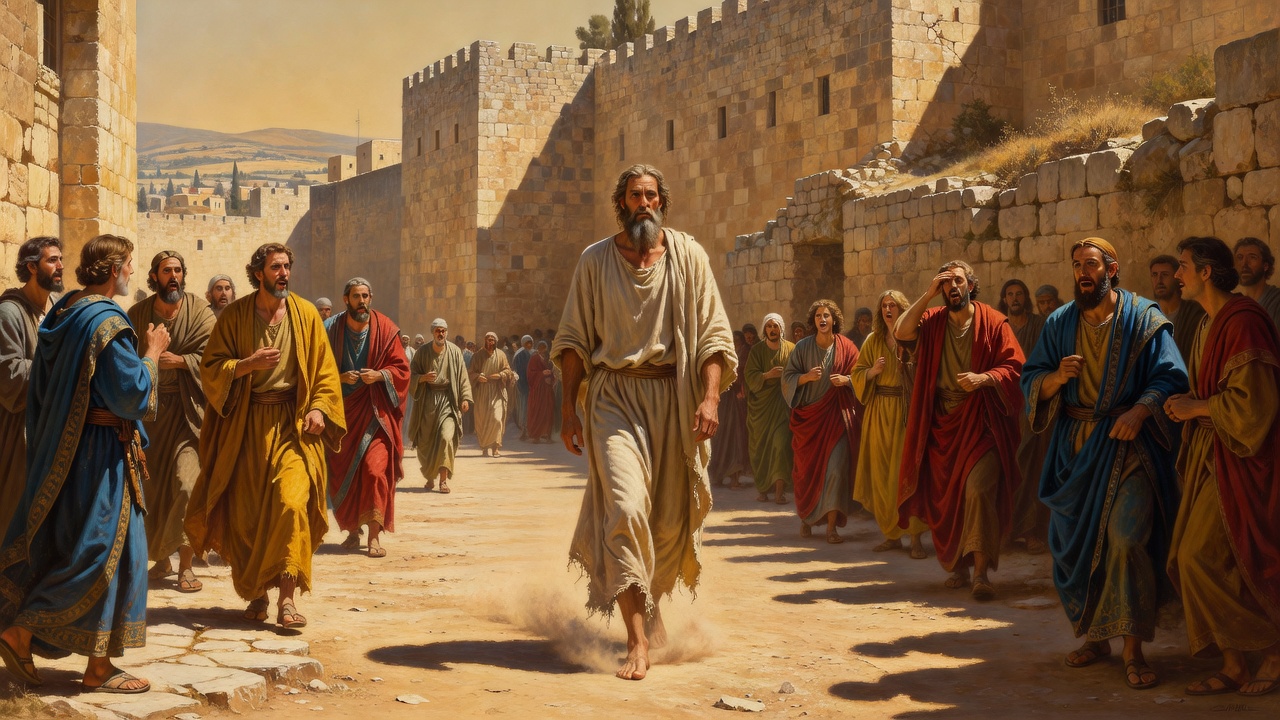
2in that time the Lord spake in the hand of Isaiah, the son of Amoz, and said, Go thou, and unbind the sack-cloth from thy loins, and take away thy shoes from thy feet. And he did so, going naked and unshod.
3And the Lord said, As my servant Isaiah went naked and unshod, a sign and great wonder of three years shall be on Egypt, and on Ethiopia;
4so the king of Assyrians shall drive the captivity of Egypt, and the passing over of Ethiopia, a young man and an eld [or old] man, naked and unshod, with the buttocks uncovered, to the shame of Egypt.
5And they shall dread, and shall be ashamed of Ethiopia, their hope, and of Egypt, their glory.
6And a dweller of this isle shall say on that day, This was our hope, to which we fled for help, that they should deliver us from the face of the king of Assyrians; and how may we escape?
¿Sabías que…?
Señal profética contra Egipto y Cus
- Asdod era una ciudad filistea fuertemente fortificada, ubicada en la ruta costera que conectaba Palestina con Egipto. El rey asirio Sargón envió a su comandante para sitiar y capturar la ciudad mientras el Imperio asirio se expandía hacia el sur.Fuentes: el propio texto bíblico · Ashdod
- Dios le ordenó a Isaías quitarse el cilicio exterior y las sandalias, caminando despojado y descalzo durante tres años. Este acto profético simbolizaba cómo Asiria conquistaría y llevaría cautivos a los pueblos de Egipto y Cus en humillación.Fuentes: el propio texto bíblico · Isaiah · Cush
Notas escritas con ayuda de IA a partir de fuentes abiertas (Theographic Bible Metadata, CC BY-SA 4.0; Easton’s Bible Dictionary, dominio público) y revisadas antes de publicarse.
Lugares de este capítulo
- Ashdod · Hoy: Tel Ashdod · 31.757, 34.658 · versículo 1
- Assyria · 36.359, 43.153 · versículos 1, 4, 6
- Cush · Hoy: Cush 1 · 16.935, 33.751 · versículos 3, 4, 5
- Egypt · 30.129, 31.308 · versículos 3, 4, 5, 6
Solo aparecen lugares identificados con alta confianza (90 % o más según las fuentes académicas reunidas por OpenBible). Mapa de la época: DARE (Digital Atlas of the Roman Empire), CC BY 4.0; mapa actual: © colaboradores de OpenStreetMap; lugares: OpenBible.info (CC BY 4.0).
Créditos y licencia de esta traducción
Wycliffe's Bible with Modern Spelling
English: Wycliffe's Bible Modern Spelling (with Deuterocanon)
Copyright © 2001,2010,2011,2012,2013,2015 Terry Noble
Language: English
Dialect: Archaic
Translation by: Terry Noble
Wycliffe’s Bible with Modern Spelling, was made in response to requests from readers who wanted my Wycliffe’s Old and New Testaments and Apocrypha in one volume. Printing limitations dictated the number of pages available to me and the letter size. In my previous books, Wycliffe’s Bible, Wycliffe’s Old Testament, Vols. 1 amp 2, Wycliffe’s New Testament, and Wycliffe’s Apocrypha, I have tens of thousands of rewritten verses, presented in parentheses “( )”, to provide help in comprehending the 14th century Middle English vocabulary and grammar. In this present volume, with space at a premium, those “helps” had to be eliminated, to make room for the text of the Apocrypha.
This translation is made available to you under the terms of the
Creative Commons Attribution-Noncommercial-No Derivatives license 4.0.
You may share and redistribute this Bible translation or extracts from it in any format, provided that:
You include the above copyright and source information.
You do not sell this work for a profit.
You do not change any of the words or punctuation of the Scriptures.
Pictures included with Scriptures and other documents on this site are licensed just for use with those Scriptures and documents.
For other uses, please contact the respective copyright owners.
2019-09-26
Títulos de sección adaptados de la Berean Standard Bible (dominio público); no forman parte del texto bíblico de esta traducción.
Fuente: http://ebible.org/engwyc2017/ · eBible.org