Eclesiastés 6
Wycliffe's Bible with Modern Spelling · Toca un versículo para ver sus referencias cruzadas.
The Futility of Life
1Also another evil there is, which I saw under the sun; and certainly it is oft used with men.
2A man is, to whom God gave riches, and chattel [or substance], and honour; and nothing faileth to his soul of all things which he desireth; and God giveth not power to him, that he eat thereof, but a strange man shall devour it. This is vanity, and a great wretchedness.
3If a man engendereth an hundred free sons, and hath many days of age, and his soul useth not the goods of his chattel [or substance], and wanteth burying; I pronounce of this man, that a dead-born child is better than he.
4For he cometh in vain, and goeth to darknesses; and his name shall be done away by forgetting.
5He saw not the sun, neither knew the diversity of good and of evil;
6also though he live two thousand years, and useth not [the] goods; whether all things hasten not to one place?
7All the travail of a man is in his mouth, but the soul of him shall not be [ful] filled with goods.
8What hath a wise man more than a fool? and what hath a poor man, but that he go thither, where is life?
9It is better to see that, that thou covetest, than to desire that, that thou knowest not; but also this is vanity, and presumption of spirit.
10The name of him that shall come, is called now, and it is known, that he is a man, and he may not strive in doom against a stronger than himself.
11Words be full many, and have much vanity in disputing. What need is it to a man to seek greater things than himself;
12since he knoweth not, what shall befall to him in his life, in the number of days of his pilgrimage, and in the time that passeth as shadow? either who may show to him, what thing under [the] sun shall come after him?
¿Sabías que…?
La Vanidad de la Riqueza Insatisfecha
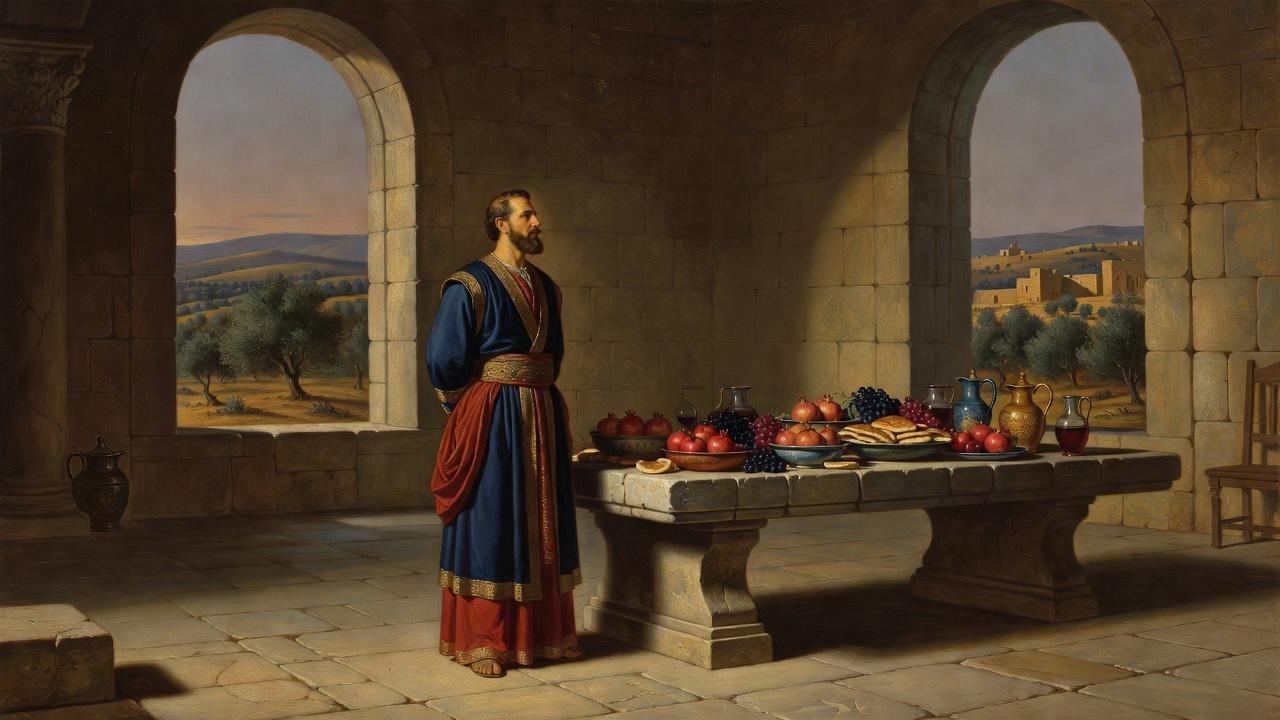
- En el pensamiento antiguo, gozar de una larga vida y engendrar muchos hijos se consideraban las mayores señales de bendición. Sin embargo, Eclesiastés observa que incluso vivir dos mil años y tener cien hijos carece de sentido si la persona no puede disfrutar de su prosperidad ni recibir una sepultura digna.Fuentes: el propio texto bíblico
- El autor señala que, aunque el trabajo humano se destina a satisfacer necesidades físicas básicas como la comida, el apetito y los deseos nunca quedan del todo satisfechos. Él contrasta el valorar lo que está presente ante los ojos con la persecución incesante de anhelos errantes.Fuentes: el propio texto bíblico
- El capítulo resalta los límites humanos, señalando que los mortales no pueden contender con lo que ha sido dispuesto por alguien más fuerte que ellos. Dado que la vida es efímera como una sombra, el ser humano no puede discernir con certeza qué es lo mejor para sí ni saber qué sucederá después de su muerte.Fuentes: el propio texto bíblico
Notas escritas con ayuda de IA a partir de fuentes abiertas (Theographic Bible Metadata, CC BY-SA 4.0; Easton’s Bible Dictionary, dominio público) y revisadas antes de publicarse.
Créditos y licencia de esta traducción
Wycliffe's Bible with Modern Spelling
English: Wycliffe's Bible Modern Spelling (with Deuterocanon)
Copyright © 2001,2010,2011,2012,2013,2015 Terry Noble
Language: English
Dialect: Archaic
Translation by: Terry Noble
Wycliffe’s Bible with Modern Spelling, was made in response to requests from readers who wanted my Wycliffe’s Old and New Testaments and Apocrypha in one volume. Printing limitations dictated the number of pages available to me and the letter size. In my previous books, Wycliffe’s Bible, Wycliffe’s Old Testament, Vols. 1 amp 2, Wycliffe’s New Testament, and Wycliffe’s Apocrypha, I have tens of thousands of rewritten verses, presented in parentheses “( )”, to provide help in comprehending the 14th century Middle English vocabulary and grammar. In this present volume, with space at a premium, those “helps” had to be eliminated, to make room for the text of the Apocrypha.
This translation is made available to you under the terms of the
Creative Commons Attribution-Noncommercial-No Derivatives license 4.0.
You may share and redistribute this Bible translation or extracts from it in any format, provided that:
You include the above copyright and source information.
You do not sell this work for a profit.
You do not change any of the words or punctuation of the Scriptures.
Pictures included with Scriptures and other documents on this site are licensed just for use with those Scriptures and documents.
For other uses, please contact the respective copyright owners.
2019-09-26
Títulos de sección adaptados de la Berean Standard Bible (dominio público); no forman parte del texto bíblico de esta traducción.
Fuente: http://ebible.org/engwyc2017/ · eBible.org