Hechos 15
Wycliffe's Bible with Modern Spelling · Toca un versículo para ver sus referencias cruzadas.
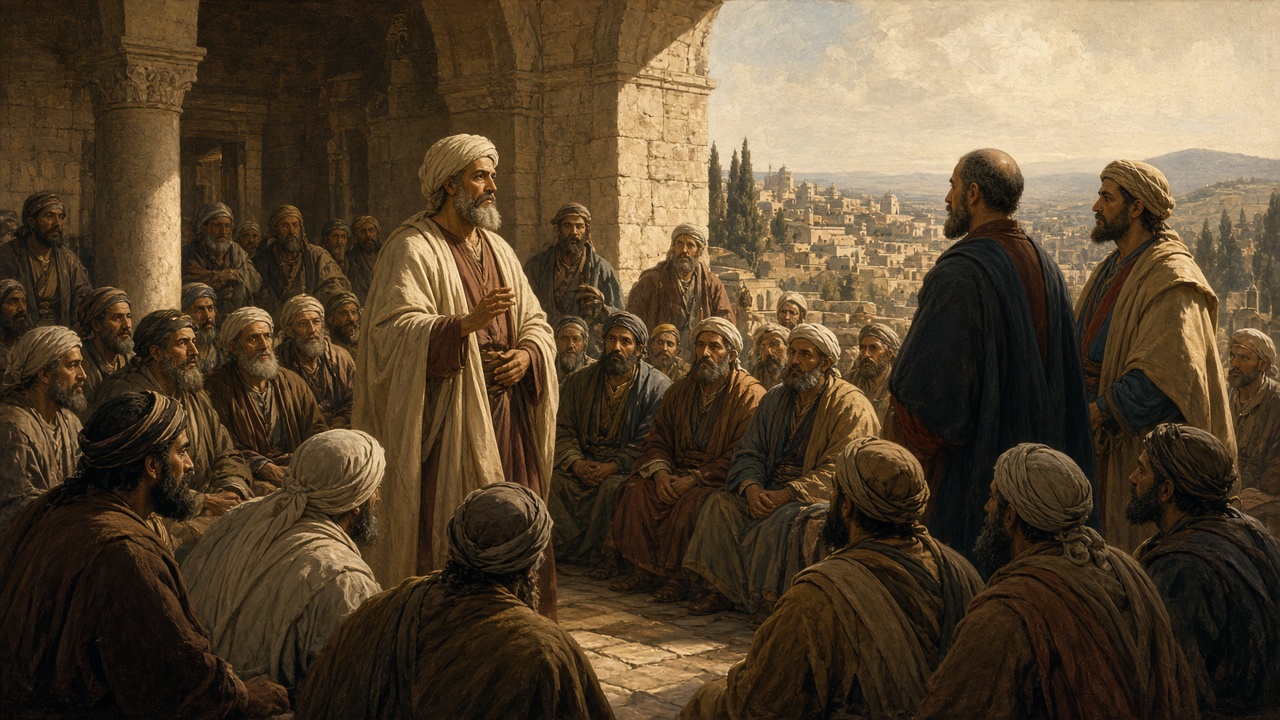
The Dispute over Circumcision
1And some men came down from Judea, and taught brethren, That but ye be circumcised after the law of Moses, ye may not be made safe [or may not be saved].
2Therefore when there was made not a little dissension to Paul and Barnabas against them, they ordained, that Paul and Barnabas, and some others of them, should go up to the apostles and priests in Jerusalem, on this question.
3And so they were led forth of the church, and passed by Phoenicia and Samaria; and they told the conver-sation [or the living] of heathen men, and they made great joy to all the brethren.
4And when they came to Jeru-salem, they were received of the church, and of the apostles, and of the elder men, and told, how great [or how many] things God did with them.
The Council at Jerusalem
5But some of the heresy of the Pharisees, that believed, rose up, and said, That it behooveth them to be circumcised, and to command to keep also the law of Moses.
6And the apostles and elder men came together, to see of this word.
7And when there was made a great seeking thereof, Peter rose, and said to them, Brethren, ye know, that of old days in you, God chose by my mouth heathen men, to hear the word of the gospel, and to believe;
8and God, that knew the hearts, bare witnessing, and gave to them the Holy Ghost, as also to us;
9and nothing diversed betwixt us and them, cleansing the hearts of them by faith.
10Now then what tempt ye God, to put a yoke on the neck of the disciples, which neither we, neither our fathers might bear?
11But by the grace of our Lord Jesus Christ we believe to be saved, as also they.
12And all the multitude held peace, and heard Barnabas and Paul, telling how great [or how many] signs and wonders God did by them in heathen men.
13And after that they held peace, James answered, and said, Brethren, hear ye me.
14Simon told, how God visited, first to take of heathen men, a people to his name. [Simon told, how first God visited, to take of heathen men a people to his name.]
15And the words of prophets accord to him, as it is written,
16After this I shall turn again, and build the tabernacle of David, that fell down; and I shall build again the cast-down things of it, and I shall raise it;
17that other men seek the Lord, and all folks, on whom my name is called to help [or in-called]; the Lord doing this thing, saith.
18From the world, the work of the Lord is known to the Lord.
19For which thing I deem them that of heathen men be converted to God, to be not dis-eased [or unquieted],
20but to write to them, that they abstain them from defoulings of mau-mets [or of simulacra], and from forni-cation, and strangled things, and blood.
21For Moses of old times hath in all cities them that preach him in syna-gogues, whereby each sabbath he is read.
The Letter to the Gentile Believers
22Then it pleased to the apostles, and to the elder men, with all the church, to choose men of them, and send to Antioch, with Paul and Barnabas, Judas, that was named Barsabas, and Silas, the first men among brethren;
23and wrote by the hands of them, Apostles and elder brethren to them that be at Antioch, and Syria, and Cilicia, brethren of heathen men, greeting.
24For we heard that some went out from us, and troubled you with words, and turned upside-down your souls, to which men we commanded not,
25it pleased to us gathered into one, to choose men, and send to you, with our most dearworthy Barnabas and Paul,
26men that gave their lives for the name of our Lord Jesus Christ.
27Therefore we sent Judas and Silas, and they shall tell the same things to you by words.
28For it is seen to the Holy Ghost, and to us, to put to you nothing more of charge, than these needful things,
29that ye abstain you from the offered things of maumets [or simu-lacra], and blood strangled, and forni-cation. From which ye keeping you, shall do well. Fare ye well.
The Believers at Antioch Rejoice
30Therefore they were let go [or dismissed], and came down to Antioch; and when the multitude was gathered, they betook the epistle;
31which when they had read, they joyed on the comfort.
32And Judas and Silas and they, for they were prophets, comforted brothers, and confirmed [them] with full many words.
33But after that they had been there a little while, they were let go of brethren with peace [or they were dismissed with peace of brethren], to them that had sent them.
34But it was seen to Silas, to dwell there; and Judas went alone to Jeru-salem.
35And Paul and Barnabas dwelt at Antioch, teaching and preaching the word of the Lord, with others many [or with many others].
Paul’s Second Missionary Journey Begins
36But after some days, Paul said to Barnabas, Turn we again, and visit we [our] brethren by all cities, in which we have preached the word of the Lord, how they have them.
37And Barnabas would take with him John, that was named Mark.
38But Paul prayed him, that he that departed from them from Pamphylia, and went not with them into the work, should not be received.
39And dissension was made, so that they departed atwain. And Barnabas took Mark, and came by boat to Cyprus.
40And Paul chose Silas, and went forth from the brethren, and was betaken to the grace of God.
41And he went by Syria and Cilicia, and confirmed the church, commanding to keep the behests [or the precepts] of the apostles and elder men.
¿Sabías que…?
El concilio sobre los creyentes gentiles
- La controversia comenzó en Antioquía, a orillas del Orontes, unas trescientas millas al norte de Jerusalén, ciudad que entonces ocupaba el tercer lugar entre las ciudades del Imperio romano, después de Roma y Alejandría. De camino al concilio, Pablo y Bernabé pasaron por Fenicia, una franja costera de unas ciento veinte millas, y por Samaria. Una nota cronológica fecha el Concilio de Jerusalén en el año 46 d. C.Fuentes: Antioch (Syria) · Phenicia · el propio texto bíblico · Jerusalem Council
- El Easton's Bible Dictionary (1897) afirma que Santiago, a quien llama hermano o pariente cercano de Jesús, dirigía la iglesia en Jerusalén y presidió el concilio sobre los gentiles. La carta que siguió iba dirigida a los creyentes gentiles de Antioquía, Siria y Cilicia. Cilicia, provincia de origen de Pablo y provincia marítima romana en el sureste de Asia Menor desde el 67 a. C., incluía su ciudad natal, Tarso.Fuentes: James (Brother of Jesus) · el propio texto bíblico · Cilicia · Paul
- Judas, llamado Barsabás, y Silas, también conocido como Silvano, eran profetas y hombres destacados de la iglesia de Jerusalén, enviados para confirmar en persona la decisión del concilio. Un desacuerdo posterior y agudo por Juan Marcos, primo de Bernabé, separó a los dos misioneros: Bernabé se llevó a Marcos y zarpó hacia Chipre, mientras Pablo eligió a Silas. Una nota cronológica fecha esa separación en el año 47 d. C.Fuentes: el propio texto bíblico · Silas · John Mark · Paul and Barnabas part ways
Notas escritas con ayuda de IA a partir de fuentes abiertas (Theographic Bible Metadata, CC BY-SA 4.0; Easton’s Bible Dictionary, dominio público) y revisadas antes de publicarse.
Lugares de este capítulo
- Antioch · Hoy: Antioch on the Orontes · 36.227, 36.172 · versículos 1, 22, 23, 30, 35
- Judea · Hoy: Judea 1 · 31.777, 35.234 · versículo 1
- Jerusalem · 31.777, 35.234 · versículos 2, 3, 4, 22, 23, 33
- Phoenicia · 33.271, 35.196 · versículo 3
- Samaria · Hoy: Samaria 2 · 32.276, 35.195 · versículo 3
- Cilicia · 36.913, 34.892 · versículos 23, 41
- Syria · Hoy: Syria 2 · 33.511, 36.306 · versículos 23, 41
- Pamphylia · 37.000, 31.000 · versículo 38
- Cyprus · 35.000, 33.000 · versículo 39
Solo aparecen lugares identificados con alta confianza (90 % o más según las fuentes académicas reunidas por OpenBible). Mapa de la época: DARE (Digital Atlas of the Roman Empire), CC BY 4.0; mapa actual: © colaboradores de OpenStreetMap; lugares: OpenBible.info (CC BY 4.0).
Créditos y licencia de esta traducción
Wycliffe's Bible with Modern Spelling
English: Wycliffe's Bible Modern Spelling (with Deuterocanon)
Copyright © 2001,2010,2011,2012,2013,2015 Terry Noble
Language: English
Dialect: Archaic
Translation by: Terry Noble
Wycliffe’s Bible with Modern Spelling, was made in response to requests from readers who wanted my Wycliffe’s Old and New Testaments and Apocrypha in one volume. Printing limitations dictated the number of pages available to me and the letter size. In my previous books, Wycliffe’s Bible, Wycliffe’s Old Testament, Vols. 1 amp 2, Wycliffe’s New Testament, and Wycliffe’s Apocrypha, I have tens of thousands of rewritten verses, presented in parentheses “( )”, to provide help in comprehending the 14th century Middle English vocabulary and grammar. In this present volume, with space at a premium, those “helps” had to be eliminated, to make room for the text of the Apocrypha.
This translation is made available to you under the terms of the
Creative Commons Attribution-Noncommercial-No Derivatives license 4.0.
You may share and redistribute this Bible translation or extracts from it in any format, provided that:
You include the above copyright and source information.
You do not sell this work for a profit.
You do not change any of the words or punctuation of the Scriptures.
Pictures included with Scriptures and other documents on this site are licensed just for use with those Scriptures and documents.
For other uses, please contact the respective copyright owners.
2019-09-26
Títulos de sección adaptados de la Berean Standard Bible (dominio público); no forman parte del texto bíblico de esta traducción.
Fuente: http://ebible.org/engwyc2017/ · eBible.org