Job 8
World English Bible · Toca un versículo para ver sus referencias cruzadas.
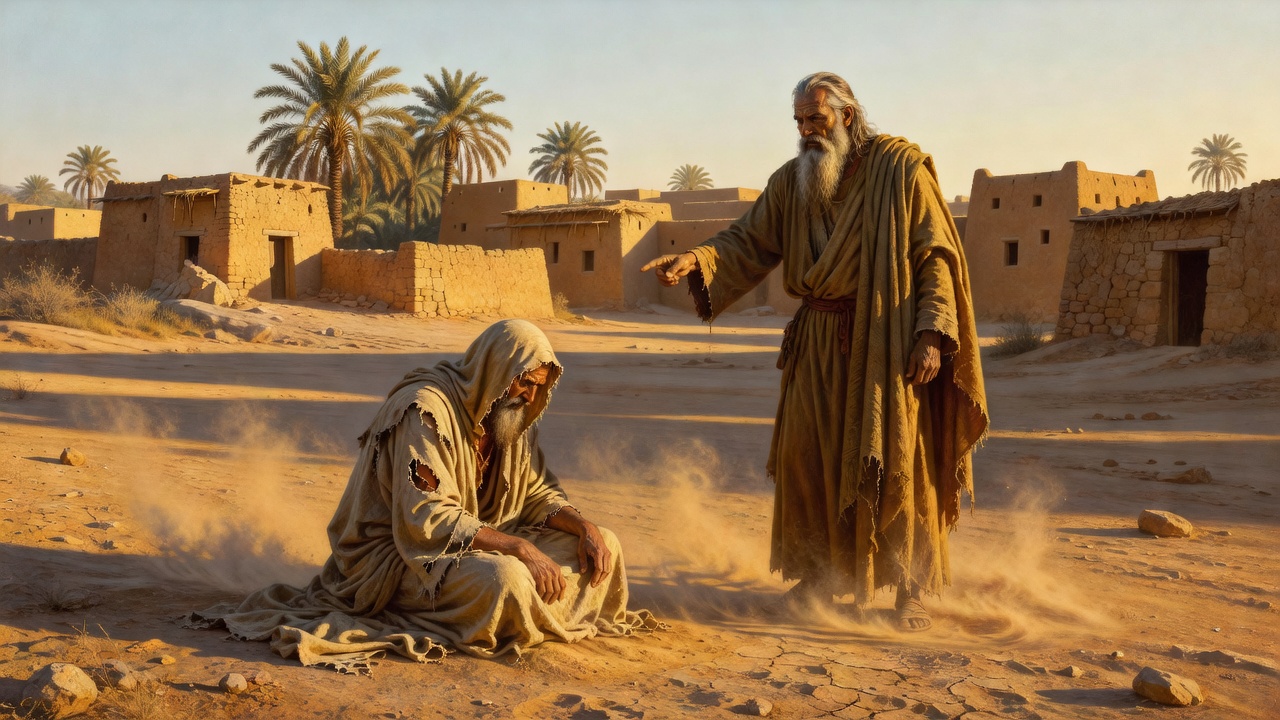
Bildad: Job Should Repent
1Then Bildad the Shuhite answered,
2“How long will you speak these things?
Shall the words of your mouth be a mighty wind?
3Does God pervert justice?
Or does the Almighty pervert righteousness?
4If your children have sinned against him,
he has delivered them into the hand of their disobedience.
5If you want to seek God diligently,
make your supplication to the Almighty.
6If you were pure and upright,
surely now he would awaken for you,
and make the habitation of your righteousness prosperous.
7Though your beginning was small,
yet your latter end would greatly increase.
8“Please inquire of past generations.
Find out about the learning of their fathers.
9(For we are but of yesterday, and know nothing,
because our days on earth are a shadow.)
10Shall they not teach you, tell you,
and utter words out of their heart?
11“Can the papyrus grow up without mire?
Can the rushes grow without water?
12While it is yet in its greenness, not cut down,
it withers before any other reed.
13So are the paths of all who forget God.
The hope of the godless man will perish,
14whose confidence will break apart,
whose trust is a spider’s web.
15He will lean on his house, but it will not stand.
He will cling to it, but it will not endure.
16He is green before the sun.
His shoots go out along his garden.
17His roots are wrapped around the rock pile.
He sees the place of stones.
18If he is destroyed from his place,
then it will deny him, saying, ‘I have not seen you.’
19Behold, this is the joy of his way.
Out of the earth, others will spring.
20“Behold, God will not cast away a blameless man,
neither will he uphold the evildoers.
21He will still fill your mouth with laughter,
your lips with shouting.
22Those who hate you will be clothed with shame.
The tent of the wicked will be no more.”
¿Sabías que…?
El llamado de Bildad a la sabiduría antigua
- Bildad es identificado como suhita, lo que probablemente lo vincula con Súa, una región árabe poblada por los descendientes de Abraham y Cetura. En este capítulo, pronuncia el primero de sus tres discursos severos a Job, afirmando que la justicia divina es absoluta e inalterable.Fuentes: Bildad · el propio texto bíblico
- En lugar de recurrir a su propia experiencia, Bildad apela al conocimiento acumulado de las generaciones pasadas, comparando los días humanos con una sombra pasajera. Para ilustrar la ruina del impío, utiliza metáforas de la naturaleza como juncos que se marchitan sin agua y la fragilidad de una telaraña.Fuentes: el propio texto bíblico
Notas escritas con ayuda de IA a partir de fuentes abiertas (Theographic Bible Metadata, CC BY-SA 4.0; Easton’s Bible Dictionary, dominio público) y revisadas antes de publicarse.
Créditos y licencia de esta traducción
The World English Bible
The World English Bible is in the Public Domain. That means that it is not copyrighted. However, "World English Bible" is a Trademark of eBible.org.
You may copy, publish, proclaim, distribute, redistribute, sell, give away, quote, memorize, read publicly, broadcast, transmit, share, back up, post on the Internet, print, reproduce, preach, teach from, and use
the World English Bible as much as you want, and others may also do so. All we ask is that if you CHANGE the actual text of the World English Bible in any way, you not call the result the World English Bible any more.
This is to avoid confusion, not to limit your freedom. The Holy Bible is God's Word. It belongs to God. He gave it to us freely, and we who have worked on this translation freely give it to you by dedicating it to the
Public Domain.
Donations to help with the expenses of this project and thus help others have free access to the Word of God may be made to us, but are not required. Please see
https://MLJohnson.org/partner/ for more about that.
The master copy of this Bible translation is posted on https://eBible.org/web/ and at https://WorldEnglish.Bible .
2020 stable text edition
Títulos de sección adaptados de la Berean Standard Bible (dominio público); no forman parte del texto bíblico de esta traducción.
Fuente: http://ebible.org/engwebp/ · eBible.org