Lucas 6
Tyndale New Testament · Toca un versículo para ver sus referencias cruzadas.
The Lord of the Sabbath
1It happened on an after saboth that he went thorow the corne felde and that his disciples plucked the eares of corne and ate and rubbed them in their hondes. 2And certayne of the Pharises sayde vnto them: Why do the that which is not laufull to do on the saboth dayes? 3And Iesus answered them and sayde: Have ye not redde what David dyd when he him sylfe was anhungred and they which were with him: 4how he went into the housse of God and toke and ate the loves of halowed breed and gave also to them which were with him: which was not laufull to eate but for the prestes only. 5And he sayde vnto them: The sonne of man is Lorde of the saboth daye.
Jesus Heals on the Sabbath
6And it fortuned in a nother saboth also that he entred in to the sinagoge and taught. And ther was a man whose right honde was dryed vp. 7And the Scribes and Pharises watched him to se whether he wolde heale on the Saboth daye that they myght fynde an accusacion agaynst him. 8But he knewe their thoughtes and sayde to the man which had the wyddred honde: Ryse vp and stonde forthe in the myddes. And he arose and stepped forthe. 9Then sayde Iesus vnto them: I will axe you a question: Whether is it laufull on the saboth dayes to do good or to do evill? to save lyfe or for to destroye it? 10And he behelde them all in compasse and sayd vnto the man: Stretche forth thy honde. And he dyd so and his honde was restored and made as whoole as the other. 11And they were filled full of madnes and communed one with another what they myght do to Iesu.
The Twelve Apostles
12And it fortuned in thoose dayes that he went out into a mountayne for to praye and cotinued all nyght in prayer to god. 13And assone as it was daye he called his disciples and of the he chose twelve which also he called apostles. 14Simon who he named Peter: and Andrew his brother. Iames and Ihon Philip and Bartlemew 15Mathew and Thomas Iames the sonne of Alpheus and Simon called zelotes 16and Iudas Iames sonne and Iudas Iscarioth which same was the traytour.
Jesus Heals the Multitudes
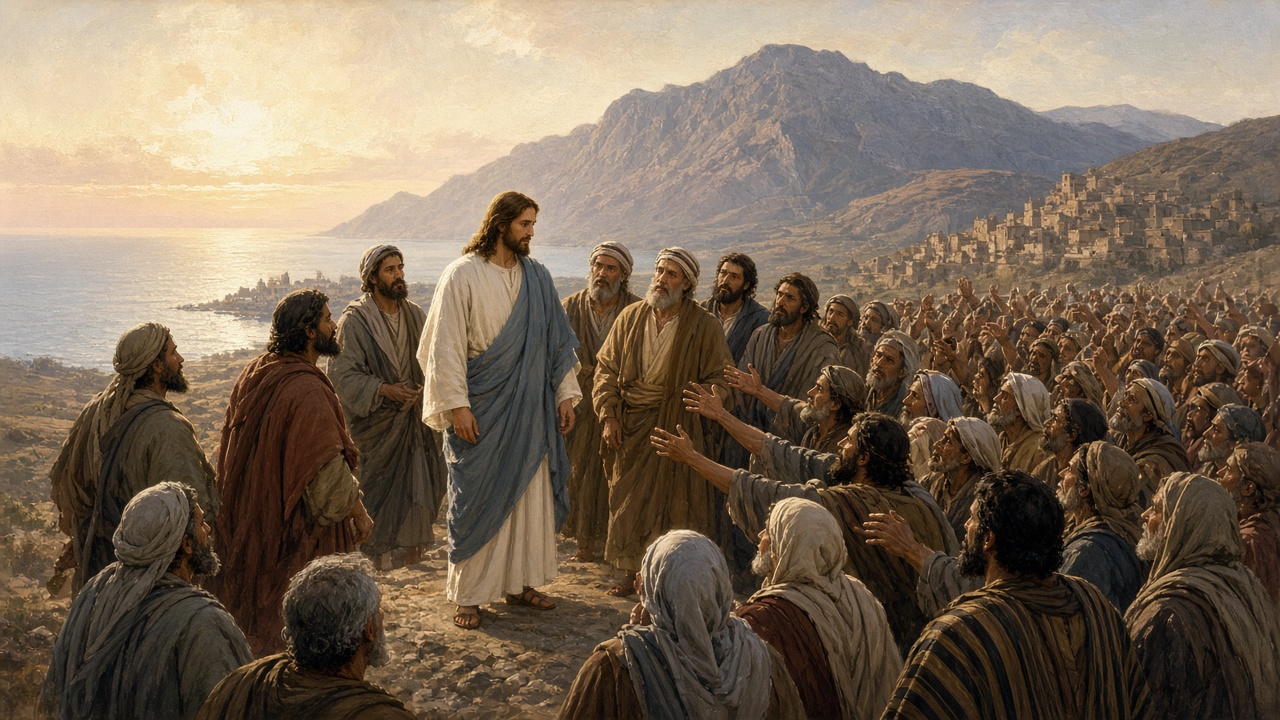
17And he came doune with them and stode in the playne felde with the company of his disciples and agreate multitude of people out of all parties of Iurie and Ierusalem and from the see cooste of Tire and Sidon which came to heare hym and to be healed of their diseases: 18and they also that were vexed with foule spretes and they were healed. 19And all the people preased to touche him: for there went vertue out of him and healed them all.
The Beatitudes
20And he lifted vp his eyes apon the disciples and sayde: Blessed be the poore: for yours is the kyngdome of God. 21Blessed are ye that honger now: for ye shalbe satisfied. 22Blessed are ye that wepe now: for ye shall laugh. Blessed are ye when men hate you and thrust you oute of their companye and rayle and abhorre youre name as an evyll thinge for the sonne of manes sake. 23Reioyse ye then and be gladde: for beholde youre rewarde is greate in heven. After this manner their fathers entreated the Prophetes.
Woes to the Satisfied
24But wo be to you that are ryche: for ye have therin youre consolacion. 25Wo be to you that are full: for ye shall honger. Wo be to you that now laugh: for ye shall wayle and wepe. 26Wo be to you when all men prayse you: for so dyd their fathers to the false prophetes.
Love Your Enemies
27But I saye vnto you which heare: Love youre enemyes. Do good to the which hate you. 28Blesse the that course you. And praye for the which wrongfully trouble you. 29And vnto him that smyteth the on the one cheke offer also the other. And him that taketh awaye thy goune forbid not to take thy coote also. 30Geve to every man that axeth of the. And of him that taketh awaye thy goodes axe them not agayne. 31And as the wolde that men shuld doo to you: so do ye to them lyke wyse. 32If ye love the which love you: what thanke are ye worthy of? For the very synners love their lovers. 33And yf ye do for them which do for you: what thanke are ye worthy of? For the very synners do even the same. 34If ye lende to them of whome ye hoope to receave: what thanke shall ye have: for the very synners lende to synners to receave as moch agayne. 35Wherfore love ye youre enemys do good and lende lokynge for nothinge agayne and youre rewarde shalbe greate and ye shalbe the chyldren of the hyest: for he is kynde vnto the vnkynde and to the evyll. 36Be ye therfore mercifull as youre father is mercifull.
Judging Others
37Iudge not and ye shall not be Iudged. Condemne not: and ye shall not be condemned. Forgeve and ye shalbe forgeven. 38Geve and that shalbe geven vnto you: good measure pressed doune shaken to geder and runnynge over shall men geve into youre bosomes. For with what measure ye mete with ye same shall men mete to you agayne. 39And he put forthe a similitude vnto the: Can the blynde leade the blynde? Do they not both then fall into the dyche? 40The disciple is not above his master. Every man shalbe perfecte even as his master is. 41Why seyst thou a moote in thy brothers eye and considerest not the beame that is in thyne awne eye? 42Ether how cannest thou saye to thy brother: Brother let me pull out the moote that is in thyne eye: when thou perceavest not the beame that is in thyne awne eye? Ypocrite cast out the beame out of thyne awne eye fyrst and then shalt thou se perfectly to pull out the moote out of thy brothers eye.
A Tree and Its Fruit
43It is not a good tree that bringeth forthe evyll frute: nether is that an evyll tree that bringeth forthe good frute. 44For every tree is knowen by his frute. Nether of thornes gader men fygges nor of busshes gader they grapes. 45A good man out of the good treasure of his hert bringeth forthe that which is good. And an evyll man out of the evyll treasure of his hert bringeth forthe that which ys evyll. For of the aboundaunce of the her his mouthe speakethe.
The House on the Rock
46Why call ye me Master, Master: and do not as I bid you? 47whosoever cometh to me and heareth my sayinges and dothe the same I will shewe you to whome he ys lyke. 48He is like a man which bilt an housse: and digged depe and layde the foundacion on a rocke. When the waters arose the fludde bet apon that housse and coulde not move that. For it was grounded apon a rocke. 49But he that heareth and doth not is lyke a man that with out foundacion bylt an housse apon the erth agaynst which the fludde did bet: and it fell by and by. And the fall of that housse was greate.
¿Sabías que…?
El sábado, los Doce y la llanura
- En un sábado, mientras Jesús pasaba por los sembrados, sus discípulos arrancaban espigas, las restregaban entre las manos y se las comían, y algunos fariseos dijeron que eso era ilícito. Jesús recordó que David y sus compañeros, con hambre, comieron el pan consagrado de la casa de Dios, lícito solo para los sacerdotes, y dijo que el Hijo del Hombre es Señor del sábado. En otro sábado, restauró en la sinagoga la mano derecha atrofiada de un hombre, mientras los escribas y fariseos lo observaban buscando un motivo para acusarlo; una cronología fecha ambos episodios en el año 28 d. C.Fuentes: el propio texto bíblico · Corn on the Sabbath · Healing a Withered Hand
- Después de pasar la noche en oración en el monte, Jesús llamó a sus discípulos y eligió a doce, a quienes designó apóstoles. Entre ellos estaban Simón, a quien llamó Pedro, y Andrés, hermano de Pedro, pescadores de Betsaida, en la costa occidental del mar de Galilea, y Mateo, recaudador de impuestos en Capernaúm, antes conocido como Leví.Fuentes: el propio texto bíblico · Simon Peter · Andrew · Matthew
- Jesús bajó con ellos y se detuvo en un lugar llano, donde se había reunido gente de Judea, de Jerusalén y de la costa de Tiro y Sidón para oírlo y ser sanada. Tiro y Sidón eran antiguas ciudades fenicias del Mediterráneo; Sidón, la más antigua, quedaba a unas veinticinco millas al norte de Tiro. Una cronología fecha esta enseñanza en el año 28 d. C. y la titula Sermón del Monte, aunque el relato sitúa a Jesús en terreno llano después de bajar del monte.Fuentes: el propio texto bíblico · Tyre · Sidon · Sermon on the Mount
Notas escritas con ayuda de IA a partir de fuentes abiertas (Theographic Bible Metadata, CC BY-SA 4.0; Easton’s Bible Dictionary, dominio público) y revisadas antes de publicarse.
Lugares de este capítulo
- Jerusalem · 31.777, 35.234 · versículo 17
- Judea · Hoy: Judea 1 · 31.777, 35.234 · versículo 17
- Sidon · Hoy: Sandikli archaeological site in Sidon · 33.561, 35.372 · versículo 17
- Tyre · 33.271, 35.196 · versículo 17
Solo aparecen lugares identificados con alta confianza (90 % o más según las fuentes académicas reunidas por OpenBible). Mapa de la época: DARE (Digital Atlas of the Roman Empire), CC BY 4.0; mapa actual: © colaboradores de OpenStreetMap; lugares: OpenBible.info (CC BY 4.0).
Créditos y licencia de esta traducción
Tyndale New Testament
The Tyndale New Testament (1534)
Public Domain
Language: English
Dialect: archaic British
Translation by: William Tyndale
2020-12-20
Títulos de sección adaptados de la Berean Standard Bible (dominio público); no forman parte del texto bíblico de esta traducción.
Fuente: http://ebible.org/engtnt/ · eBible.org