Marcos 12
Text-Critical English New Testament · Toca un versículo para ver sus referencias cruzadas.
The Parable of the Vineyard Owner
1Then Jesus began to speak to them in parables: “A man planted a vineyard, put a fence around it, dug a pit for the winepress, built a tower, leased it to farmers, and left the country. 2At harvest time he sent a servant to the farmers to receive from them some of the fruit of the vineyard. 3But they seized that servant, beat him, and sent him away empty-handed. 4Again he sent to them another servant, and they threw stones at him, struck him on the head, and sent him away after dishonoring him. 5Again he sent another, and that one they killed. He also sent many others, some of whom they beat, and some of whom they killed. 6Now he still had his one beloved son. He sent him to them as well, last of all, saying, ‘They will have respect for my son.’ 7But the farmers said to one another, ‘This is the heir. Come, let us kill him, and the inheritance will be ours.’ 8So they took him, killed him, and threw him out of the vineyard. 9What then will the owner of the vineyard do? He will come and destroy those farmers and give the vineyard to others. 10Have you not read this Scripture:
‘The stone the builders rejected
has become the cornerstone;
11this was the Lord's doing,
and it is amazing in our eyes’?”
12Then the chief priests, the scribes, and the elders were looking for a way to arrest Jesus because they knew he had spoken the parable against them. But they were afraid of the crowd, so they left him and went away.
The Question About Paying Taxes to Caesar
13Later they sent some of the Pharisees and the Herodians to Jesus to trap him in what he said. 14They came and said to him, “Teacher, we know that yoʋ are true and defer to no one, for yoʋ do not show partiality but teach the way of God in truth. Is it lawful to pay taxes to Caesar or not? Should we give or should we not give?” 15But knowing their hypocrisy, Jesus said to them, “Why are you testing me? Bring me a denarius and let me look at it.” 16So they brought one. Then he said to them, “Whose image and inscription is this?” They said to him, “Caesar's.” 17In response Jesus said to them, “Render to Caesar the things that are Caesar's, and to God the things that are God's.” And they were amazed at him.
The Sadducees Ask About the Resurrection
18Then some Sadducees (who say there is no resurrection) came to Jesus and asked him, 19“Teacher, Moses wrote for us: ‘If a man's brother dies, leaving a wife but no children, that man must marry the widow and raise up offspring for his brother.’ 20Now there were seven brothers. The first married a woman and died, leaving no offspring. 21The second married her and died, and he also left no offspring; the third did likewise. 22In fact, the seven all married her and left no offspring. Last of all, the woman also died. 23In the resurrection, when they rise again, which of them will she be the wife of? For the seven all had her as a wife.”
24Jesus answered them, “Is this not why you are in error, because you know neither the Scriptures nor the power of God? 25For when people rise from the dead, they neither marry nor are they given in marriage. Instead, they are like the angels in heaven. 26But as for the dead being raised, have you not read in the Book of Moses, in the passage about the burning bush, how God said to Moses, ‘I am the God of Abraham, the God of Isaac, and the God of Jacob’? 27He is not the God of the dead, but the God of the living. You have therefore made a serious error.”
The Most Important Commandment
28Now one of the scribes came up and heard them debating, and when he realized that Jesus had answered them well, he asked him, “Which is the most important commandment of all?” 29Jesus answered him, “The most important of all the commandments is this: ‘Hear, O Israel: The Lord our God, the Lord is one. 30And yoʋ shall love the Lord yoʋr God with all yoʋr heart, with all yoʋr soul, with all yoʋr mind, and with all yoʋr strength.’ This is the most important commandment. 31And a second like it is this: ‘Yoʋ shall love yoʋr neighbor as yoʋrself.’ There is no other commandment greater than these.” 32Then the scribe said to him, “Yoʋ are right, Teacher. In truth yoʋ have said that God is one, and that there is no other besides him, 33and that to love him with all yoʋr heart, with all yoʋr understanding, with all yoʋr soul, and with all yoʋr strength, and to love yoʋr neighbor as yoʋrself is greater than every whole burnt offering and sacrifice.” 34When Jesus saw that the man had answered wisely, he said to him, “Yoʋ are not far from the kingdom of God.” And no one dared to ask him questions anymore.
Whose Son Is the Christ?
35As Jesus taught in the temple courts, he said, “How can the scribes say that the Christ is the Son of David? 36For David himself said in the Holy Spirit,
‘The Lord said to my Lord,
“Sit at my right hand
until I make yoʋr enemies a footstool for yoʋr feet.” ’
37David himself calls him ‘Lord,’ so how is he his son?” And the large crowd was listening to him gladly.
Beware of the Scribes
38Jesus also said to them in his teaching, “Beware of the scribes who like to walk around in long robes and to receive greetings in the marketplaces 39and to have the best seats in the synagogues and the places of honor at banquets, 40who devour widows' houses and for a pretense make long prayers. They will receive a more severe judgment.”
The Widow's Offering
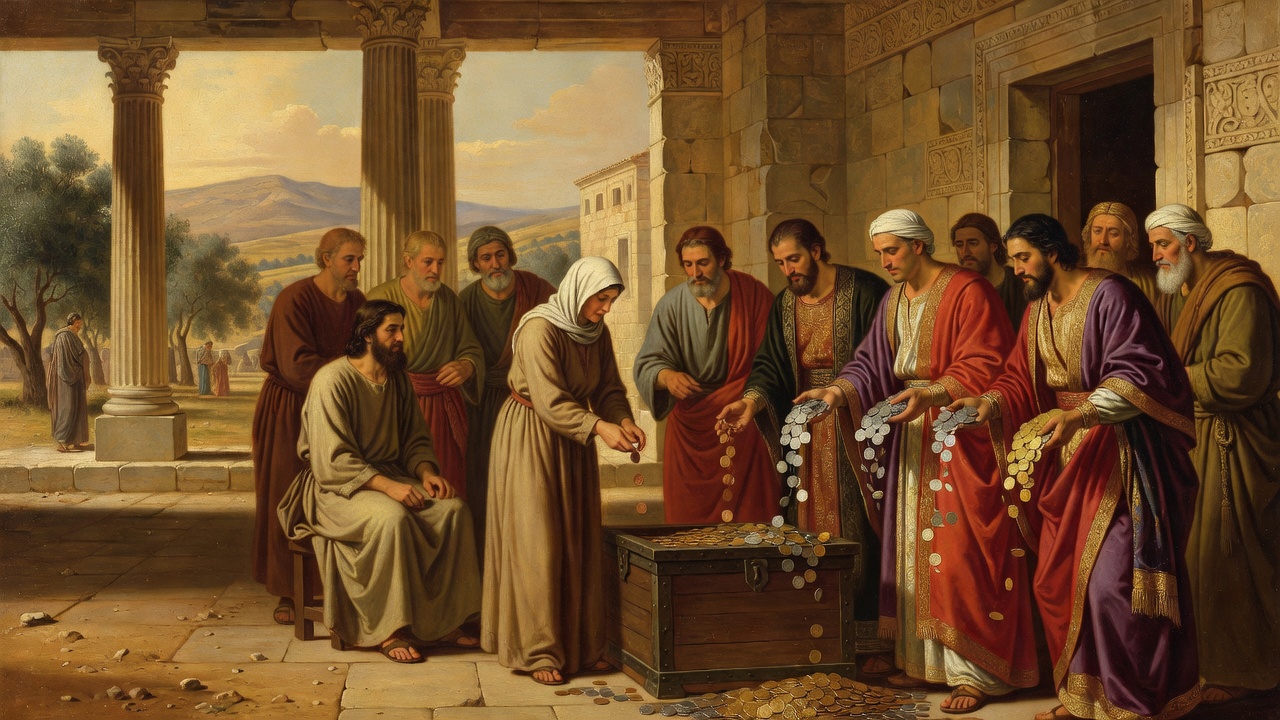
41Later Jesus sat down across from the treasury and watched how the crowd was putting money into the treasury. Many rich people put in large amounts. 42Then a poor widow came and put in two small copper coins, which are worth a penny. 43So Jesus called his disciples over and said to them, “Truly I say to you, this poor widow has put more money into the treasury than all the others. 44For they have all put in money out of their abundance, but she, out of her poverty, has put in all that she had, her entire livelihood.” So Jesus called his disciples over and said to them, “Truly I say to you, this poor widow has put more money into the treasury than all the others|src="02 Mark 12_43.png" size="span" copy="Public Domain (Gustave Doré)" ref="12:43"
¿Sabías que…?
Debates en el templo
- Los saduceos, que dicen que no hay resurrección, interrogan a Jesús sobre siete hermanos y una viuda, apelando a lo que escribió Moisés. Él los remite a la zarza ardiente en el Libro de Moisés, donde Dios dice: “Yo soy el Dios de Abraham, el Dios de Isaac y el Dios de Jacob”. Abraham, “padre de una multitud”, era hijo de Taré; Isaac era el único hijo de Abraham con Sara; y Jacob era el segundo de los hijos gemelos de Isaac y Rebeca.Fuentes: el propio texto bíblico · Abraham · Isaac · Jacob (Israel)
- Cuando le preguntan cuál es el mandamiento más importante, Jesús comienza: “Oye, Israel, el Señor nuestro Dios, el Señor es uno”, y añade: “Ama a tu prójimo como a ti mismo”. Israel es otro nombre de Jacob, el segundo de los gemelos de Isaac y Rebeca; el nombre Jacob se explica como el que sigue los talones de otro, o suplantador.Fuentes: el propio texto bíblico · Jacob (Israel)
- Mientras enseña en los atrios del templo, Jesús pregunta cómo pueden decir los escribas que el Cristo es el Hijo de David, si el propio David lo llama “Señor”. David, cuyo nombre significa “Amado”, era el octavo y el menor de los hijos de Isaí, ciudadano de Belén, y su primera ocupación fue cuidar las ovejas de su padre en las tierras altas de Judá.Fuentes: el propio texto bíblico · David
Notas escritas con ayuda de IA a partir de fuentes abiertas (Theographic Bible Metadata, CC BY-SA 4.0; Easton’s Bible Dictionary, dominio público) y revisadas antes de publicarse.
Créditos y licencia de esta traducción
Text-Critical English New Testament
The New Testament based on the Byzantine Text with extensive text-critical footnotes
Copyright © 2022 Robert Adam Boyd
Language: English
"The Text-Critical English New Testament" and "Byzantine Text Version" are trademarks of Robert Adam Boyd. If you adapt, remix, transform, or in any other way change the translation or footnotes, you may not call it "The Text-Critical English New Testament" or "Byzantine Text Version".
This translation is made available to you under the terms of the
Creative Commons Attribution license 4.0.
You may share and redistribute this Bible translation or extracts from it in any format, provided that:
You include the above copyright and source information.
If you make any changes to the text, you must indicate that you did so in a way that makes it clear that the original licensor is not necessarily endorsing your changes.
Pictures included with Scriptures and other documents on this site are licensed just for use with those Scriptures and documents.
For other uses, please contact the respective copyright owners.
Note that in addition to the rules above, revising and adapting God's Word involves a great responsibility to be true to God's Word. See Revelation 22:18-19.
2026-10-02
Fuente: http://ebible.org/engtcent/ · eBible.org