Hechos 13
Text-Critical English New Testament · Toca un versículo para ver sus referencias cruzadas.
Barnabas and Saul Are Commissioned
1Now at the church in Antioch there were certain prophets and teachers: Barnabas, Simeon (who was called Niger), Lucius of Cyrene, Manaen (who had been brought up with Herod the tetrarch), and Saul. 2As they were serving the Lord and fasting, the Holy Spirit said, “Set apart for me Barnabas and Saul for the work to which I have called them.” 3So after they had fasted and prayed, they laid their hands on them and sent them off.
Barnabas and Saul on Cyprus
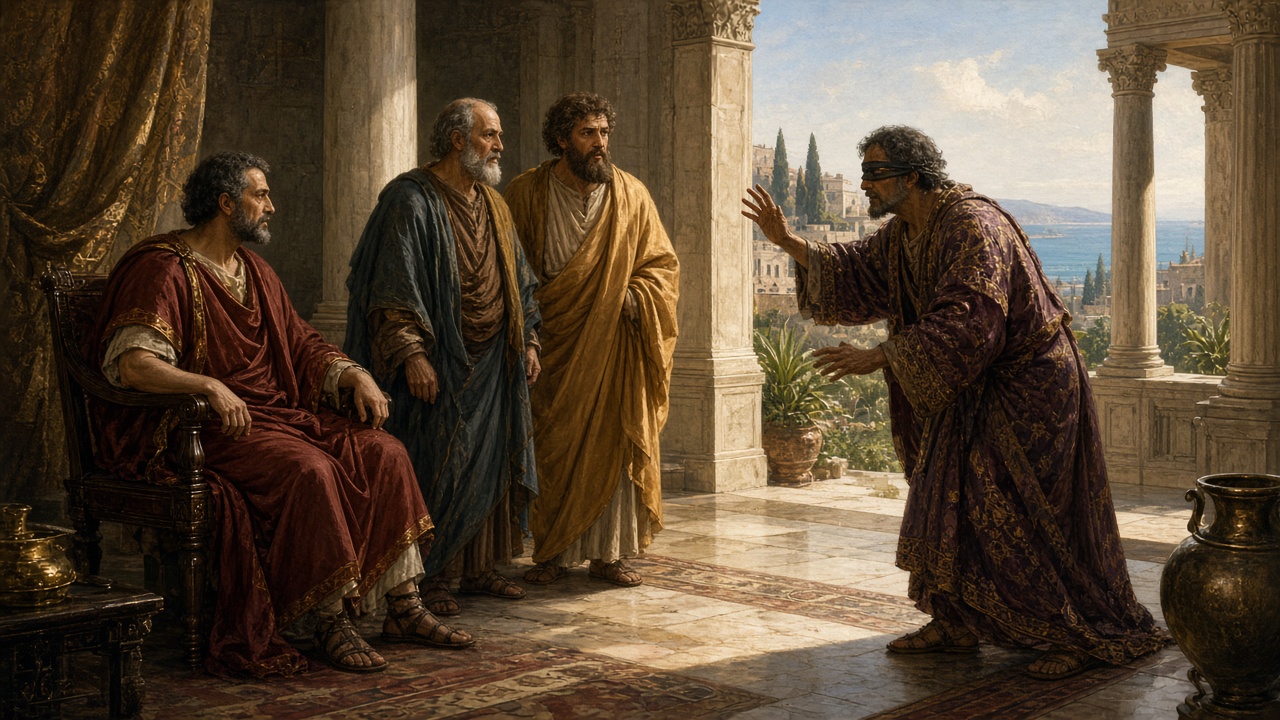
4Being sent out by the Holy Spirit, the two of them went down to Seleucia, and from there they sailed to Cyprus. 5When they arrived at Salamis, they proclaimed the word of God in the synagogues of the Jews. (They also had John as their assistant.) 6When they had gone across the island to Paphos, they came across a certain magician, a Jewish false prophet named Bar-Jesus. 7He was with the proconsul Sergius Paulus, an intelligent man, who summoned Barnabas and Saul, seeking to hear the word of God. 8But the magician Elymas (for that is what his name means) opposed them, seeking to turn the proconsul away from the faith. 9But Saul, also known as Paul, filled with the Holy Spirit, looked intently at Elymas 10and said, “O son of the devil, full of all deceit and all trickery, enemy of all righteousness, will yoʋ not cease perverting the straight paths of the Lord? 11And now, behold, the hand of the Lord is against yoʋ, and yoʋ will be blind, unable to see the sun for a period of time.” Immediately a mist and darkness fell upon him, and he was going around seeking people to lead him by the hand. 12When the proconsul saw what had happened, he believed, for he was astonished at the teaching of the Lord.
Paul and Barnabas in Antioch of Pisidia
13Then Paul and his companions set sail from Paphos and went to Perga in Pamphylia, but John left them and returned to Jerusalem. 14Continuing on from Perga, they came to Antioch in Pisidia. On the Sabbath day they went into the synagogue and sat down. 15After the reading of the Law and the Prophets, the rulers of the synagogue sent them a message, saying, “Brothers, if you have any word of exhortation for the people, speak it.”
16Standing up, Paul motioned with his hand and said, “Men of Israel and you who fear God, listen. 17The God of this people chose our fathers and exalted the people during their sojourn in the land of Egypt, and with an uplifted arm he led them out of that country. 18For about forty years, he put up with them in the wilderness, 19and after destroying seven nations in the land of Canaan, he gave their land to his people as an inheritance. 20After that he gave them judges for about four hundred and fifty years, up to the time of the prophet Samuel. 21Then the people asked for a king, and God gave them Saul the son of Kish, a man of the tribe of Benjamin, who reigned for forty years. 22After removing Saul, God raised up David as their king, about whom he testified, ‘I have found David the son of Jesse to be a man after my own heart; he will do all that I want him to do.’ 23From this man's offspring God brought salvation to Israel, according to his promise, 24after John had first preached a baptism of repentance to Israel in advance of the coming Savior. 25Now as John was completing his course, he said, ‘Who do you suppose that I am? I am not he. But behold, one is coming after me, the sandals of whose feet I am not worthy to untie.’
26“Brothers, sons of the family of Abraham, and those among you who fear God, to you the message of this salvation has been sent. 27Since those who dwell in Jerusalem, along with their rulers, failed to recognize this man and the voices of the prophets that are read every Sabbath, they fulfilled their words by condemning him. 28Even though they found no grounds for a death sentence, they asked Pilate to have him killed. 29When they had fulfilled all that was written about him, they took him down from the cross and laid him in a tomb. 30But God raised him from the dead, 31and for many days he was seen by those who had come up with him from Galilee to Jerusalem, who are his witnesses to the people. 32And we preach to you the good news that what God promised to our fathers, he has fulfilled to us, their children, by raising up Jesus, 33just as it is written in the second Psalm,
‘Yoʋ are my son;
today I have begotten yoʋ.’
34As for the fact that he raised him from the dead, no longer to return to corruption, God has spoken in this way:
‘I will give you the holy and sure blessings of David.’
35Therefore it also says in another place:
‘Yoʋ will not let yoʋr Holy One see corruption.’
36For when David had served God's purpose in his own generation, he fell asleep, was added to his fathers, and saw corruption. 37But he whom God raised up did not see corruption. 38Therefore let it be known to you, brothers, that through this man remission of sins is proclaimed to you, 39and by this man everyone who believes is acquitted of everything you could not be acquitted of by the law of Moses. 40So beware that what is said in the prophets does not happen to you:
41‘Behold, you scoffers,
be amazed and perish,
for I am doing a work in your days
that you will certainly not believe,
even if someone tells you about it.’ ”
42Now as Paul and Barnabas were going out from the synagogue of the Jews, the Gentiles were urging them to speak about these things on the next Sabbath. 43And when the meeting of the synagogue was dispersed, many of the Jews and the devout converts to Judaism followed Paul and Barnabas, who spoke to them and persuaded them to continue in the grace of God.
44On the following Sabbath, nearly the entire city was gathered together to hear the word of God. 45But when the Jews saw the crowds, they were filled with jealousy and began to contradict what Paul was saying, opposing him and slandering him. 46But Paul and Barnabas spoke boldly, saying, “It was necessary for the word of God to be spoken first to you. But since you are rejecting it and do not judge yourselves to be worthy of eternal life, behold, we are turning to the Gentiles. 47For this is what the Lord has commanded us:
‘I have appointed yoʋ to be a light to the Gentiles,
so that yoʋ may bring salvation to the ends of the earth.’ ”
48When the Gentiles heard this, they began rejoicing and glorifying the word of the Lord, and all who were appointed to eternal life believed. 49So the word of the Lord spread throughout that entire region. 50But the Jews incited the devout women of high standing and the prominent men of the city. They stirred up persecution against Paul and Barnabas, and drove them out of their region. 51But Paul and Barnabas shook off the dust from their feet in protest against them and went to Iconium. 52And the disciples were filled with joy and with the Holy Spirit.
¿Sabías que…?
La misión enviada desde Antioquía
- El Diccionario Bíblico de Easton (1897) describe a Antioquía de Siria como la tercera ciudad en importancia del Imperio romano, después de Roma y Alejandría; fue la iglesia de allí la que apartó a Bernabé y a Saulo. Entre sus profetas y maestros estaban Simeón, llamado Níger, un sobrenombre que significa negro, quizá por su tez oscura, y Lucio de Cirene, en el norte de África.Fuentes: Antioch (Syria) · el propio texto bíblico · Simeon · Lucius
- En Pafos, capital de Chipre y residencia del gobernador romano, un hechicero judío llamado Barjesús, también conocido como Elimas, un nombre árabe que significa mago o hechicero, intentó apartar de la fe al procónsul Sergio Paulo. Es aquí donde Saulo también es llamado Pablo; el Diccionario Bíblico de Easton (1897) dice que el nombre Pablo probablemente le fue dado en la infancia para usarlo en el mundo gentil, mientras que Saulo era su nombre hebreo de casa.Fuentes: Paphos · Elymas · Paul · el propio texto bíblico
- Enviados desde Antioquía, bajaron a Seleucia, el puerto de la ciudad cerca de la desembocadura del Orontes, y navegaron hasta Chipre; después desembarcaron en Perge, capital de Panfilia, a orillas del río Cestro. Allí Juan los dejó y regresó a Jerusalén; su nombre romano, Marcos, poco a poco llegó a reemplazar su nombre judío, y era primo de Bernabé.Fuentes: Seleucia · Perga · John Mark · el propio texto bíblico
Notas escritas con ayuda de IA a partir de fuentes abiertas (Theographic Bible Metadata, CC BY-SA 4.0; Easton’s Bible Dictionary, dominio público) y revisadas antes de publicarse.
Lugares de este capítulo
- Antioch · Hoy: Antioch on the Orontes · 36.227, 36.172 · versículo 1
- Cyrene · 32.821, 21.851 · versículo 1
- Cyprus · 35.000, 33.000 · versículo 4
- Seleucia · Hoy: Seleucia Pieria · 36.124, 35.922 · versículo 4
- Salamis · 35.185, 33.902 · versículo 5
- Paphos · Hoy: New Paphos · 34.756, 32.404 · versículos 6, 13
- Jerusalem · 31.777, 35.234 · versículos 13, 27, 31
- Pamphylia · 37.000, 31.000 · versículo 13
- Perga · 36.960, 30.854 · versículos 13, 14
- Antioch · Hoy: Antioch in Pisidia · 38.306, 31.189 · versículo 14
- Pisidia · 38.306, 31.189 · versículo 14
- Egypt · 30.129, 31.308 · versículo 17
- Canaan · 32.767, 35.333 · versículo 19
- Galilee · 32.760, 35.527 · versículo 31
- Iconium · Hoy: Konya · 37.872, 32.492 · versículo 51
Solo aparecen lugares identificados con alta confianza (90 % o más según las fuentes académicas reunidas por OpenBible). Mapa de la época: DARE (Digital Atlas of the Roman Empire), CC BY 4.0; mapa actual: © colaboradores de OpenStreetMap; lugares: OpenBible.info (CC BY 4.0).
Créditos y licencia de esta traducción
Text-Critical English New Testament
The New Testament based on the Byzantine Text with extensive text-critical footnotes
Copyright © 2022 Robert Adam Boyd
Language: English
"The Text-Critical English New Testament" and "Byzantine Text Version" are trademarks of Robert Adam Boyd. If you adapt, remix, transform, or in any other way change the translation or footnotes, you may not call it "The Text-Critical English New Testament" or "Byzantine Text Version".
This translation is made available to you under the terms of the
Creative Commons Attribution license 4.0.
You may share and redistribute this Bible translation or extracts from it in any format, provided that:
You include the above copyright and source information.
If you make any changes to the text, you must indicate that you did so in a way that makes it clear that the original licensor is not necessarily endorsing your changes.
Pictures included with Scriptures and other documents on this site are licensed just for use with those Scriptures and documents.
For other uses, please contact the respective copyright owners.
Note that in addition to the rules above, revising and adapting God's Word involves a great responsibility to be true to God's Word. See Revelation 22:18-19.
2026-10-02
Fuente: http://ebible.org/engtcent/ · eBible.org