Éxodo 24
One Unity Resource Bible · Toca un versículo para ver sus referencias cruzadas.
1He said to Moses [Drawn out], “Come up to Adonai, you, and Aaron [Light-bringer], Nadab, and Abihu, and seventy of the elders of Israel [God prevails]; and worship from a distance. 2Moses [Drawn out] alone shall come near to Adonai, but they shall not come near. The people shall not go up with him.”
3Moses [Drawn out] came and told the people all Adonai’s words, and all the judgments; and all the people answered with one voice, and said, “All the words which Adonai has spoken will we do.”
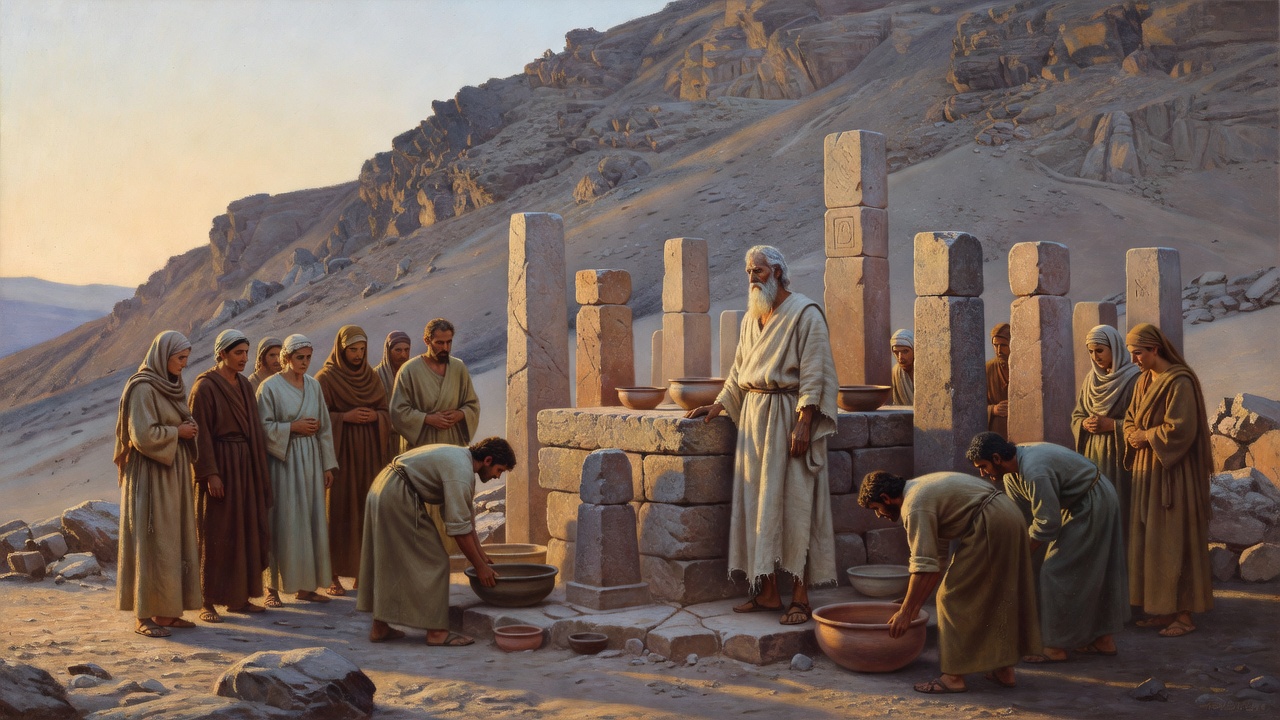
4Moses [Drawn out] wrote all Adonai’s words, and rose up early in the morning, and built an altar under the mountain, and twelve pillars for the twelve tribes of Israel [God prevails]. 5He sent young men of the children of Israel [God prevails], who offered burnt offerings and sacrificed peace offerings of cattle to Adonai. 6Moses [Drawn out] took half of the blood and put it in basins, and half of the blood he sprinkled on the altar. 7He took the book of the covenant and read it in the hearing of the people, and they said, “All that Adonai has spoken will we do, and be sh'ma ·hear obey·.”
8Moses [Drawn out] took the blood, and sprinkled it on the people, and said, “Look, this is the blood of the covenant ·binding contract between two or more parties·, which Adonai has made with you concerning all these words.”
9Then Moses [Drawn out], Aaron [Light-bringer], Nadab, Abihu, and seventy of the elders of Israel [God prevails] went up. 10They saw the God of Israel [God prevails]. Under his feet was like a paved work of sapphire stone, like the skies for clearness. 11He didn’t lay his hand on the nobles of the children of Israel [God prevails]. They saw God, and ate and drank.
12Adonai said to Moses [Drawn out], “Come up to me on the mountain, and stay here, and I will give you the stone tablets (of sapphire) with the Torah ·Teaching· and the mitzvot ·instructions· that I have written, that you may teach them.”
13Moses [Drawn out] rose up with Joshua [Yah Salvation], his servant, and Moses [Drawn out] went up onto God’s Mountain. 14He said to the elders, “Wait here for us, until we come again to you. Behold, Aaron [Light-bringer] and Hur are with you. Whoever is involved in a dispute can go to them.”
(S: Maftir ·Conclusion·) 15Moses [Drawn out] went up on the mountain, and the cloud covered the mountain. (A: Maftir ·Conclusion·) 16Adonai’s shekhinah [manifest weighty glory and presence of God] settled on Mount Sinai [Thorn], and the cloud covered it six days. The seventh day he called to Moses [Drawn out] out of the middle of the cloud. 17The appearance of the kavod Yahweh ·weighty glory of He sustains breathing· was like devouring fire on the top of the mountain in the eyes of the children of Israel [God prevails]. 18Moses [Drawn out] entered into the middle of the cloud, and went up on the mountain; and Moses [Drawn out] was on the mountain forty days and forty nights.
Haftarah Mishpatim ·Taking leave ·Judgments, Rulings·:
Yirmeyahu / Jeremiah 34:8-22, 33:25-26
B'rit Hadashah ·New Covenant·: Luke 7:1-8:3
¿Sabías que…?
El pacto en el monte Sinaí
- El Diccionario Bíblico de Easton (1897) dice que el monte Sinaí, llamado también Horeb, era la región montañosa a la que los hebreos llegaron en el tercer mes después del Éxodo, donde permanecieron acampados cerca de un año. Señala que los últimos veintidós capítulos de Éxodo, todo Levítico y Números 1–11 recogen lo ocurrido durante esa estancia.Fuentes: Mount Sinai
- El SEÑOR dice a Moisés que suba con Aarón, Nadab y Abiú y setenta ancianos de Israel, pero solo Moisés debe acercarse; los demás adoran a distancia, y el pueblo no sube. Nadab era el hijo mayor de Aarón, y Abiú el segundo; el Diccionario Bíblico de Easton (1897) señala que los dos hermanos acompañaron a su padre y a los ancianos solo parte del camino montaña arriba.Fuentes: el propio texto bíblico · Aaron · Nadab · Abihu
- Moisés sube entonces más arriba con Josué, su ayudante, y deja a Aarón y a Hur con los ancianos, para que quien tuviera una disputa pudiera acudir a ellos. El Diccionario Bíblico de Easton (1897) llama a Josué siervo de Moisés, que lo acompañó parte del camino en el Sinaí, e identifica a Hur, esposo de Miriam, como el hombre asociado con Aarón al frente del pueblo mientras Moisés estaba ausente en el monte.Fuentes: el propio texto bíblico · Joshua · Hur
Notas escritas con ayuda de IA a partir de fuentes abiertas (Theographic Bible Metadata, CC BY-SA 4.0; Easton’s Bible Dictionary, dominio público) y revisadas antes de publicarse.
Créditos y licencia de esta traducción
One Unity Resource Bible
The One Unity Resource Bible translation of the Holy Bible into American English with some transliterated Hebrew notations
Copyright © 2016,2019 Thomas Robinson
Language: English
Dialect: American
Translation by: Thomas Robinson
This translation is made available to you under the terms of the
Creative Commons Attribution Share-Alike license 4.0.
You have permission to share and redistribute this Bible translation in any format and to make reasonable revisions and adaptations of this translation, provided that:
You include the above copyright and source information.
If you make any changes to the text, you must indicate that you did so in a way that makes it clear that the original licensor is not necessarily endorsing your changes.
If you redistribute this text, you must distribute your contributions under the same license as the original.
Pictures included with Scriptures and other documents on this site are licensed just for use with those Scriptures and documents.
For other uses, please contact the respective copyright owners.
Note that in addition to the rules above, revising and adapting God's Word involves a great responsibility to be true to God's Word. See Revelation 22:18-19.
2024-12-05
Fuente: http://ebible.org/engourb/ · eBible.org