Levítico 6
Targum Onkelos Etheridge · Toca un versículo para ver sus referencias cruzadas.
Sins Requiring a Guilt Offering
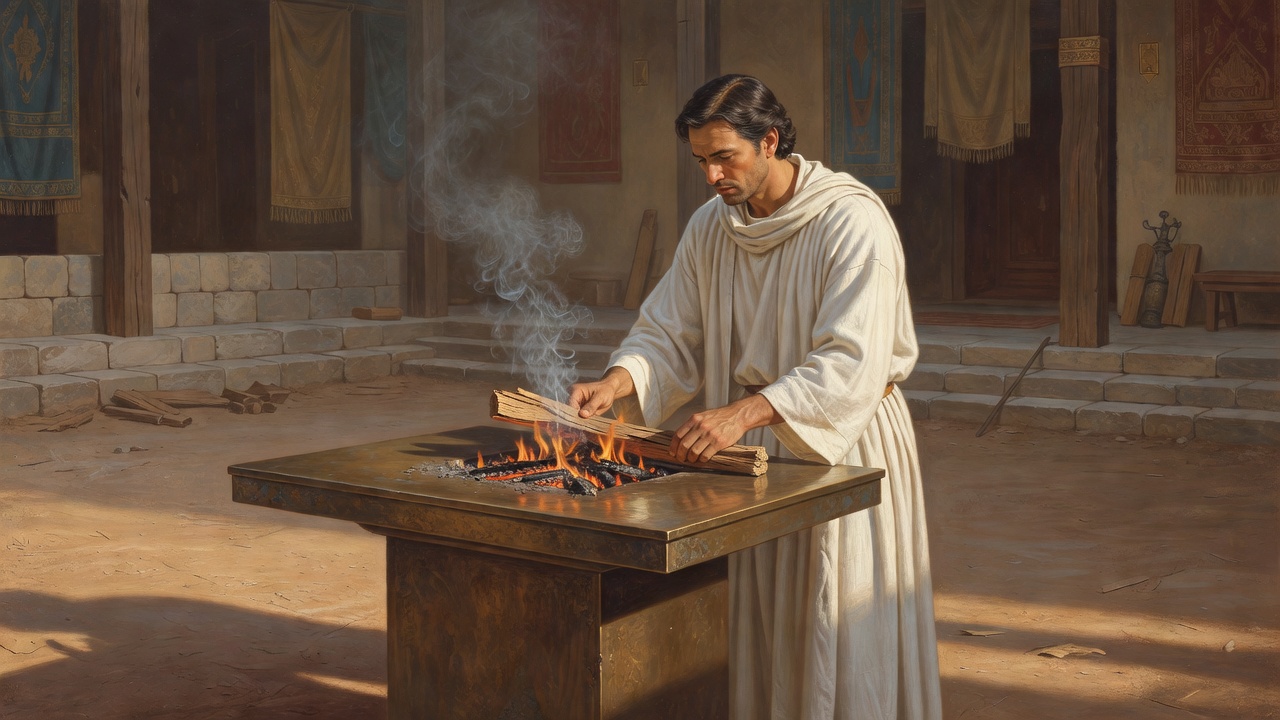
1And the Lord spake with Mosheh, saying: 2Instruct Aharon and his sons, saying: This is the law of the Burnt Offering. It is burnt offering, because burned upon the altar all night until morning, and the fire of the altar shall be burning in it. 3And the priest shall dress himself with the vestments of linen, and wear drawers of linen upon his flesh; and he shall separate the ashes which the fire hath consumed with the burnt offering upon the altar, and set them beside the altar. 4And he shall take off his vestments, and dress himself with other garments, and carry forth the ashes without the camp unto a clean place. 5But the fire upon the altar shall be burning on it, and never be extinguished; and the priest shall burn wood on it from morning to morning, and lay the burnt offering in order upon it, and burn upon it the fat of the sanctified oblations. 6The fire shall be ever burning on the altar, it shall not be extinguished.
7And this is the law of the Mincha which the sons of Aharon shall offer in the presence of the Lord before the altar.
The Burnt Offering
8And he shall separate therefrom his handful lof the flour of the mincha and of its oil, and all the frankincense that is upon the mincha, and burn it at the altar as its memorial to be accepted with favour before the Lord. 9And the remainder of it may Aharon and his sons eat, unleavened shall it be eaten in the holy place, in the court of the tabernacle of ordinance shall they eat it. 10It shall not be baked with leaven. I have given it as their portion of my oblations; it is most sacred, as the sin offering and as the trespass offering. 11All the males of the children of Aharon may eat it. (This) is an everlasting statute for your generations concerning the oblations of the Lord: everyone who toucheth them shall be holy.
12And the Lord spake with Mosheh, saying, 13This is the oblation of Aharon and his sons which they shall present before the Lord on the day when they anoint him. The tenth of three seahs of flour for a mincha perpetually, a half in the morning, and a half at eventide.
The Grain Offering
14It shall be made in a pan with oil; while soft it shall be brought a baken mincha offered in pieces to be accepted with favour before the Lord. 15And of his sons, the priest who shall be anointed in his stead shall perform it. (This is) an everlasting statute before the Lord: 16It shall be burned entirely, and every mincha of the priest shall be entirely (burned); it is not to be eaten.
17And the Lord spake with Mosheh, saying: 18Speak with Aharon and with his sons, saying, This is the law of the sin offering: In the place where the burnt offering is killed, there shall the sin offering be killed before the Lord; it is most sacred. 19The priest who maketh atonement with its blood shall eat it; in the holy place it shall be eaten, in the court of the tabernacle of ordinance. 20Everyone who toucheth the flesh thereof must be holy. And if he drop some of its blood upon a vestment, that which is bedropped shall be purified in the holy place. 21But the earthen vessel in which it was sodden shall be broken; and if it be sodden in a vessel of brass, (that) shall be scoured and washed in water. 22Any man of the priests may eat thereof: it is most sacred. 23But no sin offering whose blood is brought into the tabernacle of ordinance to make atonement in the sanctuary may be eaten, but shall be burned with fire.
¿Sabías que…?
Deberes Sacerdotales y el Fuego Continuo del Altar
- Para las faltas que implicaban robo, extorsión o falso juramento sobre bienes perdidos, la ley exigía la restitución total más una quinta parte del valor pagada al legítimo dueño antes de que el infractor pudiera presentar un carnero como ofrenda por la culpa.Fuentes: el propio texto bíblico
- Se ordenó a los sacerdotes mantener el fuego del altar ardiendo continuamente día y noche sin permitir que se apagara. Cada mañana, un sacerdote vestido con vestiduras de lino colocaba leña fresca en el altar y retiraba las cenizas para llevarlas fuera del campamento.Fuentes: el propio texto bíblico
- Debido a que la ofrenda por el pecado era considerada santísima, normas estrictas regulaban las vasijas usadas para prepararla: las vasijas de barro utilizadas para hervir la carne debían romperse, mientras que las de bronce podían fregarse y enjuagarse con agua.Fuentes: el propio texto bíblico
Notas escritas con ayuda de IA a partir de fuentes abiertas (Theographic Bible Metadata, CC BY-SA 4.0; Easton’s Bible Dictionary, dominio público) y revisadas antes de publicarse.
Créditos y licencia de esta traducción
Targum Onkelos Etheridge
The Targums of Onkelos and Jonathan Ben Uzziel On the Pentateuch With The Fragments of the Jerusalem Targum From the Chaldee by J. W. Etheridge, M.A. First Published 1862-65.
Public Domain
Language: English
2020-12-20
Títulos de sección adaptados de la Berean Standard Bible (dominio público); no forman parte del texto bíblico de esta traducción.
Fuente: http://ebible.org/engoke/ · eBible.org