Génesis 46
Targum Onkelos Etheridge · Toca un versículo para ver sus referencias cruzadas.
Jacob’s Journey to Egypt
1And Israel journeyed, and all that he had, and came to Beer Shava; and he offered sacrifices to the God of his father Izhak. 2And the Lord spake to Israel in a vision of the night, and said, Jakob, Jakob. And he said, Behold, I am. 3And He said, I am God, the God of thy father: fear not to go down into Mizraim; for a great people will I make thee there. 4I will go down with thee into Mizraim, and will surely bring thee up; but Joseph shall lay his hand upon thine eyes. 5And Jakob arose from Beer Shava. And the sons of Israel carried Jakob their father, and their children, and their wives, in the waggons which Pharoh had sent to fetch them. 6And they took their flocks and their substance which they had gotten in the land of Kenaan, and came to Mizraim, Jakob and all his sons with him.
Those Who Went to Egypt
7His sons, and his son’s sons with him, his daughters, and the daughters of his sons, and all his seed, he brought with him into Mizraim.
The Children of Leah
8And these are the names of the sons of Israel which came into Mizraim, Jakob and his sons. The firstborn of Jakob, Reuben. 9And the sons of Reuben. Hanuk and Phallu, Hesron and Karmi. 10And the sons of Sheemon, Jemuel, and Janin, and Ahad, and Jakin, and Zochar, and Shaul, the son of a Kenaanitha. 11And the sons of Levi, Gershon, Kehath, and Merari. 12And the sons of Jehuda, Er, and Onan, and Shelah, and Pharets, and Zarach. But Er and Onan had died in the land of Kenaan And the sons of Pharets, Heshron and Chamul. 13And the sons of Issakar, Tola, and Pheua, and Job, and Semeron. 14And the sons of Zabulon, Sered, and Elon, and Jahleel. 15These are the sons of Leah, which she bare to Jakob in Padan Aram, and Dinah his daughter; all the souls, his sons and his daughters, thirty and three.
The Children of Zilpah
16And the children of Gad, Sephyon and Haggi, Shuni and Ezbon, Eri, and Arodi, and Areli. 17And the sons of Asher, Jemna, and Jesva, and Jesvi, and Beriah, and Serach, their sister. And the sons of Beriah, Heber and Malchiel. 18These are the sons of Zilpha, whom Laban gave to Leah his daughter; and she bare these unto Jakob, sixteen souls.
The Children of Rachel
19The sons of Rahel, the wife of Jakob, Joseph and Benjamin. 20And to Joseph were born in the land of Mizraim Menashe and Ephraim, whom Asenath, daughter of Potiphera, prince of On, bare unto him. 21And the sons of Benjamin, Bela, and Bekor, and Ashbel, Gera, and Naaman, Achi, and Rosh, Muppim, and Huphim, and Arede. 22These are the sons of Rahel which were born to Jakob; all the souls fourteen.
The Children of Bilhah
23And the sons of Dan, Hushim: 24And the sons of Naphtali, Jahziel, and Guni, and Jezer, and Shilem. 25These are the children of Billah, whom Laban gave to Rahel his daughter, and she bare them to Jakob; all the souls seven. 26All the souls which went with Jakob into Mizraim, which came forth from his loins, besides the wives of Jakob’s sons, all the souls, sixty and six. 27And the sons of Joseph, which were born to him in Mizraim, two souls. All the souls of the house of Jakob which went into Mizraim were seventy.
Jacob Arrives in Egypt
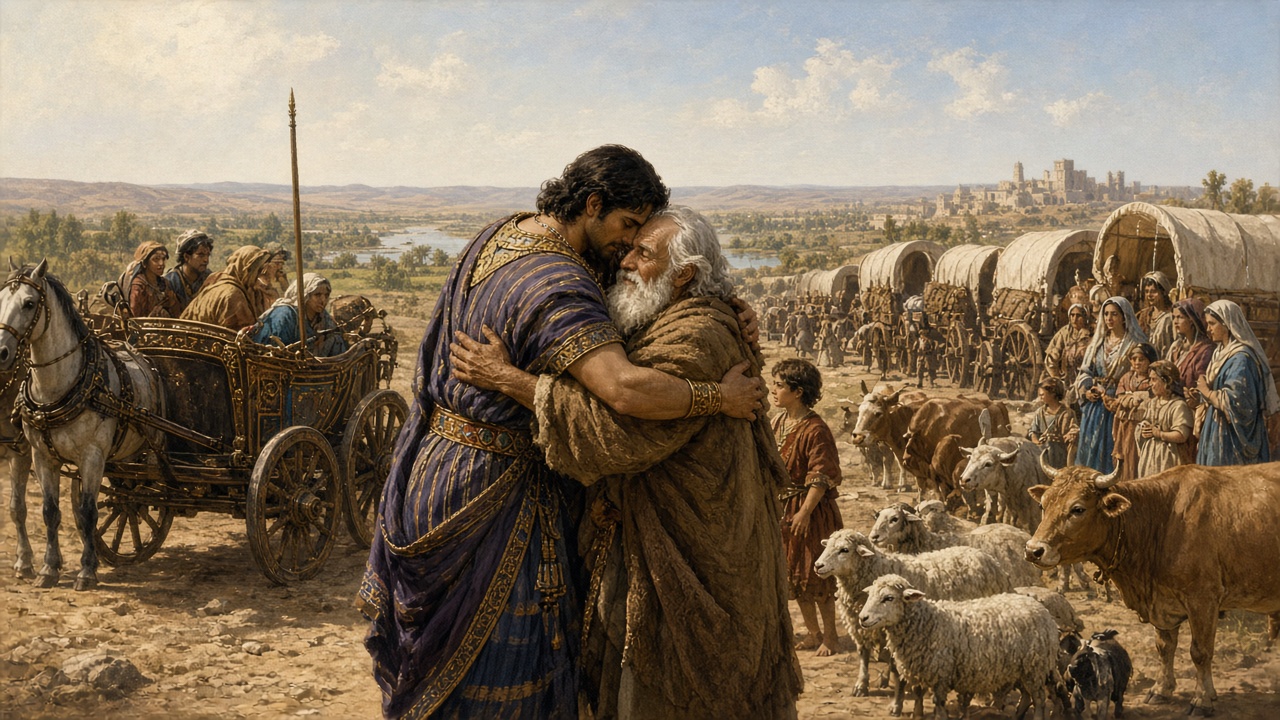
28And he sent Jehuda before him to Joseph, to make the way clear before him at Goshen, and he came to the land of Goshen. 29And Joseph arrayed his chariot, and went up to meet Israel his father in Goshen. And he saw him, and fell upon his neck, and wept. And he wept still upon his neck! 30And Israel said to Joseph, I could-die at this time! I have consolation now that I have seen thy face; for thou art yet alive. 31And Joseph said to his brothers, and to the house of his father, I will go up and show Pharoh, and will tell him, My brethren and the house of my father, who were in the land of Kenaan, have come to me. 32But the men are shepherds of sheep: for the men are masters of flocks, and their sheep and oxen and all that they have they have brought. 33And it shall be when Pharoh calleth you, and shall ask you, What is your employment? 34You will say, Thy servants have been men, the masters of flocks from our youth until now; both we and our fathers: that you may dwell in the land of Goshen; because the Mizraee keep at a distance all shepherds of flocks.
¿Sabías que…?
Israel desciende a Egipto
- Cuando Israel partió hacia Egipto con todo lo que tenía, se detuvo en Beerseba y ofreció sacrificios al Dios de su padre Isaac. Beerseba, que significa pozo del juramento o pozo de los siete, fue un pozo que Abraham cavó y nombró tras un pacto con Abimelec; cuando Isaac lo reabrió, le dio el mismo nombre. Era un lugar favorito de residencia de ambos patriarcas, y allí, aquella noche, Dios habló a Jacob en una visión y le dijo que no temiera bajar a Egipto, porque allí lo haría una gran nación.Fuentes: el propio texto bíblico · Beersheba
- Jacob envió a Judá por delante hacia José para que le indicara el camino a Gosén, un distrito egipcio al este del Nilo, al parecer cerca de la residencia real, donde la familia permaneció hasta el Éxodo. El Easton's Bible Dictionary (1897) la llama lo mejor de la tierra, hoy un desierto, y también tierra de Ramesés. José dijo a sus hermanos que afirmaran haber criado ganado desde su juventud, para poder establecerse allí, porque los pastores eran detestables para los egipcios; ese diccionario sugiere que el faraón fue probablemente Apopi, el último rey de los hicsos, que acogió a estos pastores asiáticos, mientras los egipcios nativos los aborrecían, aunque algunos argumentan que José llegó más tarde, bajo Tutmosis III, después de la expulsión de los hicsos.Fuentes: el propio texto bíblico · Goshen · Pharaoh (of Joseph)
- El capítulo cuenta sesenta y seis descendientes directos de Jacob que llegaron a Egipto, sin incluir a las esposas de sus hijos, y setenta al incluir a los dos hijos de José ya nacidos en Egipto. Los hijos de Lea y su hija Dina aparecen en esa lista, aunque el Easton's Bible Dictionary (1897) dice que la propia Lea ya había muerto en Canaán antes del viaje y fue sepultada en la cueva de Macpela; Raquel había muerto antes, al dar a luz a Benjamín, y fue sepultada en el camino a Efrata, es decir, Belén. Manasés y Efraín nacieron a José en Egipto de Asenat, hija de Potifera, sacerdote de On, un centro del culto al sol que la Septuaginta y la Vulgata llaman Heliópolis.Fuentes: el propio texto bíblico · Leah · Rachel · On
Notas escritas con ayuda de IA a partir de fuentes abiertas (Theographic Bible Metadata, CC BY-SA 4.0; Easton’s Bible Dictionary, dominio público) y revisadas antes de publicarse.
Lugares de este capítulo
- Egypt · 30.129, 31.308 · versículos 1, 3, 4, 5, 6, 7, 8, 20, 26, 27
- Canaan · 32.767, 35.333 · versículos 6, 12, 31
- Heliopolis · Hoy: Ain Shams · 30.129, 31.308 · versículo 20
- Goshen · Hoy: Goshen 1 · 30.799, 31.834 · versículos 28, 29, 34
Solo aparecen lugares identificados con alta confianza (90 % o más según las fuentes académicas reunidas por OpenBible). Mapa de la época: DARE (Digital Atlas of the Roman Empire), CC BY 4.0; mapa actual: © colaboradores de OpenStreetMap; lugares: OpenBible.info (CC BY 4.0).
Créditos y licencia de esta traducción
Targum Onkelos Etheridge
The Targums of Onkelos and Jonathan Ben Uzziel On the Pentateuch With The Fragments of the Jerusalem Targum From the Chaldee by J. W. Etheridge, M.A. First Published 1862-65.
Public Domain
Language: English
2020-12-20
Títulos de sección adaptados de la Berean Standard Bible (dominio público); no forman parte del texto bíblico de esta traducción.
Fuente: http://ebible.org/engoke/ · eBible.org