Éxodo 9
Targum Onkelos Etheridge · Toca un versículo para ver sus referencias cruzadas.
The Fifth Plague: Livestock
1And the Lord said to Mosheh, Go in unto Pharoh and say to him: Thus saith the Lord, the God of the Jehudaee; Send My people away, that they may serve before Me: 2For if thou refuse to send them away, and thou hast kept them until now, 3behold, a plague from before the Lord shall be upon thy cattle which are in the field; upon the horses, upon the asses, upon the camels, upon the oxen, and upon the sheep, a very great death. 4But the Lord will make distinction between the cattle of Israel and the cattle of the Mizraee; and of all that the children of Israel possess not one shall die. 5And the Lord set a time, saying, Tomorrow will the Lord do this thing in the land. 6And the Lord did that thing on the following day, and all the cattle of the Mizraee died; but of the cattle of the sons of Israel died not one. 7And Pharoh sent, and, behold, not one of the cattle of the sons of Israel had died. And Pharoh’s heart was hardened, and he would not send the people away.
The Sixth Plague: Boils
8And the Lord said to Mosheh and Aharon, Take you handfuls of dust of the furnace, and let Mosheh scatter it towards the heavens in the presence of Pharoh; 9And it will be like fine powder upon all the land of Mizraim, and it shall be upon man and beast an inflammation growing into ulcers in all the land of Mizraim. 10And they took the dust of the furnace and stood before Pharoh; and Mosheh scattered it towards the heavens, and it became an inflammation of ulcers multiplying on man and beast. 11And the magicians could not stand before Mosheh, on account of the disease; for the disease was upon the magicians and upon all the Mizraee. 12And the Lord obdurated the heart of Pharoh, and he would not hearken to them, as the Lord had said to Mosheh.
The Seventh Plague: Hail
13And the Lord said to Mosheh, Rise up in the morn-ing and stand before Pharoh, and say to him, Thus saith the Lord, the God of the Jehudaee Send My people away, that they may serve before Me: 14For at this time I will send all My plagues upon thy heart, and upon thy servants and thy people, that thou mayest know that there is no one like Me, the Ruler in all the earth. 15For now it is nigh before Me to send indeed My strong plagues, and smite thee and thy people with death, and cut thee off from the earth. 16For therefore have I raised thee up, that I may show thee My power, and that they may acknowledge the might of My name in all the earth. 17Until now hast thou kept My people down, that thou mayest not release them. 18Behold, I will cause to come down, as at this time tomorrow, hail most mighty, the like of which hath never been in Mizraim from the day that it was founded until now. 19And now, send, gather in thy cattle and all that thou hast in the field; for upon every man and beast that may be found in the field not gathered into the house the hail will fall, and they shall die. 20Who feared the word of the Lord among the servants of Pharoh collected his servants and his cattle unto the houses; 21But he who did not set his heart upon the word of the Lord, left his servants and his cattle in the field.
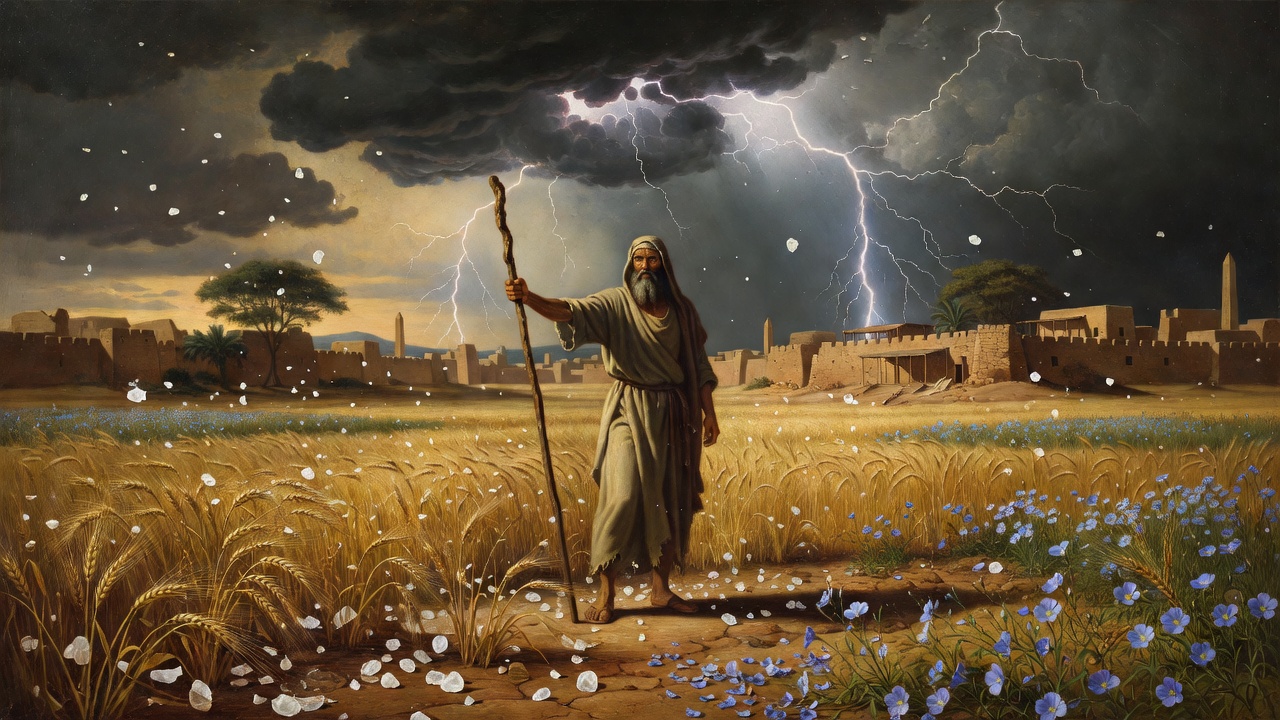
22And the Lord said to Mosheh, Uplift thy hand towards the heavens, and there shall be hail in all the land of Mizraim upon man, and beast, and every herb of the field throughout the land of Mizraim. 23And Mosheh lifted up the rod towards the heavens, and the Lord sent thunders, (voices,) and hail, and fire going upon the ground: and the Lord rained hail upon the land of Mizraim, 24And there was hail, and fire flaming among the hail, very mighty, such as the like of had not been in all the land of Mizraim since the time it had been for a people. 25And the hail smote in all the land of Mizraim all that was in the field from man to cattle, and every herb of the field the hail struck, and every tree of the field it brake. 26Only in the land of Goshen, where the sons of Israel were, there was no hail.
27And Pharoh sent and called for Mosheh and Aharon, and said to them, I have sinned this time; the Lord is righteous, and I and my people are guilty. 28Pray before the Lord that relief may be multiplied before Him, so that there may be upon us no more thunders of malediction like these before the Lord, nor hail; and I will send you away, and will not continue to detain you. 29And Mosheh said to him, When I shall have gone out of the city, I will spread forth my hands in prayer before the Lord, and the thunders shall cease, and there shall be no more hail, that you may know that the earth is the Lord’s. 30But (as for) thee and thy servants, I know that as yet ye are not humbled before the Lord God. 31And the flax and the barley were smitten, because the barley was earing and the flax was in flower: 32But the wheat and the spelt were not smitten, for they were later. 33And Mosheh went out of the city from Pharoh, and spread forth his hands in prayer before the Lord, and the thunders ceased, and the hail and the rain which had descended came not (more) upon the earth. 34And Pharoh saw that the rain had ceased, and the hail and the thunders, and he added yet to sin, and hardened his heart, he and his servants. 35And the heart of Pharoh was hardened, and he would not send away the sons of Israel, as the Lord had spoken by the hand of Mosheh.
¿Sabías que…?
Ganado, úlceras y granizo
- Este capítulo traza una línea clara entre Egipto y los israelitas: muere todo el ganado de los egipcios, pero no muere ni un animal de los israelitas, y el granizo cae en toda la tierra de Egipto excepto en Gosén, donde vivían los israelitas. Gosén, llamada también tierra de Ramsés, quedaba al este del Nilo y, al parecer, no lejos de la residencia real, y había sido asignada a la familia de Jacob como la mejor parte de la tierra.Fuentes: el propio texto bíblico · Goshen · Moses
- El faraón ante quien se presentan Moisés y Aarón no es nombrado en el capítulo. El Diccionario Bíblico de Easton (1897) lo identifica como probablemente Menephtah I, hijo de Ramsés II, que vivía en Zoán, donde tuvieron lugar sus entrevistas con Moisés y Aarón, y señala que algunos prefieren a Seti II. Después del granizo, Moisés sale de la ciudad y extiende las manos al Señor hasta que cesan el trueno y el granizo.Fuentes: el propio texto bíblico · Pharaoh (of the Exodus)
- El granizo destruyó el lino y la cebada, pero no el trigo ni la espelta. El relato explica la diferencia: la cebada ya estaba madura y el lino en flor, mientras que el trigo y la espelta eran cultivos tardíos.Fuentes: el propio texto bíblico
Notas escritas con ayuda de IA a partir de fuentes abiertas (Theographic Bible Metadata, CC BY-SA 4.0; Easton’s Bible Dictionary, dominio público) y revisadas antes de publicarse.
Lugares de este capítulo
- Egypt · 30.129, 31.308 · versículos 4, 6, 9, 18, 22, 23, 24, 25
- Goshen · Hoy: Goshen 1 · 30.799, 31.834 · versículo 26
Solo aparecen lugares identificados con alta confianza (90 % o más según las fuentes académicas reunidas por OpenBible). Mapa de la época: DARE (Digital Atlas of the Roman Empire), CC BY 4.0; mapa actual: © colaboradores de OpenStreetMap; lugares: OpenBible.info (CC BY 4.0).
Créditos y licencia de esta traducción
Targum Onkelos Etheridge
The Targums of Onkelos and Jonathan Ben Uzziel On the Pentateuch With The Fragments of the Jerusalem Targum From the Chaldee by J. W. Etheridge, M.A. First Published 1862-65.
Public Domain
Language: English
2020-12-20
Títulos de sección adaptados de la Berean Standard Bible (dominio público); no forman parte del texto bíblico de esta traducción.
Fuente: http://ebible.org/engoke/ · eBible.org