Éxodo 2
Targum Onkelos Etheridge · Toca un versículo para ver sus referencias cruzadas.
The Birth and Adoption of Moses
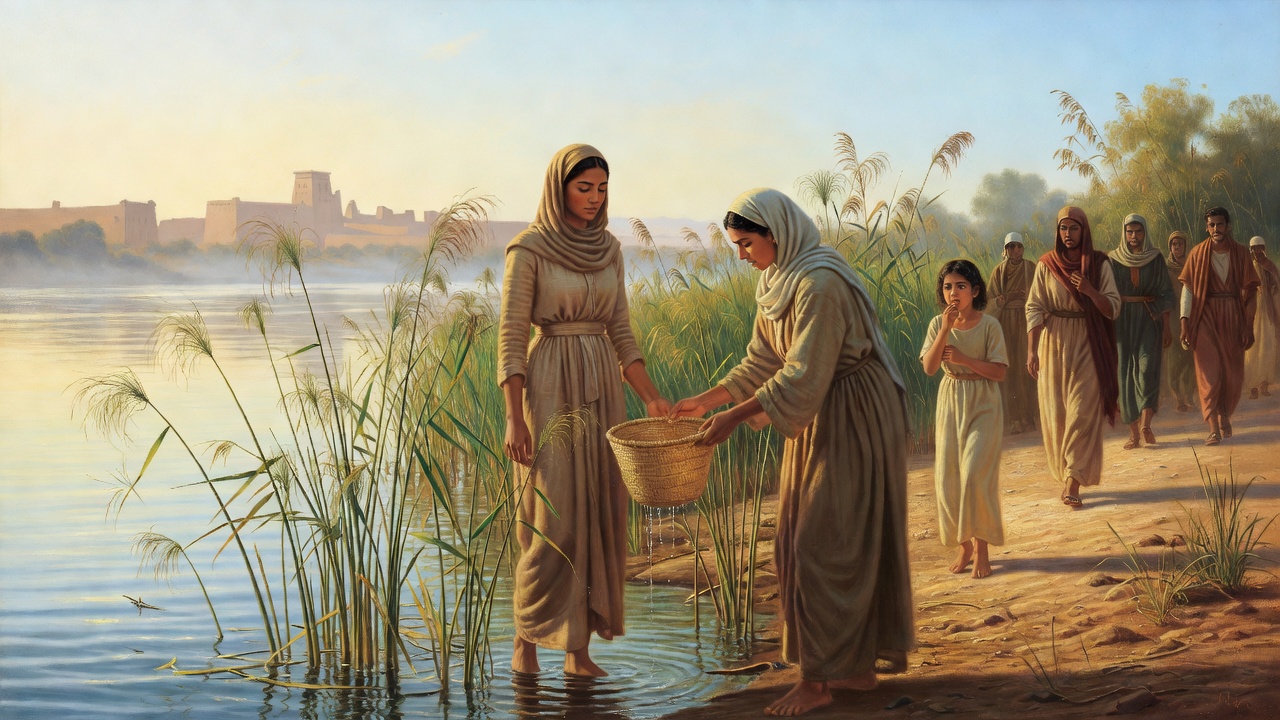
1And a man of the house of Levi went and took a daughter of Levi (to wife). 2And the woman conceived, and bare a son; and she saw that he was good, and concealed him three months. 3But not being able to hide him longer, she took an ark of reed, and covered it with bitumen and pitch, and laid the child within it, and set it in the river upon the brink of the stream. 4And his sister stationed herself at a distance, to know what would be done to him. 5And the daughter of Pharoh came down to wash at the river, and her damsels walked on the river’s bank; and she saw the ark in the flood, and reached out her arm and took it. 6And opening, she saw the child; and, behold, the infant wept. And she had compassion on him and said, This is one of the children of the Jehudaee. 7Then spake his sister to the daughter of Pharoh, Shall I go and call a nurse-woman of the Jehudaee who will suckle the child for thee? 8And the daughter of Pharoh said to her, Go; and the maiden went, and called the child’s mother. 9And Pharoh’s daughter said to her, Take this child and nurse it for me, and I will give thee they recompense. And the woman took the child and suckled him. 10And the child grew, and she brought him to Pharoh’s daughter, and he became to her a son, and she called his name Mosheh, saying, Because I drew him out from the water.
The Rejection and Flight of Moses
11And it was in those days when Mosheh had grown that he went out to his brethren and beheld their servitude. And he saw a Mizraite man smite a man, a Jehudai, (one) of his brethren. 12And he turned this way and that, and saw that there was no man; and smote the Mizraite, and buried him in the sand. 13And he went out the second day, and, behold, two men, Jehudaeen contended. And he said to the guilty one, Why did you strike your companion? 14But he said, Who set you a chief man and judge over us? Will you who speak so kill me, as you killed the Mizraya? And Mosheh was afraid, and said, Surely the thing is known.
15And Pharoh heard that thing, and sought to kill Mosheh; and Mosheh fled from before Pharoh, and dwelt in the land of Midian. And he sat by a well; 16And the prince ( rabba) of Midian had seven daughters; and they came and drew and filled the troughs to water their father’s flock. 17But the shepherds came and drave them away; and Mosheh arose and rescued them, and watered the flock. 18And they came to Reuel their father; and he said, What is this, that ye have come so quickly today? 19And they said, A man, a Mizraya, delivered us from the hand of the shepherds, and also drew for us and watered the flock. 20And he said to his daughters, And where is he? Wherefore have you left the man? Call him, that he may eat bread. 21And Mosheh was willing to dwell with the man; and he gave Zipporah his daughter unto Mosheh. 22And she bare a son; and he called his name Gershom; for, said he, I am a stranger in a foreign land.
God Hears the Cry of the Israelites
23And it was in many of those days: and the king of Mizraim died. And the sons of Israel groaned with the hard service which was upon them; and the cry rose up before the presence of the Lord, form their labour. 24And their appeal was heard before the Lord; and the Lord remembered His covenant with Abraham, with Izhak, and with Jakob. 25And the servitude of the sons of Israel was know before the Lord, and the Lord said in His Word, that He would deliver them.
¿Sabías que…?
El nacimiento y la huida de Moisés
- La hija del faraón le puso al niño el nombre de Moisés y explicó que lo había sacado del agua. El Diccionario Bíblico de Easton (1897) relaciona su nombre con “sacado”, o con la palabra egipcia mesu, “hijo”, el elemento a partir del cual el diccionario también explica Ramsés como “hijo real”.Fuentes: el propio texto bíblico · Moses
- En Éxodo 2, una hija de Leví esconde a su hijo durante tres meses, y la hija del faraón, al hallarlo entre los juncos del Nilo, reconoce a un niño hebreo. El Diccionario Bíblico de Easton (1897) vincula la aflicción de los israelitas con “el nuevo rey que no conocía a José”, durante mucho tiempo tenido por Aahmes I, llamado Amosis por Josefo, aunque el diccionario, citando descubrimientos entonces recientes, lo identifica como Seti. Su penuria, dice la obra, comenzó después de que los hicsos, dueños de Egipto durante unos cinco siglos, fueron expulsados y se restauró la antigua dinastía.Fuentes: el propio texto bíblico · Pharaoh
- Después de que el faraón buscó matarlo, Moisés huyó a Madián y se sentó junto a un pozo; más tarde se casó con Séfora, una de las siete hijas del sacerdote de Madián. Los madianitas eran árabes nómadas, descendientes de Madián, el cuarto hijo de Abraham con Cetura, y apacentaban sus rebaños en la península del Sinaí y en el desierto al norte de la península arábiga. En este capítulo el sacerdote se llama Reuel, a quien el Diccionario Bíblico de Easton (1897) llama Raguel, y considera esa forma su nombre personal y a Jetro —“excelencia”— un título oficial, si es que ambos se identifican.Fuentes: el propio texto bíblico · Midian · Midian · Jethro
Notas escritas con ayuda de IA a partir de fuentes abiertas (Theographic Bible Metadata, CC BY-SA 4.0; Easton’s Bible Dictionary, dominio público) y revisadas antes de publicarse.
Lugares de este capítulo
- Nile · Hoy: Nile River · 31.465, 30.367 · versículos 3, 5
- Midian · 28.495, 35.012 · versículos 15, 16
- Egypt · 30.129, 31.308 · versículo 23
Solo aparecen lugares identificados con alta confianza (90 % o más según las fuentes académicas reunidas por OpenBible). Mapa de la época: DARE (Digital Atlas of the Roman Empire), CC BY 4.0; mapa actual: © colaboradores de OpenStreetMap; lugares: OpenBible.info (CC BY 4.0).
Créditos y licencia de esta traducción
Targum Onkelos Etheridge
The Targums of Onkelos and Jonathan Ben Uzziel On the Pentateuch With The Fragments of the Jerusalem Targum From the Chaldee by J. W. Etheridge, M.A. First Published 1862-65.
Public Domain
Language: English
2020-12-20
Títulos de sección adaptados de la Berean Standard Bible (dominio público); no forman parte del texto bíblico de esta traducción.
Fuente: http://ebible.org/engoke/ · eBible.org