Cantares 4
The Orthodox Jewish Bible · Toca un versículo para ver sus referencias cruzadas.
Solomon Admires His Bride
The Bridegroom
1Behold, thou art yafeh, my love; behold, thou art yafeh;
thine eyes are yonim (doves) behind your veil;
thy hair is like an eder (flock) of goats descending from Mount Gil'ad.
2Thy teeth are like an eder of sheep that are just shorn,
coming up from washing;
whereof every one is matched,
and none is missing among them.
3Thy lips are like a thread of scarlet,
and thy mouth is naveh (lovely);
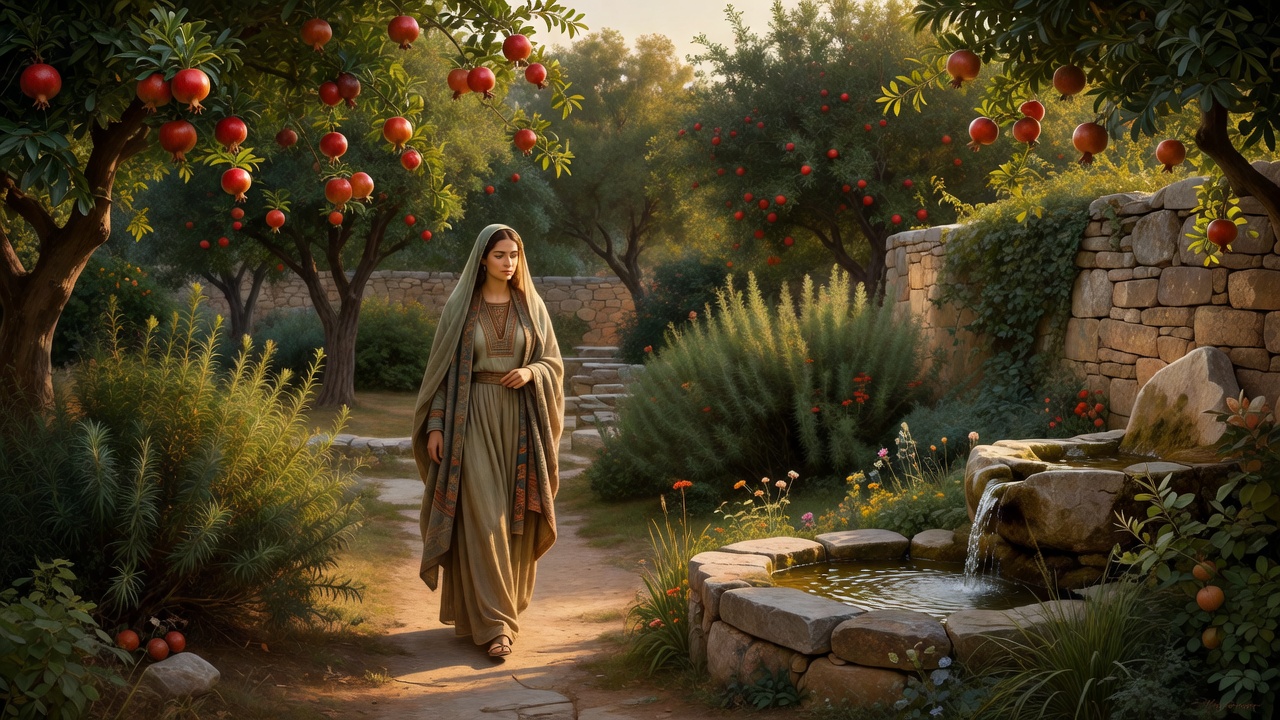
thy temple is like a half-pomegranate
within thy veil.
4Thy tzavar (neck) is like the migdal Dovid
girt with battlements,
whereon there hang a thousand mogen,
all the shields of Gibborim.
5Thy two breasts are like two ofarim (fawns, young deer)
that are twins, which graze among the lilies.
6Until HaYom (the day) break, and the shadows flee away,
I will get me to the har hamor (mountain of myrrh),
and to the hill of frankincense.
7Thou art all yafeh, my love;
there is no mum (blemish, spot, defect, flaw) in thee.
8Come with me from the Levanon,
my kallah (bride), with me from the Levanon;
come down from the heights of Amanah,
from the top of Senir and Chermon,
from the dens of the arayot (lions),
from the hills of the nemerim (leopards).
9Thou hast ravished my lev, my sister, my kallah;
thou hast ravished my lev with one of thy glances,
with one link of thy necklace.
10How fair is thy love, my sister, my kallah!
How much better is thy love than yayin!
And the scent of thine perfumes than any spice!
11Thy lips, O my kallah, drip like the honeycomb;
devash and cholov are under thy tongue;
and the scent of thy garments is like the scent of the Levanon.
12A gan (garden) locked is my sister, my kallah;
a spring enclosed, a ma'ayan (fountain) sealed.
13Thy plants are a pardeis (park, paradise) of pomegranates, with pleasant p'ri;
henna with spikenard,
14Spikenard and saffron; calamus and cinnamon,
with kol atzei levonah (all kinds of incense trees);
myrrh and aloes, with all the finest spices:
15A na'yan (fountain) of gardens, a be'er (well) of mayim chayyim (well of living waters),
and streams from the Levanon.
The Bride
16Awake, O north wind;
and come, thou south wind;
blow upon my gan (garden),
that the fragrances thereof may flow out.
Let dodi (my beloved) come into his gan (garden),
and let him taste its choice pri (fruits).
¿Sabías que…?
La belleza de la novia y el huerto de especias
- El poema invita a la novia a descender de las imponentes cordilleras del norte en el Líbano, que incluyen Amana, Senir y el monte Hermón. El monte Hermón es la cumbre más alta del Antilíbano, y las fuentes bíblicas señalan que Senir era el nombre amorreo para este monte.Fuentes: el propio texto bíblico · Hermon · Senir · Lebanon
- El cabello de la amada se compara con un rebaño de cabras que desciende por el monte Galaad, una región fértil y montañosa situada al este del río Jordán.Fuentes: el propio texto bíblico · Gilead
- La novia es descrita como un huerto cerrado, una fuente sellada y un vergel repleto de valiosas especias como nardo, azafrán, canela e incienso, lo que evoca exclusividad, frescura y fragancia.Fuentes: el propio texto bíblico
Notas escritas con ayuda de IA a partir de fuentes abiertas (Theographic Bible Metadata, CC BY-SA 4.0; Easton’s Bible Dictionary, dominio público) y revisadas antes de publicarse.
Lugares de este capítulo
- Gilead · Hoy: Gilead 1 · 32.187, 35.692 · versículo 1
- Lebanon · 33.540, 35.584 · versículos 8, 11, 15
- Mount Hermon · 33.400, 35.850 · versículo 8
- Senir · Hoy: Mount Hermon · 33.400, 35.850 · versículo 8
Solo aparecen lugares identificados con alta confianza (90 % o más según las fuentes académicas reunidas por OpenBible). Mapa de la época: DARE (Digital Atlas of the Roman Empire), CC BY 4.0; mapa actual: © colaboradores de OpenStreetMap; lugares: OpenBible.info (CC BY 4.0).
Créditos y licencia de esta traducción
The Orthodox Jewish Bible
The Orthodox Jewish Bible - Tanakh and Orthodox Jewish Brit Chadasha - The Holy Bible
copyright © 2002-2011, 2021, 2024 Artists for Israel International
Language: English
Contributor: Artists for Israel International
THE ORTHODOX JEWISH TANAKH
Artists For Israel Intl Inc.
This version also appears with the Orthodox Yiddish Triglot which presents the Hebrew Yiddish script in Latin script and an English word for word translation, available at afii.org/Torah
To donate PayPal.Me
This translation is made available to you under the terms of the
Creative Commons Attribution license 4.0.
You may share and redistribute this Bible translation or extracts from it in any format, provided that:
You include the above copyright and source information.
If you make any changes to the text, you must indicate that you did so in a way that makes it clear that the original licensor is not necessarily endorsing your changes.
Pictures included with Scriptures and other documents on this site are licensed just for use with those Scriptures and documents.
For other uses, please contact the respective copyright owners.
Note that in addition to the rules above, revising and adapting God's Word involves a great responsibility to be true to God's Word. See Revelation 22:18-19.
2026-01-06
Títulos de sección adaptados de la Berean Standard Bible (dominio público); no forman parte del texto bíblico de esta traducción.
Fuente: http://ebible.org/engojb/ · eBible.org