Salmos 53
The Orthodox Jewish Bible · Toca un versículo para ver sus referencias cruzadas.
The Fool Says There Is No God
1(For the one directing. According to ma'alot. Maskil of Dovid)
2The naval (fool) hath said in his lev, Ein Elohim (There is no G-d).
Corrupt are they, and they do abominable iniquity;
there is none that doeth tov.
3Elohim looked down from Shomayim upon Bnei Adam,
to see if there were any of seichel, that did seek Elohim.
4Every one of them has fallen away; they are altogether perverse;
there is none that doeth tov, no, not echad (one).
5Have the workers of iniquity no da'as?
Who eat up My people as they eat lechem;
they have not called upon Elohim.
6There were they in great pachad (fear), pachad such as never was;
for Elohim hath scattered the atzmot of him that encampeth against thee;
thou hast put them to shame, because Elohim hath rejected them.
7Oh that the Yeshu'at Yisroel would come out of Tziyon!
When Elohim bringeth back the captivity of Amo (His people),
Ya'akov shall rejoice,
and Yisroel shall be glad.
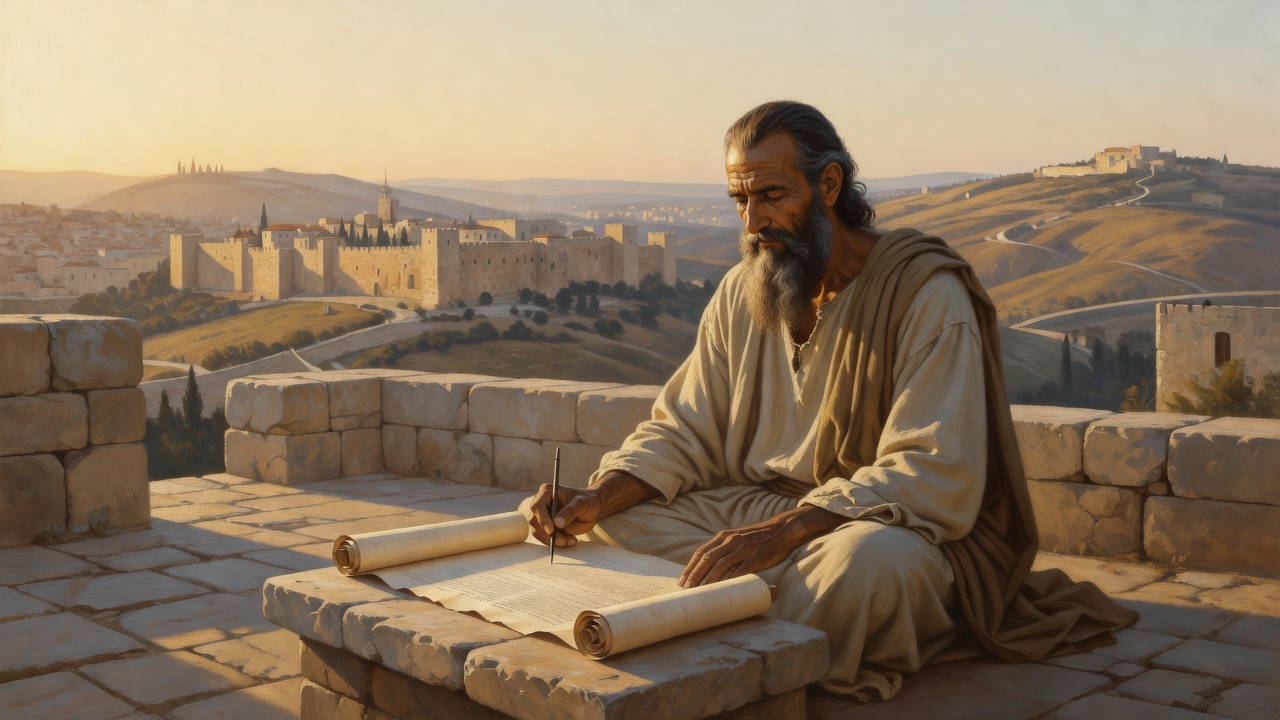
¿Sabías que…?
Una Reflexión sobre la Insensatez y la Liberación
- El salmo describe a Dios observando a la humanidad desde el cielo para ver si alguien Le busca, notando que todos se han desviado y corrompido.Fuentes: el propio texto bíblico
- El versículo final pide que la salvación provenga de Sion, la colina del sureste de Jerusalén donde David estableció su fortaleza y palacio tras tomarla de los jebuseos.Fuentes: el propio texto bíblico · Zion
- El poema concluye uniendo los nombres Jacob e Israel en un llamado al regocijo, recordando al patriarca Jacob, hijo de Isaac, a quien también se le dio el nombre de Israel.Fuentes: el propio texto bíblico · Jacob (Israel)
Notas escritas con ayuda de IA a partir de fuentes abiertas (Theographic Bible Metadata, CC BY-SA 4.0; Easton’s Bible Dictionary, dominio público) y revisadas antes de publicarse.
Lugares de este capítulo
- Zion · Hoy: Jerusalem · 31.777, 35.234 · versículo 6
Solo aparecen lugares identificados con alta confianza (90 % o más según las fuentes académicas reunidas por OpenBible). Mapa de la época: DARE (Digital Atlas of the Roman Empire), CC BY 4.0; mapa actual: © colaboradores de OpenStreetMap; lugares: OpenBible.info (CC BY 4.0).
Créditos y licencia de esta traducción
The Orthodox Jewish Bible
The Orthodox Jewish Bible - Tanakh and Orthodox Jewish Brit Chadasha - The Holy Bible
copyright © 2002-2011, 2021, 2024 Artists for Israel International
Language: English
Contributor: Artists for Israel International
THE ORTHODOX JEWISH TANAKH
Artists For Israel Intl Inc.
This version also appears with the Orthodox Yiddish Triglot which presents the Hebrew Yiddish script in Latin script and an English word for word translation, available at afii.org/Torah
To donate PayPal.Me
This translation is made available to you under the terms of the
Creative Commons Attribution license 4.0.
You may share and redistribute this Bible translation or extracts from it in any format, provided that:
You include the above copyright and source information.
If you make any changes to the text, you must indicate that you did so in a way that makes it clear that the original licensor is not necessarily endorsing your changes.
Pictures included with Scriptures and other documents on this site are licensed just for use with those Scriptures and documents.
For other uses, please contact the respective copyright owners.
Note that in addition to the rules above, revising and adapting God's Word involves a great responsibility to be true to God's Word. See Revelation 22:18-19.
2026-01-06
Títulos de sección adaptados de la Berean Standard Bible (dominio público); no forman parte del texto bíblico de esta traducción.
Fuente: http://ebible.org/engojb/ · eBible.org