Salmos 120
The Orthodox Jewish Bible · Toca un versículo para ver sus referencias cruzadas.
In My Distress I Cried to the LORD
1(Shir HaMa'alot — Song of Ascents)
1 In my tzoros I cried unto Hashem,
and He heard me.
2Save my nefesh, Hashem, from sefat sheker (lying lips),
and from lashon remiyyah (a tongue of deceit).
3What shall be given unto thee?
Or what shall be done unto thee, thou lashon remiyyah?
4Sharp khitzim (arrows) of the gibbor,
with burning (charcoal) coals of the broom plant.
5Woe is me, that I sojourn in Meshech,
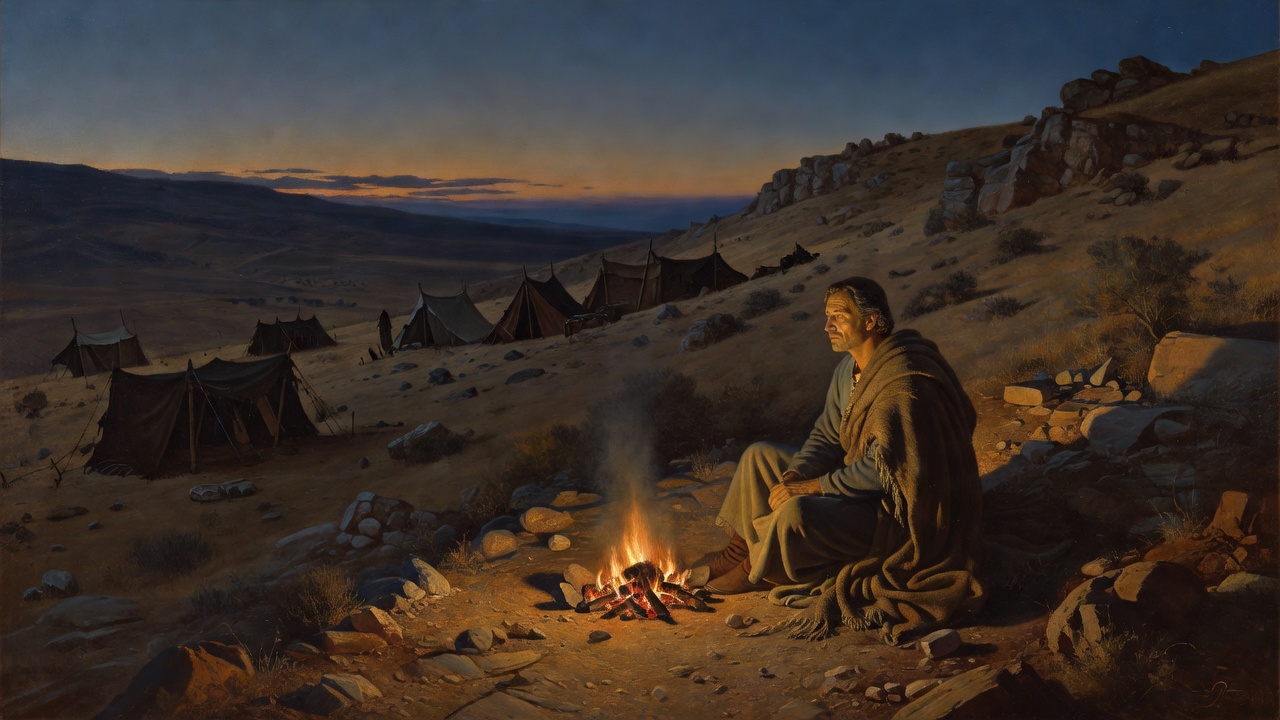
that I dwell in the ohalim of Kedar!
6My nefesh hath long dwelt
with him that hateth shalom.
7I am for shalom;
but when I speak, they are for milchamah (war).
¿Sabías que…?
Un clamor por la paz en el exilio
- El Salmo 120 abre la serie de quince "cánticos de las subidas", comenzando con un clamor personal que pide liberación de labios mentirosos y de un entorno hostil.Fuentes: el propio texto bíblico
- El salmista lamenta habitar en Mesec y entre las tiendas de Cedar. Mesec se asociaba con pueblos del norte cerca de los mares Negro y Caspio, mientras que Cedar se refería a tribus nómadas que vivían en tiendas negras en el noroeste de Arabia; juntos simbolizan tierras lejanas y extrañas, apartadas de la comunidad de adoración.Fuentes: Meshech · Kedar · el propio texto bíblico
Notas escritas con ayuda de IA a partir de fuentes abiertas (Theographic Bible Metadata, CC BY-SA 4.0; Easton’s Bible Dictionary, dominio público) y revisadas antes de publicarse.
Lugares de este capítulo
- Jerusalem · 31.777, 35.234 · versículo 1
- Kedar · 29.811, 39.868 · versículo 5
- Meshech · Hoy: about 200 km around Gordion · 39.655, 31.994 · versículo 5
Solo aparecen lugares identificados con alta confianza (90 % o más según las fuentes académicas reunidas por OpenBible). Mapa de la época: DARE (Digital Atlas of the Roman Empire), CC BY 4.0; mapa actual: © colaboradores de OpenStreetMap; lugares: OpenBible.info (CC BY 4.0).
Créditos y licencia de esta traducción
The Orthodox Jewish Bible
The Orthodox Jewish Bible - Tanakh and Orthodox Jewish Brit Chadasha - The Holy Bible
copyright © 2002-2011, 2021, 2024 Artists for Israel International
Language: English
Contributor: Artists for Israel International
THE ORTHODOX JEWISH TANAKH
Artists For Israel Intl Inc.
This version also appears with the Orthodox Yiddish Triglot which presents the Hebrew Yiddish script in Latin script and an English word for word translation, available at afii.org/Torah
To donate PayPal.Me
This translation is made available to you under the terms of the
Creative Commons Attribution license 4.0.
You may share and redistribute this Bible translation or extracts from it in any format, provided that:
You include the above copyright and source information.
If you make any changes to the text, you must indicate that you did so in a way that makes it clear that the original licensor is not necessarily endorsing your changes.
Pictures included with Scriptures and other documents on this site are licensed just for use with those Scriptures and documents.
For other uses, please contact the respective copyright owners.
Note that in addition to the rules above, revising and adapting God's Word involves a great responsibility to be true to God's Word. See Revelation 22:18-19.
2026-01-06
Títulos de sección adaptados de la Berean Standard Bible (dominio público); no forman parte del texto bíblico de esta traducción.
Fuente: http://ebible.org/engojb/ · eBible.org