Mateo 13
The Orthodox Jewish Bible · Toca un versículo para ver sus referencias cruzadas.
The Parable of the Sower
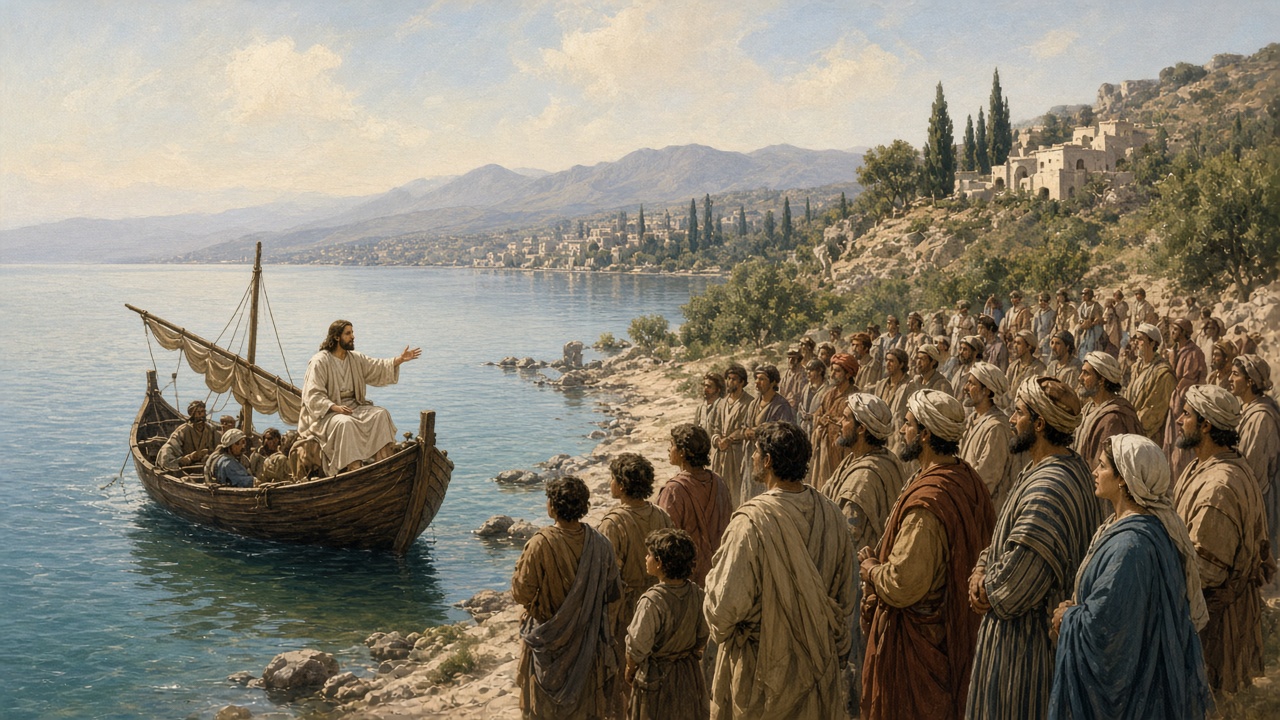
1On that day, having gone out of the bais, Rebbe, Melech HaMoshiach sat beside the lake. 2And many multitudes gathered together to him so that he got into a sirah (boat) to sit down, and the entire multitude stood along the shore. 3And Rebbe, Melech HaMoshiach told them many things in meshalim (parables), saying Hinei! The Sower went out to sow. 4And while he sowed, on the one hand, this fell along the road, and the birds having come, devoured them. 5And others fell upon the rocky places, where there is not much soil, and immediately it sprouts on account of the lack of the soilʼs depth. 6And when the shemesh (sun) arose, the zera (seed) was scorched, and because it did not have a root, it withered. 7And others fell among the thorns, and the thorns grew up and choked them. 8But others fell on the adamah tovah (good ground), and they yielded fruit: the one, one hundred, the other, sixty, the other, thirty. 9The one having oznayim (spiritual ears), let him hear!
The Purpose of Jesus’ Parables
10And, approaching, the talmidim said to Rebbe, Melech HaMoshiach, Why in meshalim (parables) are you speaking to them? 11And Rebbe, Melech HaMoshiach answered them, Because to you it has been granted to have daas of the razim (mysteries) of the Malchut HaShomayim, but to those it has not been granted. 12For whoever has, will be given to him, and he will have an abundance. But whoever does not have, even what he has will be taken from him. 13For this reason in meshalim I am speaking to them, for while seeing they do not see, and hearing they do not hear, nor do they have binah (understanding). 14And in them is fulfilled the nevuah (prophecy) of Yeshayah HaNavi, saying, SHIMU SHAMOA VAL TAVINU UREU RAO VAL TEIDAU (In hearing you will hear and by no means understand, and seeing you will see and by no means perceive). 15HASHMEIN LEV HAAM HAZEH VAZNAV HACHBEID VEINAV HASHA, PEN YIREH VEINAV UVEAZNAV YISHMAH ULEVAVO YAVIN, VSHAV NRAFAH LOH. (For the heart of this people has been made dull, and [their] ears are hard of hearing, and their eyes are shut, lest they see with the their eyes and with [their] ears they hear, and with the lev (heart) they understand and they turn and I will give them refuah [healing]). 16But ashrey are your eyes, for they see, and your ears, for they hear. 17For truly I say to you that many Neviim and tzaddikim desired to see what you see, and they did not see, and to hear what you hear, and they did not hear it.
The Parable of the Sower Explained
18You, therefore, listen to the mashal of the sower. 19When anyone hears the Dvar HaMalchut and does not have binah, HaRah (the Evil one) comes and seizes that which was sown in his lev (heart). This is the zera (seed) sown along the path. 20And the zera sown upon the rocky places is the person listening to the Dvar Hashem and immediately with simcha receives it. 21Yet he has no root in himself but is short-lived, and when ES TZARAH comes or persecution on account of the Dvar Hashem, immediately he ceases being a maamin Meshichi (Messianic believer) and becomes meshummad (apostate), falling away and giving up the faith. 22And the sown among the thorns is the one hearing the dvar (word), and the rogez HaOlam Hazeh (the anxiety of this age) and the mirmah (deceit) of riches, choke the Dvar Hashem and it becomes unfruitful. 23And the zera sown upon the adamah tovah (the good ground), this is the one who hears the Dvar Hashem and, understanding, indeed bears pri and, one produces a hundred, the other sixty, the other thirty.
The Parable of the Weeds
24Another mashal Rebbe, Melech HaMoshiach placed before them, saying, The Malchut HaShomayim is like a man sowing zera tov (good seed) in his field. 25But while men slept, his oyev (enemy) came and oversowed weeds in between the wheat and went away. 26But when the wheat sprouted and produced pri, then the weeds also appeared. 27So the servants of the Baal Bayit said to him, Adoneinu, did you not sow zera tov (good seed) in your field? How then does it have weeds? 28And he said to them, An oyev did this. So the servants say to him, Do you want us to go and pull them all? 29But he says, No, lest gathering the weeds you should uproot the wheat together with them. 30Permit both to grow together until the Katzir (harvest); and in time of the Katzir, I will say to the kotzerim, Collect first the weeds, and bind them into bundles to burn them. But the wheat gather into my storehouse.
The Parable of the Mustard Seed
31Another mashal Rebbe, Melech HaMoshiach placed before them, saying, The Malchut HaShomayim is like a mustard seed, which a man took and sowed in his field. 32This that is indeed less than all the zeraim (seeds), but when it grows, it is larger than the garden vegetables and it becomes an etz (tree), so that the OPH HASHOMAYIM come and dwell in its branches.
The Parable of the Leaven
33Another mashal Rebbe, Melech HaMoshiach spoke to them. The Malchut HaShomayim is like seor (leaven), which having taken, a woman hid in three satas of wheat flour until the whole was leavened.
I Will Open My Mouth in Parables
34All these things Rebbe, Melech HaMoshiach spoke in meshalim to the multitudes. And apart from meshalim Rebbe, Melech HaMoshiach did not speak to them: 35So that might be fulfilled what was spoken through the Navi, saying, EFTCHA VMASHAL PI AVIAH CHIDOT (I will open my mouth with parables, I will utter things having been hidden) from the foundation of the world ( Ps 78:2).
The Parable of the Weeds Explained
36Then having sent away the multitudes, Rebbe, Melech HaMoshiach came into the bais (house). And Moshiachʼs talmidim approached him, saying, Explain to us the mashal of the weeds of the field. 37And answering, Rebbe, Melech HaMoshiach said, The Sower of the zera tov is the Bar Enosh (Moshiach). 38The field is HaOlam Hazeh. And the zera tov, the good seed, these are the Bnei HaMalchut, and the weeds, these are the bnei HaRah (sons of the Evil one). 39And the Oyev (the Enemy) sowing them is HaSatan. And the Katzir (Harvest), this is HaKetz HaOlam (the end of the age). And the kotzerim (reapers, harvesters) are malachim (angels). 40As the weeds are pulled up and gathered and are consumed with Eish (Fire), so also it will be at the Ketz HaOlam. 41The Bar Enosh will send forth his malachim, and they will pull up and gather out of the Moshiachʼs Malchut all the things making meshummad (apostate) and the ones who are without gezetz (law) and antinomian. 42And Moshiachʼs malachim will throw them into the furnace of Eish; there will be weeping and grinding of teeth. 43Then the tzaddikim will shine as the shemesh (sun) in the Malchut of their Father. The one having oznayim (spiritual ears), let him hear.
The Parables of the Treasure and the Pearl
44The Malchut HaShomayim is like otzar (treasure) hidden in the field, which, having found, a man hid. And from the simcha he experienced, he goes away and sells everything he has and buys that field.
45Again, the Malchut HaShomayim is like a merchant searching for fine pearls. 46And having found one precious peninah (pearl), he went away and liquidated everything he had and acquired it.
The Parable of the Net
47Again, the Malchut HaShomayim is like a reshet (net) having been cast into the lake, a reshet collecting and gathering dagim (fish) of all descriptions, 48which, when this reshet (net) was filled, they hoisted it upon the shore, sat down, collected the tov (good) into a creel, and the rah (evil), they threw out. 49Thus it will be at HaKetz HaOlam Hazeh (The End of This World). The malachim will go out and they will separate the resha'im from among the tzaddikim. 50And they will throw the resha'im into the furnace of Eish. In that place there will be weeping and gnashing of teeth.
51Did you have binah of all these things? They say to Rebbe, Melech HaMoshiach, Ken. 52So Rebbe, Melech HaMoshiach said to them, Therefore, every sofer (scribe, torah teacher, rabbi) who becomes a talmid of the Malchut HaShomayim is like a man a Baal Bayit, who takes out of his otzar (treasure), chadashot (new things) and also yeshanot (old things).
The Rejection at Nazareth
53And it came about when Rebbe, Melech HaMoshiach finished these meshalim, that he went away from there. 54And having come into Moshiachʼs shtetl, he began ministering as a moreh (teacher) in their shul, so that they were amazed and said, From where did this chochmah come to this one, this chochmah and these moftim (miracles, wonders, omens)? 55Is this not the ben hanaggar (the carpenterʼs son)? Is not his Em called Miryam? And are not his achim Ya'akov, Yosef, Shim'on and Yehuda? 56And are not his achayot (sisters) with us? From where, therefore, came to this one all these things? 57And they were taking offense at Rebbe, Melech HaMoshiach. But Rebbe, Melech HaMoshiach said to them, A Navi (prophet) is not without honor except in his hometown and in his bais. 58And Rebbe, Melech HaMoshiach did not accomplish in that place many moftim, because of their lack of emunah (faith) and bitachon (trust).
¿Sabías que…?
Parábolas del Reino de los Cielos
- El día que describe este capítulo, Jesús salió de la casa y se sentó junto al mar. La multitud creció tanto que subió a una barca y enseñó desde allí, mientras la gente permanecía de pie en la orilla, y no les habló nada sino en parábolas. Una cronología fecha estas parábolas junto al mar en el año 28 d.C.Fuentes: el propio texto bíblico · Seaside Parables and Miracle
- Cuando los discípulos preguntaron por qué hablaba al pueblo en parábolas, Jesús respondió que el conocimiento de los misterios del reino de los cielos se les había dado a ellos, pero no a las multitudes. Dijo que la profecía de Isaías se cumplía en las multitudes: seguirían oyendo y viendo, pero jamás entenderían ni percibirían, porque su corazón se había endurecido. El Easton’s Bible Dictionary (1897) describe a Isaías como hijo de Amoz, que profetizó durante los reinados de Uzías, Jotam, Acaz y Ezequías.Fuentes: el propio texto bíblico · Isaiah
- Más tarde, Jesús llegó a su ciudad natal, enseñó en la sinagoga, y la gente se ofendió por causa de él. Preguntaron si era el hijo del carpintero, nombraron a su madre María y a sus hermanos Jacobo, José, Simón y Judas, y señalaron que sus hermanas vivían entre ellos; a causa de la incredulidad de ellos, no hizo muchos milagros allí. María es identificada como esposa de José y madre de Jesús, Simón como uno de los hermanos del Señor, y una cronología fecha este segundo rechazo en Nazaret en el año 29 d.C.Fuentes: el propio texto bíblico · Mary (Mother of Jesus) · Simon · 2nd Rejection at Nazareth
Notas escritas con ayuda de IA a partir de fuentes abiertas (Theographic Bible Metadata, CC BY-SA 4.0; Easton’s Bible Dictionary, dominio público) y revisadas antes de publicarse.
Lugares de este capítulo
- Nazareth · 32.702, 35.298 · versículo 54
Solo aparecen lugares identificados con alta confianza (90 % o más según las fuentes académicas reunidas por OpenBible). Mapa de la época: DARE (Digital Atlas of the Roman Empire), CC BY 4.0; mapa actual: © colaboradores de OpenStreetMap; lugares: OpenBible.info (CC BY 4.0).
Créditos y licencia de esta traducción
The Orthodox Jewish Bible
The Orthodox Jewish Bible - Tanakh and Orthodox Jewish Brit Chadasha - The Holy Bible
copyright © 2002-2011, 2021, 2024 Artists for Israel International
Language: English
Contributor: Artists for Israel International
THE ORTHODOX JEWISH TANAKH
Artists For Israel Intl Inc.
This version also appears with the Orthodox Yiddish Triglot which presents the Hebrew Yiddish script in Latin script and an English word for word translation, available at afii.org/Torah
To donate PayPal.Me
This translation is made available to you under the terms of the
Creative Commons Attribution license 4.0.
You may share and redistribute this Bible translation or extracts from it in any format, provided that:
You include the above copyright and source information.
If you make any changes to the text, you must indicate that you did so in a way that makes it clear that the original licensor is not necessarily endorsing your changes.
Pictures included with Scriptures and other documents on this site are licensed just for use with those Scriptures and documents.
For other uses, please contact the respective copyright owners.
Note that in addition to the rules above, revising and adapting God's Word involves a great responsibility to be true to God's Word. See Revelation 22:18-19.
2026-01-06
Títulos de sección adaptados de la Berean Standard Bible (dominio público); no forman parte del texto bíblico de esta traducción.
Fuente: http://ebible.org/engojb/ · eBible.org