Lucas 16
The Orthodox Jewish Bible · Toca un versículo para ver sus referencias cruzadas.
The Parable of the Shrewd Manager
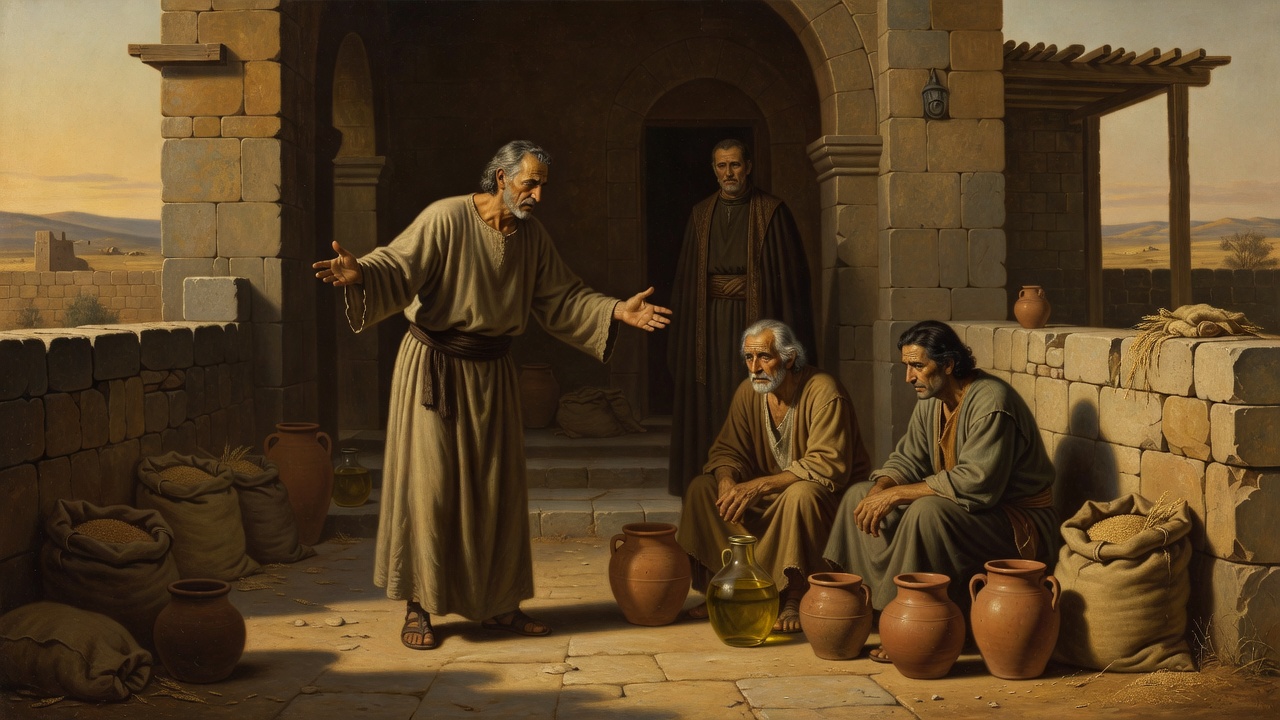
1And Rebbe, Melech HaMoshiach was saying also to the talmidim, A certain oisher (rich man) had a sochen (steward, estate manager or agent), and the charge brought against him was that he was squandering the property of the oisher (rich man). 2And having called him, the oisher said to the sochen, What is this I hear about you? Submit to a bikoret beshbonot (audit) for that which is under your pekuddah (stewardship care), for you are no longer able to be sochen. 3And the sochen said to himself, What may I do, because Adoni takes away the pekuddah from me? I am not strong enough to dig, I am ashamed to beg. 4Oh! I have daas of what I may do, that when I am removed from the work of the sochen, they may receive me into their batim. 5And having summoned his Adonʼs debtors one by one, he was saying to the first, How much do you owe Adoni? 6And he said, One hundred jugs of olive oil. And the sochen said to him, Take your bill, sit down, quickly write fifty. 7Then to another he said, And you, how much do you owe? And he said, One hundred containers of wheat. He says to him, Take your bill and write eighty. 8And the Baal Bayit praised the unrighteous sochen because he acted with chochmah. Because the Bnei HaOlam HaZeh have more seichel in dealing with their own generation than the Bnei HaOhr. 9And I say to you, use the mammon (the wealth of the Olam HaZeh) to make for yourselves yedidim (friends, chaverim), so that when unrighteous mammon fails, they may welcome you into the mishkenot olam (eternal dwellings of the Olam HaBah).
10The one oisgehalten in little, also is neeman in much, and the one who is unrighteous in little, also in much is unrighteous. 11If, then, you were not ne'eman with unrighteous mammon, who will entrust you with hon emes? 12And if you were not neeman with that which belongs to another, who will give you what is your own? 13No eved is able to serve two adonim; for either he will have sinah (hatred) toward the one and he will have ahavah (love) toward the other, or one he will be devoted to and the other he will despise. Your avodas service cannot be for both Hashem and Mammon.
The Law and the Prophets
14And the Perushim, who were ohavei kesef (lovers of money), heard all this and they made leitzonus (fun) of Rebbe, Melech HaMoshiach. 15And Rebbe, Melech HaMoshiach said to them, You are the ones who in the sight of Bnei Adam credit yourself as being yitzdak im Hashem (justified with G-d), but Hashem has daas (knowledge) of your levavot. Because the thing highly esteemed among Bnei Adam is a to'eva (abomination) before Hashem.
16The Torah and the Neviim were proclaimed until Yochanan; since then it is the Malchut Hashem that is being preached as Besuras HaGeulah, and anyone entering it must strive to do so. 17But it is easier for HaShomayim and HaAretz to pass away than for one tag (ornamental flourish) of the Torah to fail.
18Anyone giving the get to his isha and taking another wife commits ni'uf (adultery), and the one marrying a gerusha (divorcee) commits ni'uf (adultery).
The Rich Man and Lazarus
19Now there was a certain oisher (rich man). He was dressed in purple and fine linen, and yom yom (daily) he feasted sumptuosly and every day for him was to make a simcha. 20And there was a certain ish oni (poor man) covered with sores, El'azar by name, who had been laid at the oisherʼs sha'ar (gate). 21And the ish oni El'azar longed to fill his mogen (stomach) with what fell from the oisherʼs tish. But even the kelevim (dogs) were coming and licking the sores of the ish oni (poor man). 22And it came to pass that El'azar died, and he was carried away by the malachim to the tish at the kheyk (bosom) of Avraham Avinu. And then the oisher (rich man) died also, and he was buried. 23And lifting up his eynayim in Sheol, where he was in the torments of agony, he sees Avraham Avinu off in the distance and El'azar at tish at his kheyk (bosom). 24And he called, Avraham Avinu! Chaneni na and send El'azar that he may dip the tip of his finger into the mayim and cool my tongue, because I am in torment in this moked (fire). 25But Avraham Avinu said, Beni, have zikaron (recollection) that you received your tov in the span of your days, and El'azar likewise received the ra'ah. But now he is given nechamah (comfort) here, but you, yisurim (sufferings, torments). 26And, in addition to all these things, there has been fixed between us and you a tehom gedolah (a great abyss, chasm), so that the ones wishing to come over from here to you are not able, neither from there to us may they cross over. 27And the oisher said, I ask you then, Avraham Avinu, that you may send El'azar to the bais of Avi, 28for I have chamesh achim (five brothers) that he may warn them, lest also they may come to this place of yisurim (torments). 29But Avraham Avinu says, They have Moshe Rabbeinu and the Neviim. Let them listen to them. 30But the oisher said, Lo (no), Avraham Avinu, but if someone from the Mesim should go to them, they will make teshuva. 31But Avraham said to him, If Moshe Rabbeinu and the Neviim they do not listen to, neither if someone should make his Techiyah from the Mesim should they be persuaded.
¿Sabías que…?
Riqueza, dos amos y Lázaro
- En las palabras de Jesús sobre el rico y Lázaro, el rico clama: 'Padre Abraham', y Abraham responde: 'Hijo'. El Diccionario Bíblico de Easton (1897) explica el nombre Abraham como 'Padre de una multitud' y lo describe como heredero de las promesas.Fuentes: el propio texto bíblico · Abraham
- Hablando a los fariseos, que se burlaban de él, Jesús dice que la Ley y los Profetas fueron proclamados hasta Juan, y que desde entonces se predica el evangelio del reino de Dios. El Diccionario Bíblico de Easton (1897) llama a Juan el Bautista 'precursor de nuestro Señor', afirma que su misión fue objeto de profecía, entre ellas Isaías 40:3 y Malaquías 3:1, y declara que su nacimiento ocurrió seis meses antes del de Jesús.Fuentes: el propio texto bíblico · John the Baptist
- A un administrador acusado de desperdiciar los bienes de su señor se le ordena rendir cuentas y dejar el puesto. Hace que los deudores reescriban sus cuentas, reduciendo cien medidas de aceite de oliva a cincuenta y cien medidas de trigo a ochenta, y el señor elogia al administrador deshonesto porque había actuado con astucia. Jesús dice entonces que ningún siervo puede servir a dos amos, y que nadie puede servir al mismo tiempo a Dios y al dinero.Fuentes: el propio texto bíblico
Notas escritas con ayuda de IA a partir de fuentes abiertas (Theographic Bible Metadata, CC BY-SA 4.0; Easton’s Bible Dictionary, dominio público) y revisadas antes de publicarse.
Créditos y licencia de esta traducción
The Orthodox Jewish Bible
The Orthodox Jewish Bible - Tanakh and Orthodox Jewish Brit Chadasha - The Holy Bible
copyright © 2002-2011, 2021, 2024 Artists for Israel International
Language: English
Contributor: Artists for Israel International
THE ORTHODOX JEWISH TANAKH
Artists For Israel Intl Inc.
This version also appears with the Orthodox Yiddish Triglot which presents the Hebrew Yiddish script in Latin script and an English word for word translation, available at afii.org/Torah
To donate PayPal.Me
This translation is made available to you under the terms of the
Creative Commons Attribution license 4.0.
You may share and redistribute this Bible translation or extracts from it in any format, provided that:
You include the above copyright and source information.
If you make any changes to the text, you must indicate that you did so in a way that makes it clear that the original licensor is not necessarily endorsing your changes.
Pictures included with Scriptures and other documents on this site are licensed just for use with those Scriptures and documents.
For other uses, please contact the respective copyright owners.
Note that in addition to the rules above, revising and adapting God's Word involves a great responsibility to be true to God's Word. See Revelation 22:18-19.
2026-01-06
Títulos de sección adaptados de la Berean Standard Bible (dominio público); no forman parte del texto bíblico de esta traducción.
Fuente: http://ebible.org/engojb/ · eBible.org