Levítico 6
The Orthodox Jewish Bible · Toca un versículo para ver sus referencias cruzadas.
[TZAV]
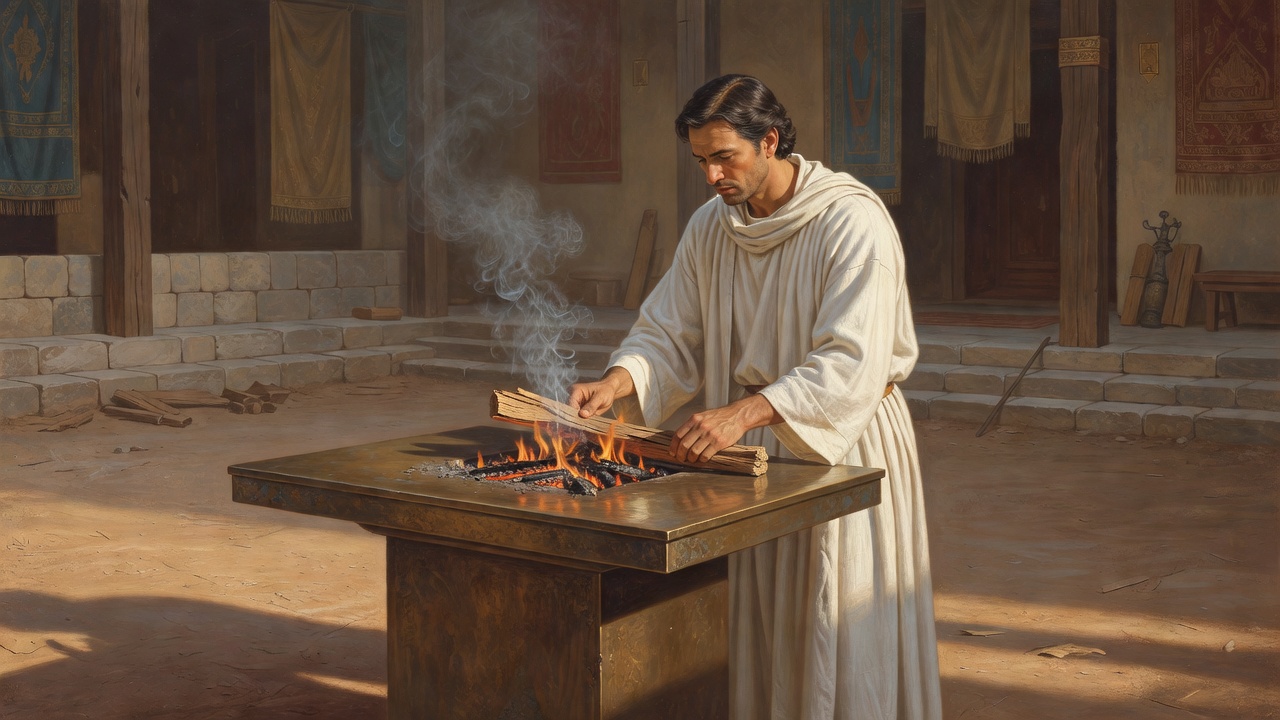
1And Hashem spoke unto Moshe, saying, 2Command Aharon and his Banim, saying, This is the Torat HaOlah: It is the olah (burnt offering) that is to stay on the flame upon the Mizbe'ach kol halailah unto the boker, and the eish of the Mizbe'ach must be burning on it. 3And the kohen shall put on his linen tunic, and his linen breeches shall he put upon his basar, and remove the ashes which the eish hath consumed with the olah (burnt offering) on the Mizbe'ach, and he shall put them beside the Mizbe'ach. 4And he shall take off his garments, and put on begadim acherim (other garments), and carry forth the ashes outside the machaneh unto a makom tahor.
5And the eish upon the Mizbe'ach shall be burning in it; it must not go out; and the kohen shall burn wood on it every boker, and arrange the olah (burnt offering) upon it; and he must burn thereon the chelvei HaShelamim (fat of the peace offerings). 6The eish must ever be burning upon the Mizbe'ach; it shall never go out.
7And this is the Torat HaMinchah: the Bnei Aharon shall offer it before Hashem, before the Mizbe'ach. 8And he shall take of it his handful, of the flour of the minchah, and of the shemen thereof, and all the incense which is upon the minchah, and shall burn it upon the Mizbe'ach for a re'ach nicho'ach, even the memorial portion of it, unto Hashem. 9And the remainder thereof shall Aharon and his Banim eat: with matzot shall it be eaten in the makom kadosh; in the khatzer (courtyard) of the Ohel Mo'ed they shall eat it. 10It shall not be baked with chametz. I have given it unto them for their chelek (allotted share, portion) of My offerings made by eish; it is kodesh kodashim, like the chattat (sin offering), and like the asham (trespass offering). 11Any of the zachar among the Bnei Aharon shall eat of it. It shall be a chok olam in your dorot concerning the offerings of Hashem made by eish; every one that toucheth them shall be kadosh.
12And Hashem spoke unto Moshe, saying, 13This is the korban of Aharon and of his Banim, which they shall offer unto Hashem in the Yom Himmashach (Day he is anointed, i.e., assumes office, seven-day ordination); the tenth part of an ephah of fine flour for a continual minchah, half of it in the boker, and half thereof at erev. 14In a pan it shall be made with shemen; and when it is scalded, thou shalt bring it in; and the repeatedly baked minchah, broken in pieces, shalt thou offer for a re'ach nicho'ach unto Hashem. 15And the kohen of his Banim that is hamoshiach (the anointed) to succeed him shall offer it; it is a chok olam unto Hashem; it shall be completely burned. 16For every minchah for the kohen shall be completely burned; it shall not be eaten.
17And Hashem spoke unto Moshe, saying, 18Speak unto Aharon and to his Banim, saying, This is the Torat HaChattat: In the place where the olah (burnt offering) is slaughtered (shachat) shall the chattat (sin offering) be slaughtered before Hashem; it is kodesh kodashim. 19The kohen that offereth it for sin shall eat it; in the makom kadosh shall it be eaten, in the khatzer (courtyard) of the Ohel Mo'ed. 20Everything that touches the basar thereof shall be kadosh; and when there is sprinkled of the dahm thereof upon any garment, thou shalt wash that whereon it was sprinkled in the makom kadosh. 21But the clay keli (vessel) wherein it is boiled must be broken; and if it be boiled in a keli nechoshet (copper vessel), it shall be both scoured, and rinsed in mayim. 22Any of the zachar among the kohanim shall eat thereof; it is kodesh kodashim. 23And no chattat (sin offering), whereof any of the dahm is brought into the Ohel Mo'ed to make kapporah therewith in the Kodesh (holy place), shall be eaten; it shall be burned in the eish.
¿Sabías que…?
Deberes Sacerdotales y el Fuego Continuo del Altar
- Para las faltas que implicaban robo, extorsión o falso juramento sobre bienes perdidos, la ley exigía la restitución total más una quinta parte del valor pagada al legítimo dueño antes de que el infractor pudiera presentar un carnero como ofrenda por la culpa.Fuentes: el propio texto bíblico
- Se ordenó a los sacerdotes mantener el fuego del altar ardiendo continuamente día y noche sin permitir que se apagara. Cada mañana, un sacerdote vestido con vestiduras de lino colocaba leña fresca en el altar y retiraba las cenizas para llevarlas fuera del campamento.Fuentes: el propio texto bíblico
- Debido a que la ofrenda por el pecado era considerada santísima, normas estrictas regulaban las vasijas usadas para prepararla: las vasijas de barro utilizadas para hervir la carne debían romperse, mientras que las de bronce podían fregarse y enjuagarse con agua.Fuentes: el propio texto bíblico
Notas escritas con ayuda de IA a partir de fuentes abiertas (Theographic Bible Metadata, CC BY-SA 4.0; Easton’s Bible Dictionary, dominio público) y revisadas antes de publicarse.
Créditos y licencia de esta traducción
The Orthodox Jewish Bible
The Orthodox Jewish Bible - Tanakh and Orthodox Jewish Brit Chadasha - The Holy Bible
copyright © 2002-2011, 2021, 2024 Artists for Israel International
Language: English
Contributor: Artists for Israel International
THE ORTHODOX JEWISH TANAKH
Artists For Israel Intl Inc.
This version also appears with the Orthodox Yiddish Triglot which presents the Hebrew Yiddish script in Latin script and an English word for word translation, available at afii.org/Torah
To donate PayPal.Me
This translation is made available to you under the terms of the
Creative Commons Attribution license 4.0.
You may share and redistribute this Bible translation or extracts from it in any format, provided that:
You include the above copyright and source information.
If you make any changes to the text, you must indicate that you did so in a way that makes it clear that the original licensor is not necessarily endorsing your changes.
Pictures included with Scriptures and other documents on this site are licensed just for use with those Scriptures and documents.
For other uses, please contact the respective copyright owners.
Note that in addition to the rules above, revising and adapting God's Word involves a great responsibility to be true to God's Word. See Revelation 22:18-19.
2026-01-06
Fuente: http://ebible.org/engojb/ · eBible.org