Levítico 12
The Orthodox Jewish Bible · Toca un versículo para ver sus referencias cruzadas.
[TAZRIA]
1And Hashem spoke unto Moshe, saying, 2Speak unto the Bnei Yisroel, saying, If an isha have conceived, and born a zachar, then she shall be temeiah shivat yamim; according to the yamim of the niddah (menstruation separation) for her infirmity shall she be temeiah (unclean). 3And in the yom hashemini the basar of his arel (uncircumcision, foreskin) shall be circumcised. 4And shloshim yom ushloshet she shall then remain in demei tohorah (blood of her purifying, i.e., period in which she would be unclean); she shall touch no kodesh, nor enter the Mikdash, until the yamei of her tohorah be fulfilled. 5But if she bear a nekevah, then she shall be temeiah two weeks, as in her niddah (separation); and she shall remain in the blood of her tohorah sixty-six days. 6And when the yemei tohorah are fulfilled, for a ben, or for a bat, she shall bring a keves of the first year for an olah, and a young pigeon, or a turtledove, for a chattat (sin offering), unto the entrance of the Ohel Mo'ed unto the kohen; 7Who shall offer it before Hashem, and make kapporah for her; and she shall be cleansed from the issue of her dahm. This is the torah for her that hath born a zachar or a nekevah.
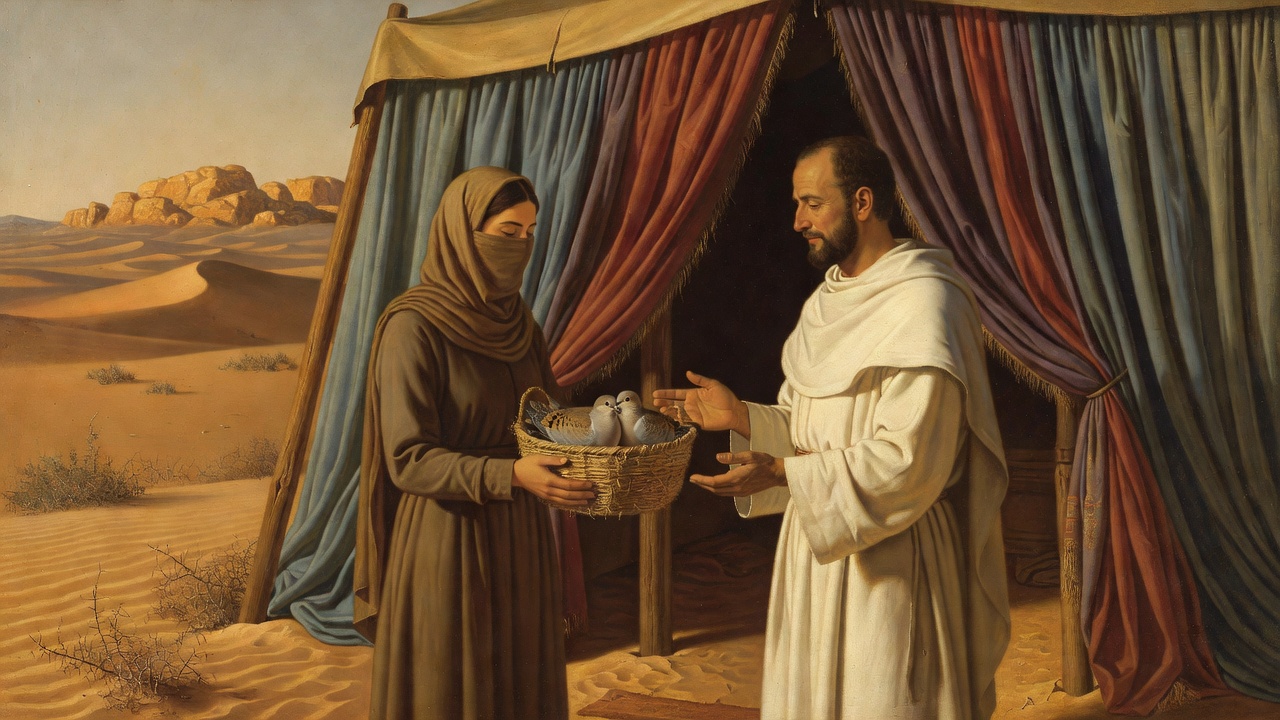
8And if she be not able to afford to bring a seh, then she shall bring two turtledoves, or two young pigeons; the one for an olah, and the other for a chattat; and the kohen shall make kapporah for her, and she shall be teherah (clean).
¿Sabías que…?
Purificación después del Parto
- Levítico especifica períodos distintos de purificación ceremonial después del parto: un total de cuarenta días por un hijo varón (siete días más treinta y tres días) y ochenta días por una hija (catorce días más sesenta y seis días). Durante este tiempo, la madre no debía tocar ningún objeto sagrado ni entrar al santuario.Fuentes: el propio texto bíblico
- Al concluir el período de purificación, la madre debía llevar un holocausto y una ofrenda por el pecado ante el sacerdote en la entrada de la Tienda de Reunión. Si sus recursos no le alcanzaban para un cordero, la ley permitía expresamente una ofrenda alternativa de dos tórtolas o dos pichones de paloma.Fuentes: el propio texto bíblico
Notas escritas con ayuda de IA a partir de fuentes abiertas (Theographic Bible Metadata, CC BY-SA 4.0; Easton’s Bible Dictionary, dominio público) y revisadas antes de publicarse.
Créditos y licencia de esta traducción
The Orthodox Jewish Bible
The Orthodox Jewish Bible - Tanakh and Orthodox Jewish Brit Chadasha - The Holy Bible
copyright © 2002-2011, 2021, 2024 Artists for Israel International
Language: English
Contributor: Artists for Israel International
THE ORTHODOX JEWISH TANAKH
Artists For Israel Intl Inc.
This version also appears with the Orthodox Yiddish Triglot which presents the Hebrew Yiddish script in Latin script and an English word for word translation, available at afii.org/Torah
To donate PayPal.Me
This translation is made available to you under the terms of the
Creative Commons Attribution license 4.0.
You may share and redistribute this Bible translation or extracts from it in any format, provided that:
You include the above copyright and source information.
If you make any changes to the text, you must indicate that you did so in a way that makes it clear that the original licensor is not necessarily endorsing your changes.
Pictures included with Scriptures and other documents on this site are licensed just for use with those Scriptures and documents.
For other uses, please contact the respective copyright owners.
Note that in addition to the rules above, revising and adapting God's Word involves a great responsibility to be true to God's Word. See Revelation 22:18-19.
2026-01-06
Fuente: http://ebible.org/engojb/ · eBible.org