Job 5
The Orthodox Jewish Bible · Toca un versículo para ver sus referencias cruzadas.
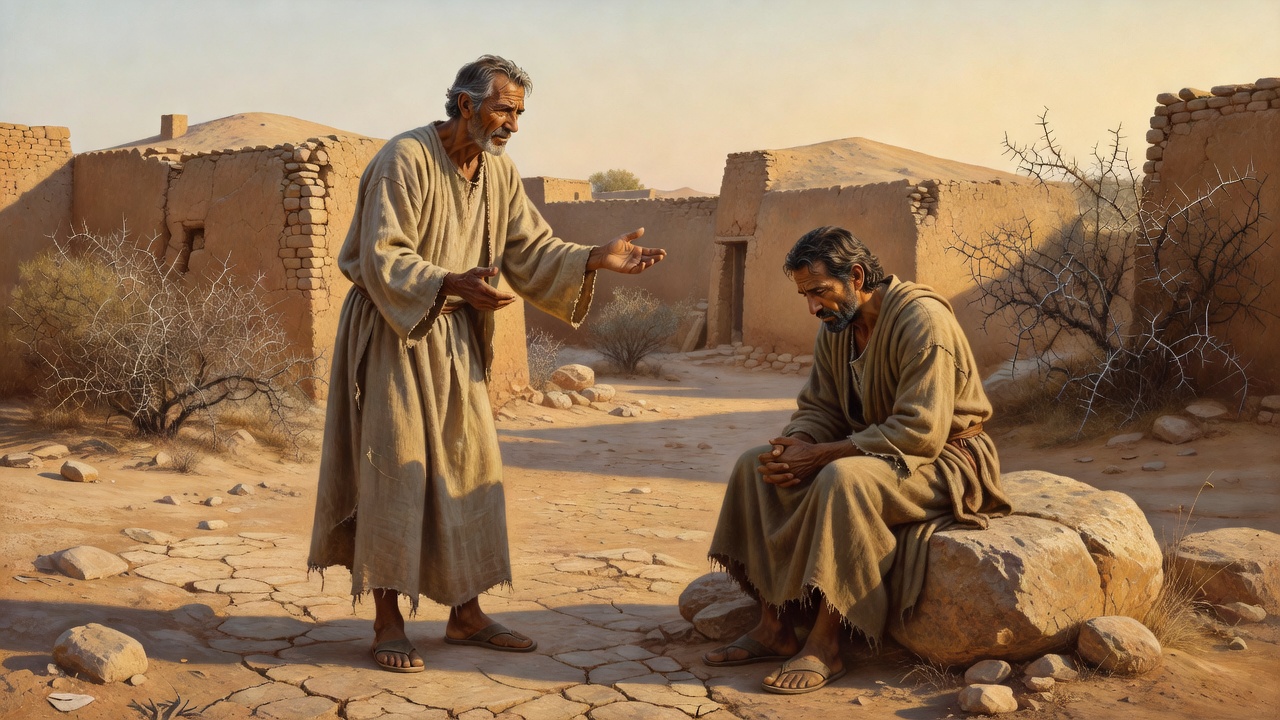
Eliphaz Continues: God Blesses those Who Seek Him
1Call now, if there be any that will answer thee,
and to which of the Kedoshim (holy ones) wilt thou turn?
2For ka'as (anger) killeth the foolish man,
and kinah (envy) slayeth the simple one.
3I have seen the fool taking shoresh (root),
but suddenly I cursed his habitation.
4His banim are far from yesha (safety, salvation),
and they are crushed in the sha'ar (gate, before the public),
neither is there any to deliver them.
5Whose katzir (harvest) the hungry eateth up,
and taketh it even from among of the tzinnim (thorns),
and the intriguer pants after their wealth.
6Although affliction springeth not forth of the aphar (dust),
neither doth amal (trouble, tzoros) sprout out of the adamah;
7Yet adam is born unto amal (trouble, tzoros),
even as sparks fly upward.
8I would seek El (G-d),
and before Elohim would I lay my cause;
9Who doeth gedolot unsearchable,
marvellous things without mispar;
10Who giveth matar upon eretz,
and sendeth mayim upon the fields;
11To set up on high those that be the shefalim (the lowly ones);
that those which mourn may be exalted to safety,
12Thwarting the machshevot of the arumim (crafty ones),
so that their hands cannot accomplish tushiyyah (success).
13He taketh the chachamim in their own arum (craftiness),
and the etzah of the wily is swiftly swept away.
14They meet with choshech in the daytime,
and grope in the noonday as in the lailah,
15But He saveth the needy from the cherev of their mouth,
and from the yad chazak.
16So the poor hath tikveh,
and olatah (perversity, wickedness) stoppeth her mouth.
17Hinei, ashrei is the enosh whom Eloah correcteth;
therefore despise not thou the musar (chastening) of Shaddai;
18For He woundeth, and bindeth up;
He injureth, and His yadayim (hands) heal.
19He shall deliver thee in shesh tzoros;
yea, in shivah there shall no rah touch thee.
20In ra'av (famine) He shall redeem thee from mavet;
and in milchamah from the power of the cherev.
21Thou shalt be hid from the scourge of the leshon,
neither shalt thou be afraid of destruction when it cometh.
22At destruction and famine thou shalt laugh;
neither shalt thou be afraid of the chayyat ha'aretz.
23For thou shalt be in league with the avanim of the sadeh,
and the chayyat sadeh shall be hashelemah (at peace) with thee.
24And thou shalt know that shalom shall be thy ohel;
and thou shalt visit thy habitation, and find nothing wanting.
25Thou shalt know also that thy zera shall be rav,
and thine offspring as the esev ha'aretz.
26Thou shalt come to thy kever in a ripe age,
like a shock of grain cometh in its season.
27Hinei zot, this we have searched out, so it is;
hear it, and apply thou it for thy good.
¿Sabías que…?
El Consejo de Elifaz sobre el Sufrimiento y la Corrección Divina
- Elifaz presenta el sufrimiento como una disciplina divina con propósito y no como una calamidad arbitraria, afirmando que la aflicción no brota del suelo sin causa. Por ello, exhorta a Job a no despreciar la corrección del Todopoderoso, quien hiere solo para vendar y sanar.Fuentes: el propio texto bíblico
- Al prometer rescate de seis calamidades e incluso de siete, Elifaz recurre a una fórmula poética tradicional de paralelismo numérico gradual. Este recurso, habitual en la literatura sapiencial del Antiguo Oriente Próximo, añade énfasis para expresar una protección cabal y absoluta.Fuentes: el propio texto bíblico
- Elifaz describe la restauración plena mediante imágenes agrícolas y pastoriles, imaginando una existencia en la que los animales del campo y las piedras del suelo dejan de ser hostiles. Anticipa una muerte en la vejez con vigor, semejante a una gavilla de grano recogida a su debido tiempo.Fuentes: el propio texto bíblico
Notas escritas con ayuda de IA a partir de fuentes abiertas (Theographic Bible Metadata, CC BY-SA 4.0; Easton’s Bible Dictionary, dominio público) y revisadas antes de publicarse.
Créditos y licencia de esta traducción
The Orthodox Jewish Bible
The Orthodox Jewish Bible - Tanakh and Orthodox Jewish Brit Chadasha - The Holy Bible
copyright © 2002-2011, 2021, 2024 Artists for Israel International
Language: English
Contributor: Artists for Israel International
THE ORTHODOX JEWISH TANAKH
Artists For Israel Intl Inc.
This version also appears with the Orthodox Yiddish Triglot which presents the Hebrew Yiddish script in Latin script and an English word for word translation, available at afii.org/Torah
To donate PayPal.Me
This translation is made available to you under the terms of the
Creative Commons Attribution license 4.0.
You may share and redistribute this Bible translation or extracts from it in any format, provided that:
You include the above copyright and source information.
If you make any changes to the text, you must indicate that you did so in a way that makes it clear that the original licensor is not necessarily endorsing your changes.
Pictures included with Scriptures and other documents on this site are licensed just for use with those Scriptures and documents.
For other uses, please contact the respective copyright owners.
Note that in addition to the rules above, revising and adapting God's Word involves a great responsibility to be true to God's Word. See Revelation 22:18-19.
2026-01-06
Títulos de sección adaptados de la Berean Standard Bible (dominio público); no forman parte del texto bíblico de esta traducción.
Fuente: http://ebible.org/engojb/ · eBible.org