Job 39
The Orthodox Jewish Bible · Toca un versículo para ver sus referencias cruzadas.
The LORD Speaks of His Creation
1Dost thou have da'as of the et (time) when the mountain goats give birth,
or art thou shomer to watch when the doe bears her fawn?
2Canst thou number the months that they fulfil,
or dost thou have da'as of the et (time) when they give birth?
3They crouch down, they bring forth their yeledim,
their chavalim (birth pains) are cast off in riddance.
4Their banim gain strength, they grow up in the bar (open, wild);
they go forth, and return not unto them.
5Who hath sent out the pere (wild donkey) free,
or who hath untied the ropes of the arod (wild donkey, onager),
6Whose bais I have made the aravah,
and the barren land his mishkenot (dwellings)?
7He laughs at the tumult of the kiryah (city),
neither regardeth he the shouts of the driver.
8The range of the harim is his pasture,
and he searcheth after every green thing.
9Will the wild ox be willing to be thy eved,
or stay the night by thy evus (animal feeding trough)?
10Canst thou bind the wild ox to the furrow with a rope,
or will it behind thee till the amakim (valleys)?
11Wilt thou depend on him, because his ko'ach is great,
or wilt thou hand over thy heavy work to him?
12Wilt thou believe him, that he will bring in thy zera (grain),
and gather it into thy goren (threshing floor)?
13Joyfully flapping are the wings of the ostrich,
but are her wings and feathers like the khasidah (stork)?
14For the ostrich layeth her betzim (eggs) la'aretz (on the ground),
and warmeth them in the sand,
15And forgetteth that the regel may crush them,
or that the wild beast may break them.
16She treats harshly her banim, as though they were not hers;
though her labor should be in vain, yet she is without pachad (fear, care),
17Because Elo'ah hath deprived her of chochmah,
neither hath he imparted to her binah.
18Yet at the et (time) she flaps her wings [to run],
she laughs at the sus and his rider.
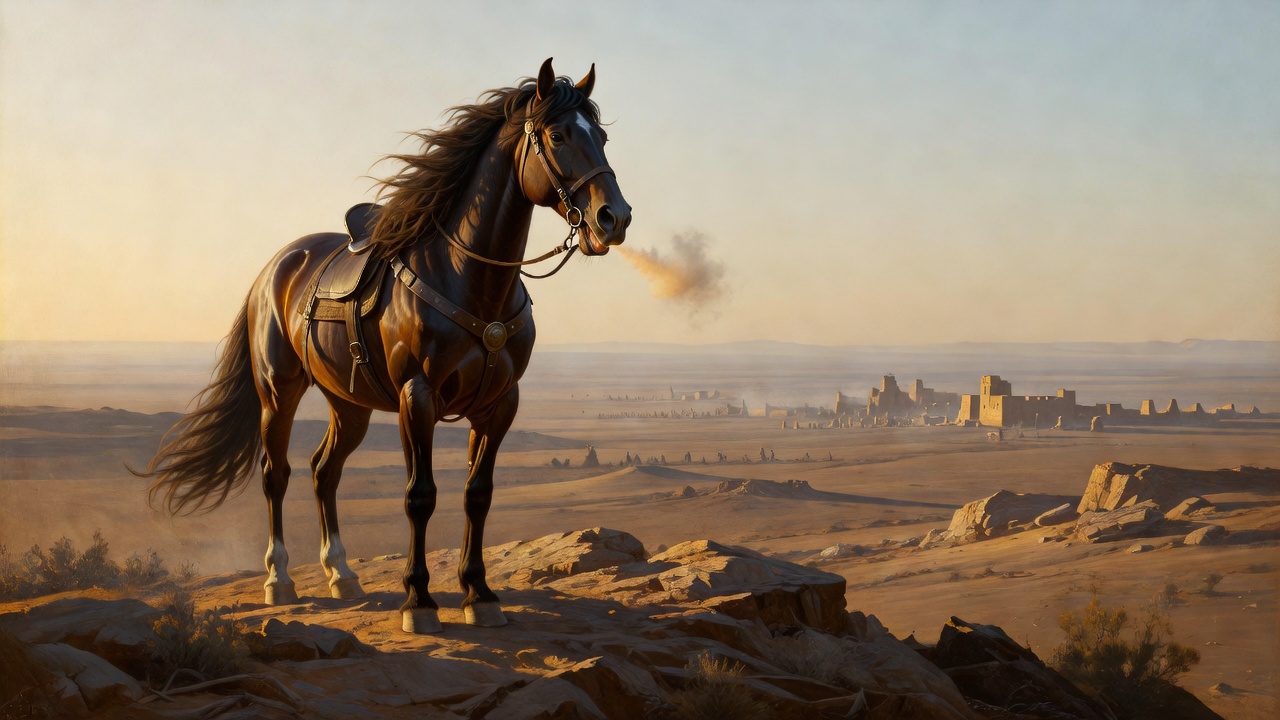
19Hast thou given the sus gevurah?
Hast thou clothed his neck with a flowing mane?
20Canst thou make him leap like an arbeh (locust)?
The hod (glory) of his snorting strikes terror.
21He paweth in the emek (valley), and rejoiceth in his koach;
he chargeth into the fray.
22He laugheth at pachad, and nothing fears;
neither turneth he back from the cherev.
23The quiver rattleth at his side,
the glittering spear and the kidon (scimitar, curved sword).
24He eats up the eretz with fierceness and rogez (rage);
neither standeth he still at the sound of the shofar.
25As often as the shofar, he snorts Aha!
and he smelleth the milchamah afar off,
the shout of the sarim, and the teru'ah (battle cry).
26Doth the hawk fly by thy binah,
and stretch her wings toward the south?
27Doth the nesher (eagle) mount up at thy command,
and make her ken (nest) on high?
28She dwelleth and abideth on the cliff,
upon the crag of the rock, its metzudah (stronghold).
29From there she seeketh the okhel (food, prey),
and her eyes behold it from afar off.
30Her young ones feast on dahm;
and where the chalalim (slain ones) are, there it is.
¿Sabías que…?
El cuidado y el diseño de Dios en el reino animal
- El discurso divino interpela a Job acerca de la naturaleza indómita de animales como el asno salvaje y el buey salvaje. A diferencia de las bestias domesticadas usadas para arar y trillar, estas criaturas habitan libres en el desierto y las llanuras salinas, al margen del dominio humano.Fuentes: el propio texto bíblico
- El texto resalta los hábitos particulares del avestruz al anidar, describiendo cómo deja sus huevos en la arena sin el cuidado protector típico de otras aves, aunque supera en velocidad al caballo y a su jinete en campo abierto.Fuentes: el propio texto bíblico
- La descripción del caballo de batalla resalta su intrepidez, fuerza y entusiasmo ante las armas y el toque del cuerno de guerra, subrayando que su valentía y naturaleza provienen de Dios y no del entrenamiento humano.Fuentes: el propio texto bíblico
Notas escritas con ayuda de IA a partir de fuentes abiertas (Theographic Bible Metadata, CC BY-SA 4.0; Easton’s Bible Dictionary, dominio público) y revisadas antes de publicarse.
Créditos y licencia de esta traducción
The Orthodox Jewish Bible
The Orthodox Jewish Bible - Tanakh and Orthodox Jewish Brit Chadasha - The Holy Bible
copyright © 2002-2011, 2021, 2024 Artists for Israel International
Language: English
Contributor: Artists for Israel International
THE ORTHODOX JEWISH TANAKH
Artists For Israel Intl Inc.
This version also appears with the Orthodox Yiddish Triglot which presents the Hebrew Yiddish script in Latin script and an English word for word translation, available at afii.org/Torah
To donate PayPal.Me
This translation is made available to you under the terms of the
Creative Commons Attribution license 4.0.
You may share and redistribute this Bible translation or extracts from it in any format, provided that:
You include the above copyright and source information.
If you make any changes to the text, you must indicate that you did so in a way that makes it clear that the original licensor is not necessarily endorsing your changes.
Pictures included with Scriptures and other documents on this site are licensed just for use with those Scriptures and documents.
For other uses, please contact the respective copyright owners.
Note that in addition to the rules above, revising and adapting God's Word involves a great responsibility to be true to God's Word. See Revelation 22:18-19.
2026-01-06
Títulos de sección adaptados de la Berean Standard Bible (dominio público); no forman parte del texto bíblico de esta traducción.
Fuente: http://ebible.org/engojb/ · eBible.org