Job 34
The Orthodox Jewish Bible · Toca un versículo para ver sus referencias cruzadas.
Elihu Confirms God’s Justice
1Furthermore Elihu answered and said,
2Hear my words, O ye chachamim;
and give ear unto me, ye that have da'as.
3For the ozen trieth words,
as the mouth tasteth food.
4Let us choose for ourselves what is mishpat (right);
let us know among ourselves what is tov.
5For Iyov hath said, I am innocent;
and El hath taken away my mishpat (right).
6I declare the mishpat (case) against me a lie;
though without peysha, my arrow wound is incurable.
7What gever is like Iyov,
who drinketh up the scorn [of his friends] like mayim?
8Who goeth in chaverah with the po'alei aven (workers of iniquity, evildoers),
and walketh with anshei resha.
9For he hath said,
It profiteth a gever nothing that he should please Elohim.
10Therefore pay heed unto me ye anashei levav (men of understanding);
far be it from El, that He should do evil,
and from Shaddai, that He should do wrong.
11For the po'al adam (work of a man) shall He repay unto him,
and make every man to find according to the manʼs ways.
12Yea, surely El will not do wickedly,
neither will Shaddai pervert mishpat (justice).
13Who hath given Him right to rule the earth?
Or who hath appointed Him over the tevel?
14If He should so determine,
if He gather unto Himself His Ruach and His Neshamah,
15All basar would perish together,
and adam would return unto aphar.
16If now thou hast binah, hear this:
pay heed to the kol (voice) of my words.
17Shall even one that hateth mishpat (right) govern?
And wilt thou condemn Him that is Tzaddik and Kabir (the Mighty One)?
18Is it fit to say to a melech, Thou art beli'ya'al?
And to nobles, Ye are rasha.
19Who shows no partiality to sarim (princes),
nor regardeth the rich more than the poor?
For they all are the ma'aseh (work) of His hands.
20In a moment shall they die,
and at chatzot lailah the people shall be shaken, and pass away,
and the mighty shall be taken away without human hand.
21For His eyes are upon the darkhei ish
and He seeth all his goings.
22There is no choshech, nor tzalmavet,
where the po'alei aven (evildoers) may hide themselves.
23For He does not need to consider an ish further
for anyone to go before El in mishpat (judgment).
24He shall break in pieces kabirim (mighty men) without investigation,
and sets acherim (others) in their place.
25Therefore He knoweth their works,
and He overthroweth them in the lailah,
so that they are crushed.
26He striketh them as resha'im
in the open sight of others;
27Because they turned back from following Him,
and would not regard any of His drakhim;
28So that they caused the cry of the poor to come unto Him,
and He heareth the cry of the aniyim.
29When He giveth quietness, who then can condemn?
When He hideth His panim, who then can behold Him?
Whether it be a nation, or an individual only?
30That the chanef (hypocrite) reign not,
nor those who ensnare the people.
31For has anyone said unto El,
I have borne chastisement, I will not offend any more;
32Teach Thou me what I see not;
im (if) I have done iniquity, I will do no more?
33Will He then recompense to suit you, just because you disavow it?
Thou must choose, not I;
therefore speak that of which thou hast da'as.
34Let anshei levav (men of understanding) say to me,
and let a gever chacham who pays heed unto me say,
35Iyov hath spoken without da'as,
and his words were without seichel.
36Iyov ought to be tried unto the limit,
because his answers are those of anshei aven.
37For he addeth peysha unto his chattat,
he clappeth his hands (shaking fist at G-d) among us,
and multiplieth his words against El.
¿Sabías que…?
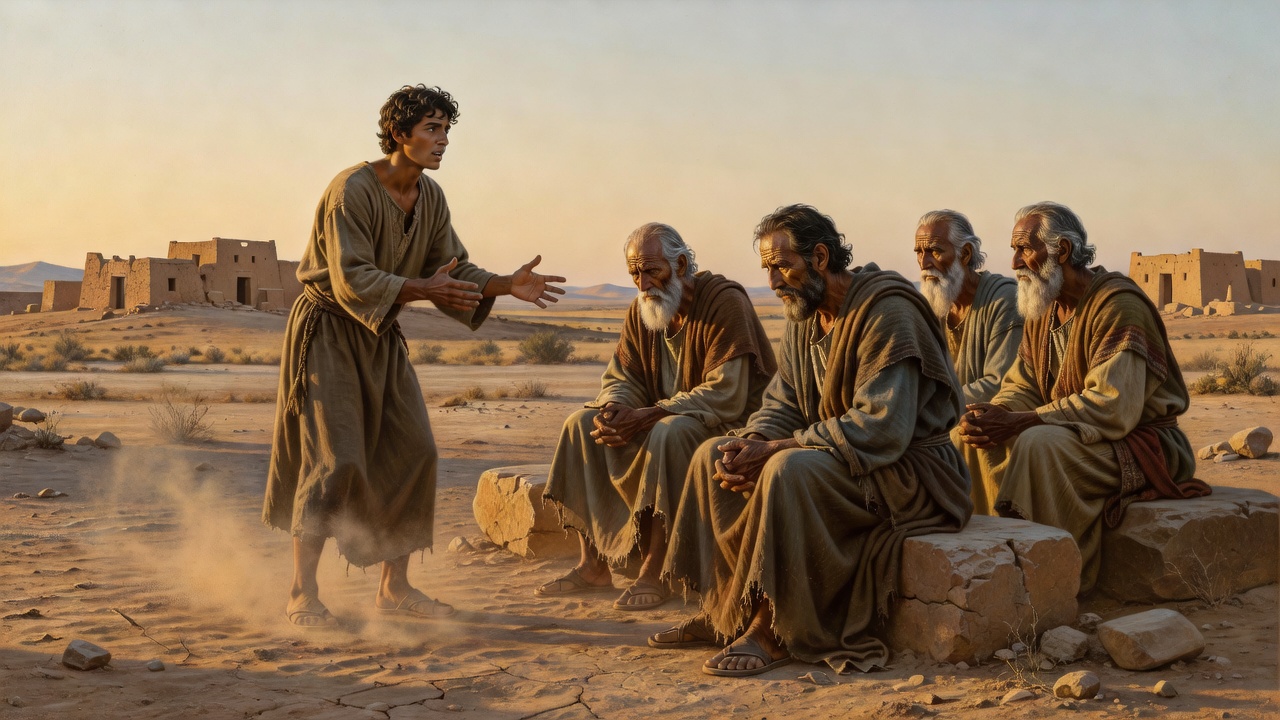
Eliú defiende la justicia de Dios
- Eliú, hijo de Baraquel el buzita, entró en el diálogo después de que concluyó el debate entre Job y sus tres amigos, presentando su propia evaluación de la crisis a lo largo de los capítulos 32 al 37.Fuentes: Elihu · el propio texto bíblico
- En el capítulo 34, Eliú apela directamente a los oyentes y hombres sabios presentes, invitándolos a evaluar su razonamiento tal como el paladar prueba la comida, mientras defiende la absoluta imparcialidad de Dios hacia reyes, nobles y pobres por igual.Fuentes: el propio texto bíblico
Notas escritas con ayuda de IA a partir de fuentes abiertas (Theographic Bible Metadata, CC BY-SA 4.0; Easton’s Bible Dictionary, dominio público) y revisadas antes de publicarse.
Créditos y licencia de esta traducción
The Orthodox Jewish Bible
The Orthodox Jewish Bible - Tanakh and Orthodox Jewish Brit Chadasha - The Holy Bible
copyright © 2002-2011, 2021, 2024 Artists for Israel International
Language: English
Contributor: Artists for Israel International
THE ORTHODOX JEWISH TANAKH
Artists For Israel Intl Inc.
This version also appears with the Orthodox Yiddish Triglot which presents the Hebrew Yiddish script in Latin script and an English word for word translation, available at afii.org/Torah
To donate PayPal.Me
This translation is made available to you under the terms of the
Creative Commons Attribution license 4.0.
You may share and redistribute this Bible translation or extracts from it in any format, provided that:
You include the above copyright and source information.
If you make any changes to the text, you must indicate that you did so in a way that makes it clear that the original licensor is not necessarily endorsing your changes.
Pictures included with Scriptures and other documents on this site are licensed just for use with those Scriptures and documents.
For other uses, please contact the respective copyright owners.
Note that in addition to the rules above, revising and adapting God's Word involves a great responsibility to be true to God's Word. See Revelation 22:18-19.
2026-01-06
Títulos de sección adaptados de la Berean Standard Bible (dominio público); no forman parte del texto bíblico de esta traducción.
Fuente: http://ebible.org/engojb/ · eBible.org