Job 21
The Orthodox Jewish Bible · Toca un versículo para ver sus referencias cruzadas.
Job: God Will Punish the Wicked
1But Iyov answered and said,
2Hear diligently my speech,
and let this be your tanechumot (consolations).
3Bear with me that I may speak;
and achar (after) that I have spoken, mock on.
4As for me, is my complaint to adam (mortals)?
Or why should my ruach not become impatient?
5Look at me, and be astonished,
and lay your yad upon your peh (mouth).
6Even when I remember I am afraid,
and trembling taketh hold on my basar.
7Madu'a (why) do the resha'im live,
become old, yea, are mighty in power?
8Their zera is established in their sight with them,
and their offspring before their eyes.
9Their batim (houses) are shalom from pachad;
neither is the shevet Eloah upon them.
10Their shor (bull) breeds, and faileth not;
their cow calveth, and doth not miscarry her calf.
11They send forth their little ones like a tzon,
and their yeladim jump about.
12They sing to the tambourine and kinnor,
and rejoice at the sound of the flute.
13They spend their yamim in tov,
and in a moment go down to Sheol.
14Therefore they say unto El, Depart from us;
for we desire not the da'as of Thy ways.
15What is Shaddai, that we should serve Him?
And what profit should we have, if we importune Him?
16Lo, their tov is not in their yad;
the etzah (counsel, scheme) of the resha'im is far from me.
17How oft is the ner (light) of the resha'im put out!
And how oft cometh their destruction upon them
and He distributeth pains in His anger.
18They are as straw before the ruach,
and as chaff that the storm carrieth away.
19Eloah layeth up his iniquity for his banim;
He payeth him back, and he shall know it.
20His eyes shall see his destruction,
and he shall drink of the wrath of Shaddai.
21For what pleasure hath he in his bais after him,
when the mispar (number) of his months is cut off?
22Shall any teach El da'as,
seeing He judgeth those that are on high?
23Zeh (this one) dieth in his full prosperity,
being wholly at ease and secure.
24His troughs are full of cholov,
and his atzmot are moistened with marrow.
25And another dieth in the marah (bitterness) of his nefesh,
and never eateth with pleasure.
26They shall lie down alike in the aphar,
and the worms shall cover them.
27Behold, I know your machshevot,
and the stratagems which ye wrongfully imagine against me.
28For ye say, Where is the bais of the tyrant?
And where are the ohel mishkenot of the resha'im?
29Have ye not asked them that travel the derech?
And do ye not accept their testimony,
30That the rah is spared in the yom eid (day of calamity)?
They shall be rescued in the yom avarot (day of wrath).
31Who shall declare his derech to his face?
And who shall repay him what he hath done?
32Yet shall he be brought to the grave,
and shall remain in the gadish (gravemound).
33The clods of the valley shall be sweet unto him,
and kol adam shall draw after him,
as there are innumerable before him.
34How then comfort ye me with hevel (empty nothings),
seeing in your answers there is nothing left but falsehood?
¿Sabías que…?
La prosperidad de los impíos
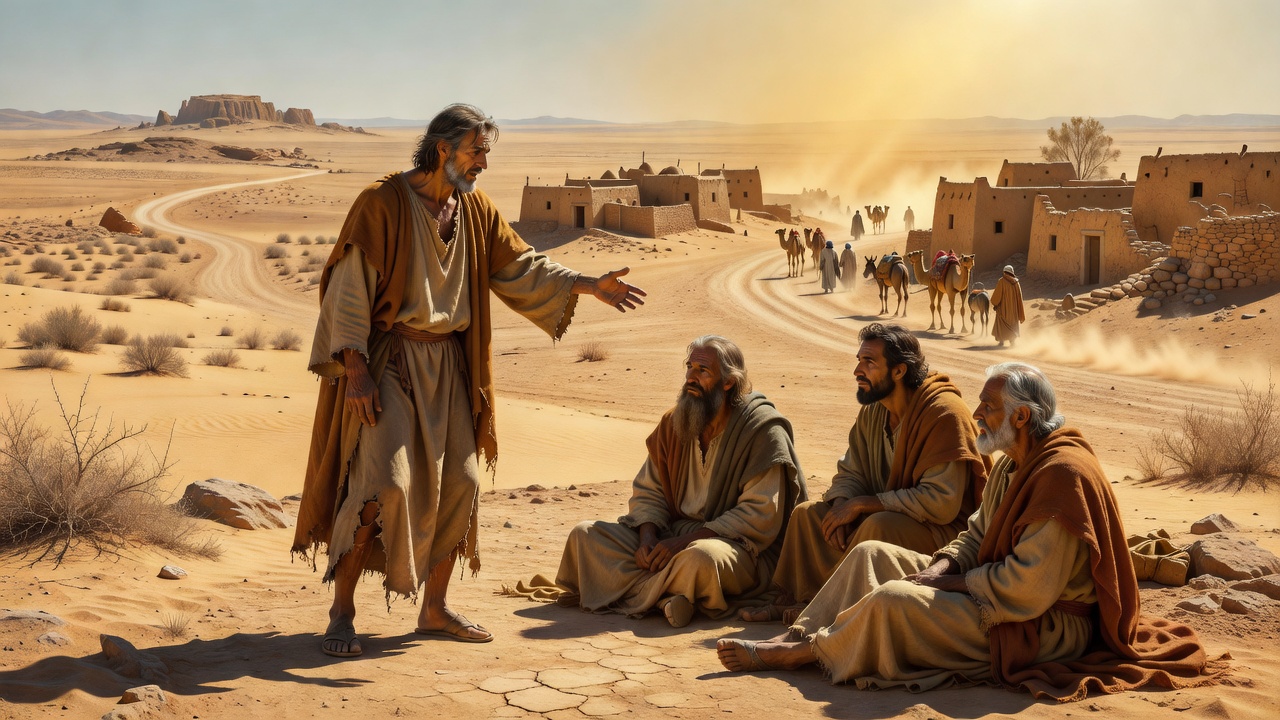
- Job refuta la creencia de sus amigos de que los malvados siempre sufren en esta vida. Señala que muchas personas impías envejecen, aumentan su poder, ven a sus hijos prosperar al son de liras y flautas, y mueren en pacífica tranquilidad.Fuentes: el propio texto bíblico
- Frente a la noción de que Dios reserva el castigo de una persona para sus descendientes, Job argumenta que la verdadera justicia exige que el propio transgresor reciba la retribución personalmente y experimente la ira del Todopoderoso durante su vida.Fuentes: el propio texto bíblico
- Job insta a sus compañeros a consultar a los viajeros sobre la realidad en los caminos. Observa que, ya sea que una persona viva con vigorosa riqueza o muera en amarga pobreza, ambas comparten el mismo fin terrenal al descansar juntas en el polvo.Fuentes: el propio texto bíblico
Notas escritas con ayuda de IA a partir de fuentes abiertas (Theographic Bible Metadata, CC BY-SA 4.0; Easton’s Bible Dictionary, dominio público) y revisadas antes de publicarse.
Créditos y licencia de esta traducción
The Orthodox Jewish Bible
The Orthodox Jewish Bible - Tanakh and Orthodox Jewish Brit Chadasha - The Holy Bible
copyright © 2002-2011, 2021, 2024 Artists for Israel International
Language: English
Contributor: Artists for Israel International
THE ORTHODOX JEWISH TANAKH
Artists For Israel Intl Inc.
This version also appears with the Orthodox Yiddish Triglot which presents the Hebrew Yiddish script in Latin script and an English word for word translation, available at afii.org/Torah
To donate PayPal.Me
This translation is made available to you under the terms of the
Creative Commons Attribution license 4.0.
You may share and redistribute this Bible translation or extracts from it in any format, provided that:
You include the above copyright and source information.
If you make any changes to the text, you must indicate that you did so in a way that makes it clear that the original licensor is not necessarily endorsing your changes.
Pictures included with Scriptures and other documents on this site are licensed just for use with those Scriptures and documents.
For other uses, please contact the respective copyright owners.
Note that in addition to the rules above, revising and adapting God's Word involves a great responsibility to be true to God's Word. See Revelation 22:18-19.
2026-01-06
Títulos de sección adaptados de la Berean Standard Bible (dominio público); no forman parte del texto bíblico de esta traducción.
Fuente: http://ebible.org/engojb/ · eBible.org