Job 15
The Orthodox Jewish Bible · Toca un versículo para ver sus referencias cruzadas.
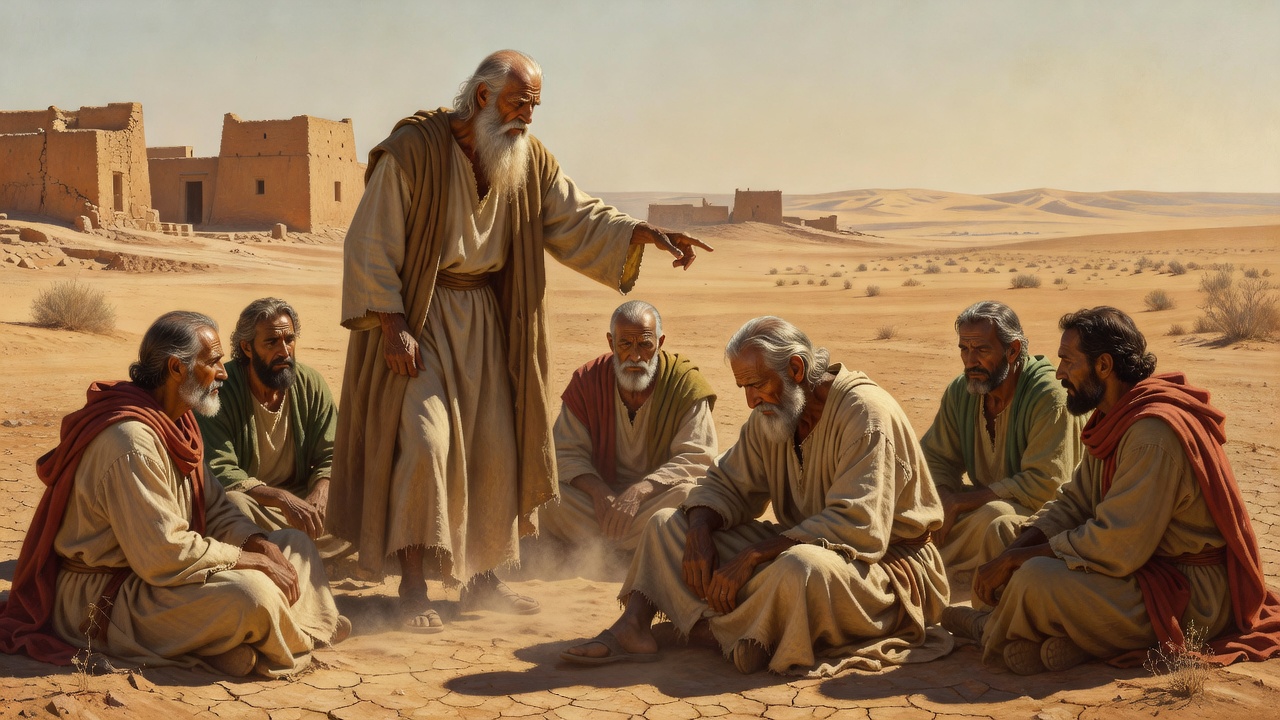
Eliphaz: Job Does Not Fear God
1Then answered Eliphaz the Temani, and said,
2Should a chacham (wise man) utter vain knowledge,
and fill his inner being with the east wind?
3Should he reason with unprofitable davar (talk)?
Or with speeches wherewith no good is done?
4Yea, thou makest void yireh [Elohim],
and doth diminish si'akh (meditation) before El.
5For thy mouth uttereth thine avon,
and thou choosest the leshon arumim (tongue of the crafty).
6Thine own mouth condemneth thee, and loh Ani (not I);
yea, thine own lips testify against thee.
7Art thou harishon adam (the first man) that was born?
Or wast thou made before the hills?
8Hast thou attended to the sod Eloah (counsel of G-d)?
And dost thou limit chochmah to thyself?
9Of what dost thou have da'as, that we know not?
What understandest thou, which is not in us?
10Both the grayheaded and very aged men are among us,
much elder than avicha.
11Are the tanechumot El (consolations of G-d) not enough for thee?
Or the davar that deals gently with thee?
12Why doth thine lev carry thee away?
And why do thy eyes flash,
13That thou ventest thy ruach against El (G-d),
and lettest such words pour out of thy mouth?
14What is enosh, that he should be pure [in the sight of Hashem]?
And he which is born of an isha, that yitzdak (he should be in the right)?
15If He trusteth not His Kedoshim;
yea, Shomayim is not pure in His eyes.
16How much more vile and corrupt is ish,
which drinketh iniquity like mayim?
17I will show thee, shema to me;
and that which I have seen I will declare;
18Things which chachamim declare
from their avot without concealment;
19Unto whom alone ha'aretz was given,
and no zar passed among them.
20The reshah travaileth with pain all his yamim,
and numbered shanim are reserved for the oppressor.
21A dreadful sound is in his oznayim;
during shalom the shoded (destroyer) shall come upon him.
22He believeth not in a return from choshech,
and he is marked for the cherev.
23He wandereth about after lechem, saying, Where is it?
He has da'as the Yom Choshech is near at hand for him.
24Distress and anguish shall make him afraid;
they shall seize him as a melech poised for battle.
25For he stretcheth out his yad against El (G-d),
and with insolence vaunts himself against Shaddai.
26He charges against Him, with a stiff neck,
with the thick bosses of his mogen (shield);
27Though he covereth his panim with his fatness,
and addeth fat on his flanks;
28And he dwelleth in desolate towns,
and in batim (houses) which no man inhabiteth,
which are ready to crumble to rubble.
29He shall not be osher, neither shall his substance continue;
neither shall their possessions spread over ha'aretz.
30He shall not escape from choshech;
the flame shall wither his branches,
and in the ruach of his mouth shall he perish.
31Let not him that is deceived trust in shav (vanity);
for shav shall be his recompense.
32His Yom is not yet;
then it is accomplished, and his branch shall not flourish.
33He shall shake off his unripe grape like the gefen,
and shall cast off his blossom like the zayit (olive tree).
34For the Adat Chanef (congregation of hypocrites) shall be barren,
and eish shall consume the ohalim of bribery.
35They conceive amal (trouble), and give birth to evil,
and their belly worketh mirmar (deceit).
¿Sabías que…?
El segundo discurso de Elifaz y la sabiduría ancestral
- Elifaz acusa a Job de llenar su vientre con el viento del este, utilizando una conocida metáfora del antiguo Oriente Próximo sobre el viento abrasador del desierto que marchita la vegetación y trae devastación en lugar de sustento.Fuentes: el propio texto bíblico
- Para respaldar su postura de que los malvados sufren inevitablemente la ruina, Elifaz apela a la autoridad de ancianos de cabellos canos y a tradiciones transmitidas desde tiempos anteriores a la influencia de pueblos extranjeros.Fuentes: el propio texto bíblico · Eliphaz
Notas escritas con ayuda de IA a partir de fuentes abiertas (Theographic Bible Metadata, CC BY-SA 4.0; Easton’s Bible Dictionary, dominio público) y revisadas antes de publicarse.
Créditos y licencia de esta traducción
The Orthodox Jewish Bible
The Orthodox Jewish Bible - Tanakh and Orthodox Jewish Brit Chadasha - The Holy Bible
copyright © 2002-2011, 2021, 2024 Artists for Israel International
Language: English
Contributor: Artists for Israel International
THE ORTHODOX JEWISH TANAKH
Artists For Israel Intl Inc.
This version also appears with the Orthodox Yiddish Triglot which presents the Hebrew Yiddish script in Latin script and an English word for word translation, available at afii.org/Torah
To donate PayPal.Me
This translation is made available to you under the terms of the
Creative Commons Attribution license 4.0.
You may share and redistribute this Bible translation or extracts from it in any format, provided that:
You include the above copyright and source information.
If you make any changes to the text, you must indicate that you did so in a way that makes it clear that the original licensor is not necessarily endorsing your changes.
Pictures included with Scriptures and other documents on this site are licensed just for use with those Scriptures and documents.
For other uses, please contact the respective copyright owners.
Note that in addition to the rules above, revising and adapting God's Word involves a great responsibility to be true to God's Word. See Revelation 22:18-19.
2026-01-06
Títulos de sección adaptados de la Berean Standard Bible (dominio público); no forman parte del texto bíblico de esta traducción.
Fuente: http://ebible.org/engojb/ · eBible.org